Crested Pigeon
Ocyphaps lophotes
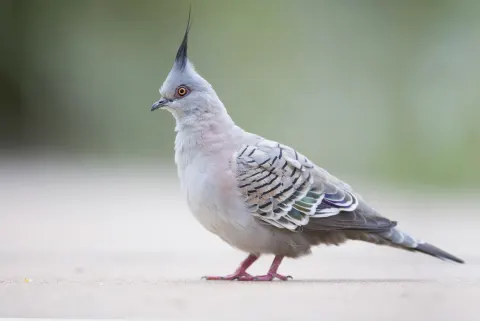
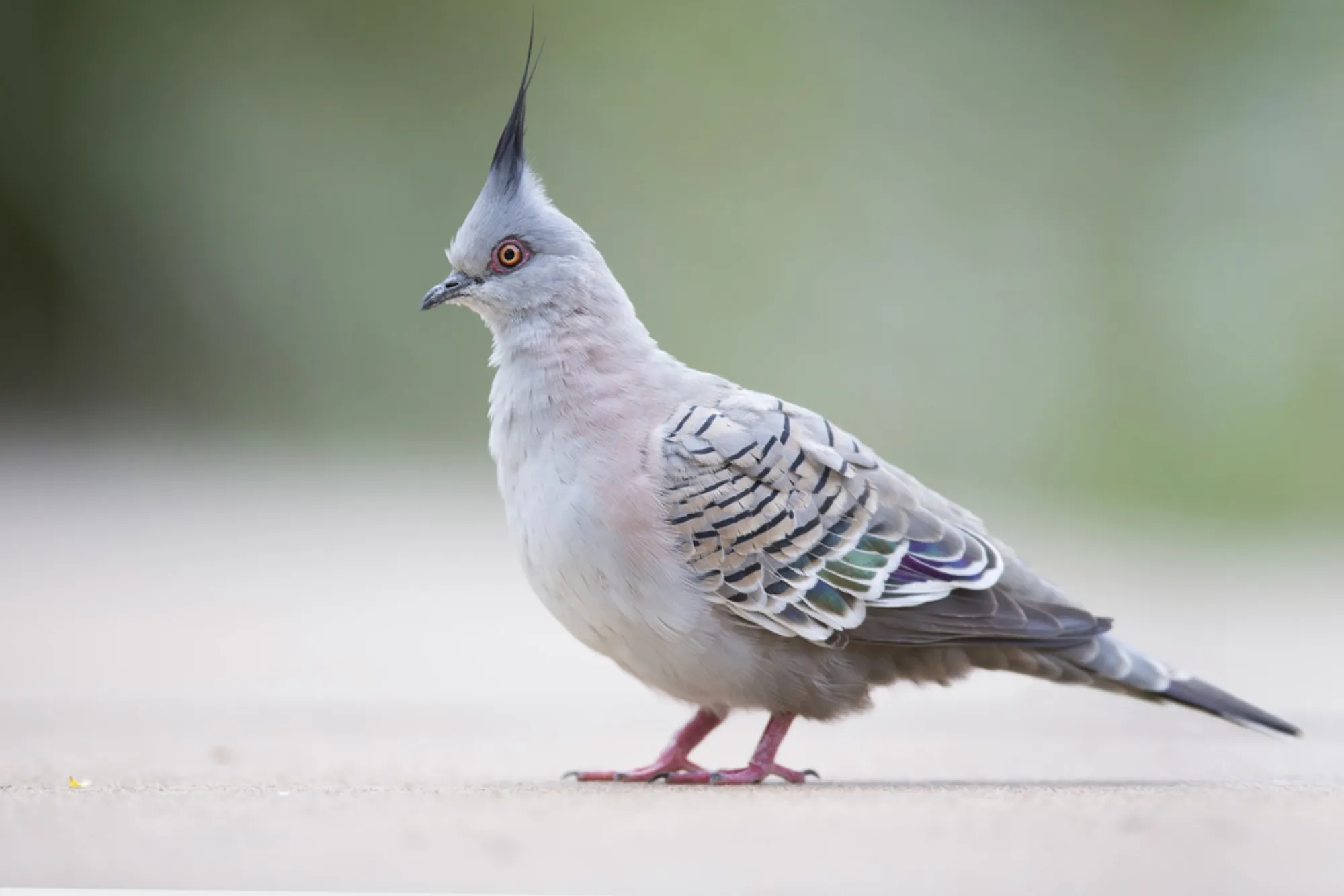
A slender black crest gives the Crested Pigeon an easy feature to look for as it walks or runs. This grey bird has touches of brown, pink and green, orange skin around the eyes, and black stripes across its bronzed wings. In the light, its flight feathers can show brown, purple, blue and green. Young birds are duller and lack the bronze colouring on their wings. Adults measure 30 to 34 cm long, and males and females have the same plumage. Of the two Australian pigeon species with an upright crest, this is the larger. When startled, a bird takes off with a distinctive whistling sound from its wings. The sound may alert other pigeons and draw predators' attention away from birds still on the ground. On landing, it tilts its tail upwards.
Look for Crested Pigeons across much of mainland Australia, apart from the far northern tropical areas. They live in lightly wooded grasslands in rural and urban places, and also visit watercourses, gardens, pastoral land, sports grounds and golf courses. Their range has expanded as settlement created pastoral land, and they have adapted to feeding in grain farming areas. They forage for grain and often eat the weed Echium plantagineum. These social pigeons can gather in flocks of different sizes and are gregarious around people. They breed year-round, most often when the weather is warmer. A nest is usually a platform of twigs in a shrub or tree. Both parents incubate the two white, glossy eggs, which usually hatch after 3 weeks.
Written from the English Wikipedia article Crested pigeon (CC BY-SA 4.0).
- Records
- 550,597
- Countries
- 1
- Atlas places
- 4
These are open occurrence records, so they show where people looked for and recorded the Crested Pigeon as much as where it lives. Cells are up to 25 km across, and every location is generalised to its cell.
Generalised encounter areas, not exact locations. Each shape is a grid cell coloured by how likely the species is there.
- Very likelyAustralia25 km zone · high confidence · 550597 records · updated 80 days ago
Conservation status not assessed here yet, so every location is generalised to its grid cell.