Degu
Octodon degus
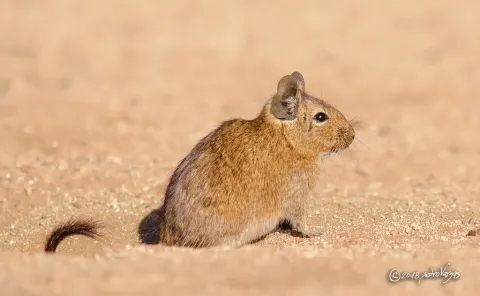
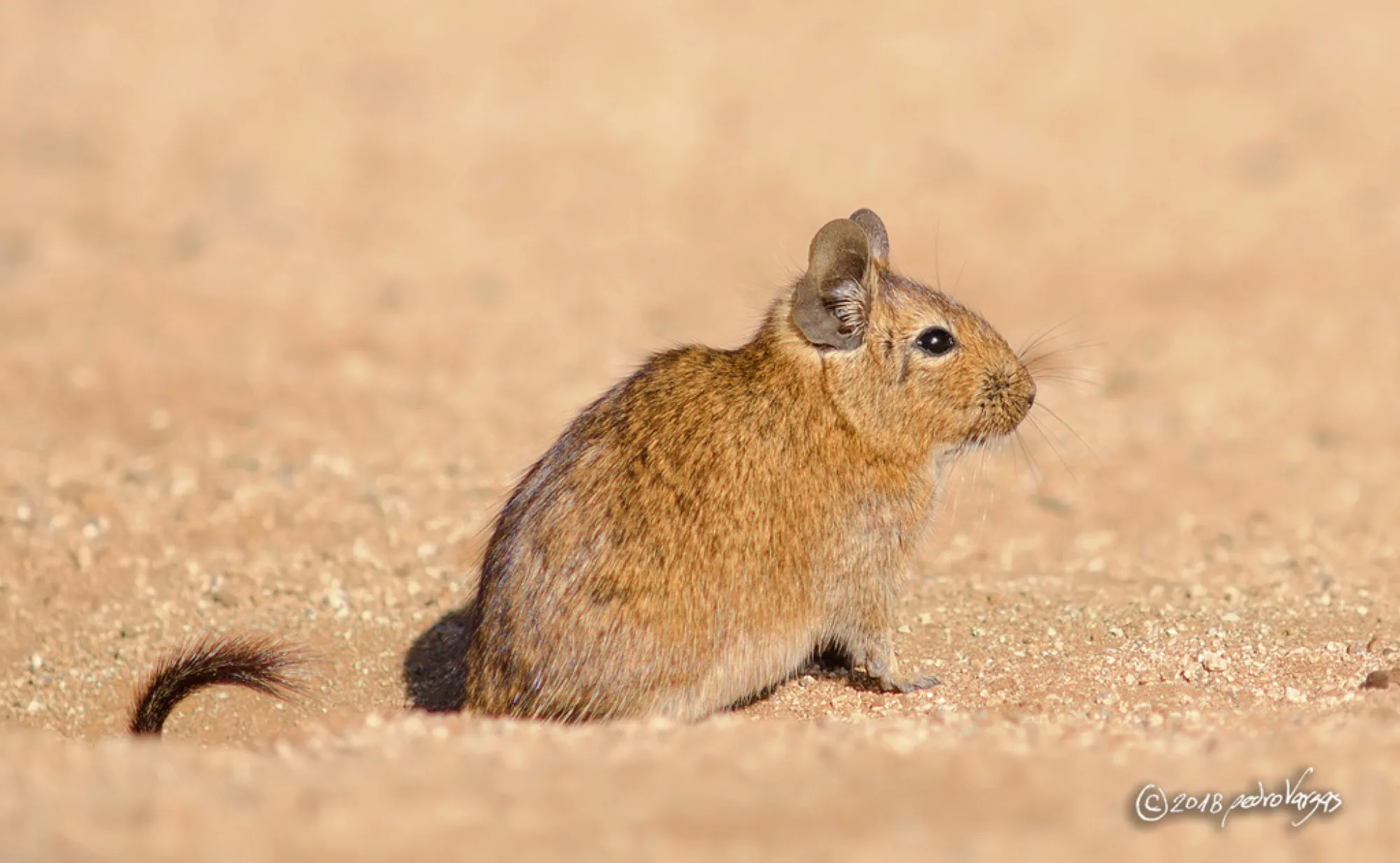
In central Chile's matorral, the Degu spends much of its time above ground, foraging in company. This small rodent has yellow-brown fur on its back, a creamy-yellow underside and yellow markings around its eyes. A pale band circles its neck, while its long, thin tail ends in a black tuft. Its body measures 25.0 to 31.0 cm, and it weighs 170 to 400 g. Found only in the Chilean matorral ecoregion, it feeds on grasses, shrub leaves and seeds. Much of its food is dry for a large part of the year, and the Degu is adapted to a diet high in fibre.
Degus are active during the day and live in burrows, which they excavate together in coordinated digging chains. Working communally allows them to build larger, more elaborate burrows than an individual could manage alone. They are highly social, and animals foraging in larger groups are better able to detect predators while each spends less time keeping watch. In high summer, they remain underground in the middle of the day and come out to feed in the morning and evening. They communicate through a range of calls and scent marks, responding to marks left by other degus. Wild breeding begins in the Chilean autumn, with pups arriving in early to mid-spring after a pregnancy of approximately ninety days. Litters average six pups, and the young are born fully furred, with their eyes open. Females in the same group may share a nest and nurse each other's young, while males also help protect and raise their pups. Predators are a threat: a Degu can shed the skin and tuft of its tail to escape capture, though the loss is painful and the tail end does not grow back.
Written from the English Wikipedia article Common degu (CC BY-SA 4.0).
- Records
- 67
- Countries
- 2
No atlas park has a record of the Degu in or around it yet.
These are open occurrence records, so they show where people looked for and recorded the Degu as much as where it lives. Cells are up to 25 km across, and every location is generalised to its cell.
Generalised encounter areas, not exact locations. Each shape is a grid cell coloured by how likely the species is there.
- Very likelyChile25 km zone · medium confidence · 64 records · updated 80 days ago
- LikelyNetherlands25 km zone · medium confidence · 3 records · updated 80 days ago
Conservation status not assessed here yet, so every location is generalised to its grid cell.