American Pika
Ochotona princeps
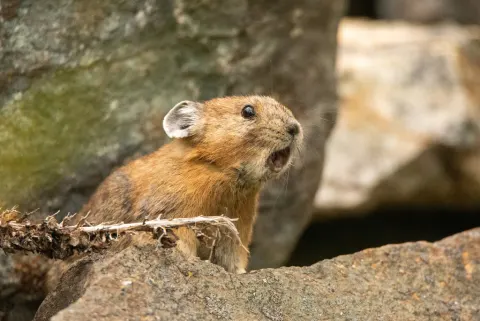
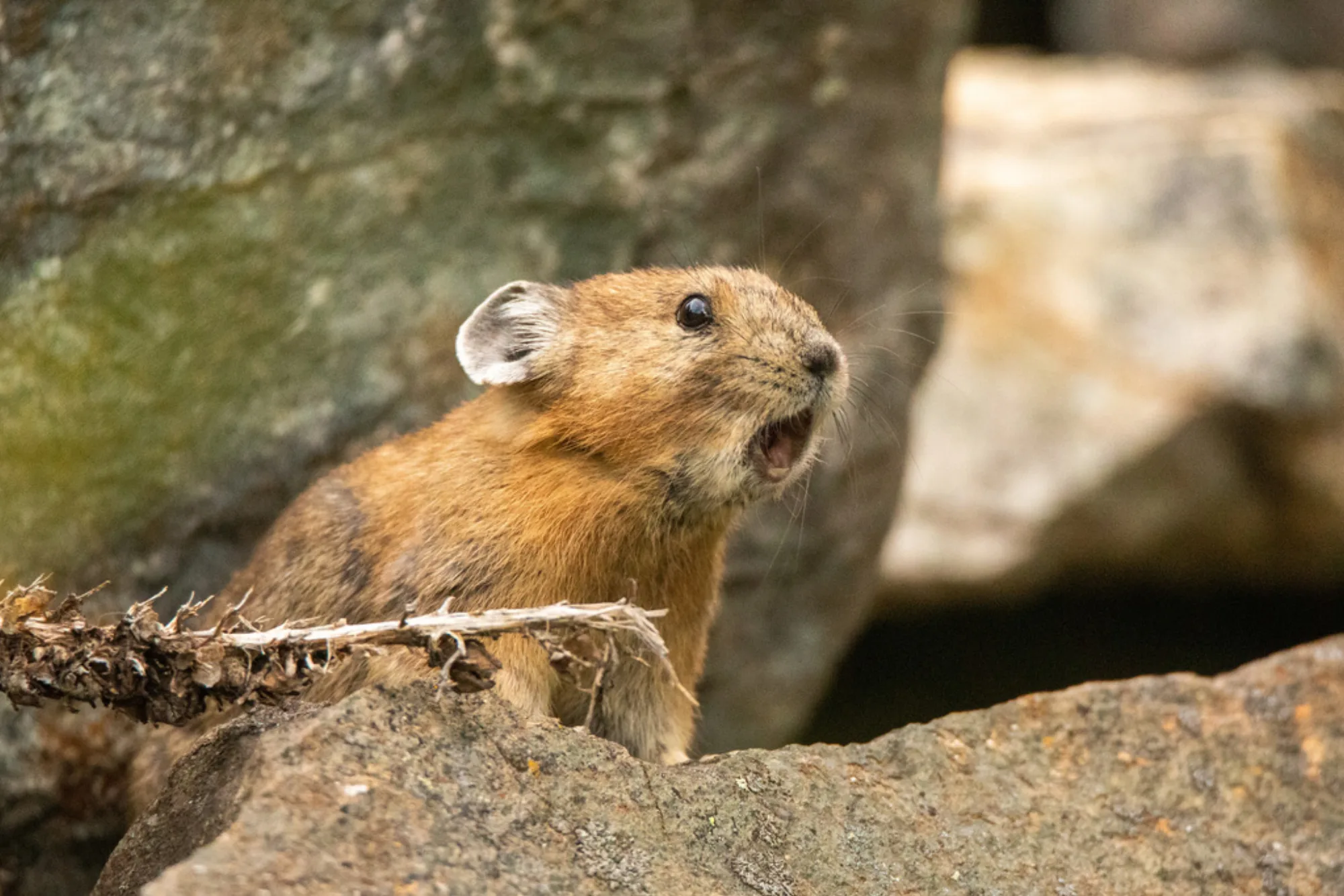
A small, rounded relative of rabbits and hares, the American Pika has a low stance, rounded ears and thick fur that conceals its short tail. Its ears are usually dark with white edges, while its back ranges from greyish to cinnamon-brown and becomes greyer in winter. An adult weighs 121 to 176 g and measures 16.2 to 21.6 cm in length.
Look for it among scree, talus and broken rock in the mountains of western North America, from central British Columbia and Alberta south to New Mexico. It makes its den beneath rocks in cool, moist places around or above the tree line, and sometimes perches on prominent boulders. Active by day, it gives short calls to warn of predators, while longer songs are linked to breeding and territory. Eagles, hawks, coyotes, bobcats, foxes and weasels are among its predators. It eats grasses, sedges, thistles, fireweed and other green plants, and drinks when water is available. In summer it also gathers vegetation into haypiles for winter, when it continues to feed rather than hibernate. Females typically produce two litters a year, averaging three young each, although a mother raises a second litter only if the first does not survive. The young become independent after about four weeks.
Heat is a serious threat: without a cool refuge, pikas can die within six hours above 25.5 °C. They retreat into cool openings in the scree during midday heat, but isolated patches of mountain habitat limit their ability to move as temperatures rise. Some populations are declining, and warmer, drier conditions have been linked to disappearances and shrinking ranges at lower elevations.
Written from the English Wikipedia article American pika (CC BY-SA 4.0).
- Records
- 1,631
- Countries
- 2
- Atlas places
- 12
- Banff National Park· Canada
- Kootenay National Park· Canada
- Rocky Mountain National Park· United States
- Jasper National Park· Canada
- Yellowstone National Park· United States
- Yosemite National Park· United States
- Grand Teton National Park· United States
- Sequoia National Park· United States
- Yoho National Park· Canada
- Glacier National Park· United States
- Waterton Lakes National Park· Canada
- Zion National Park· United States
These are open occurrence records, so they show where people looked for and recorded the American Pika as much as where it lives. Cells are up to 25 km across, and every location is generalised to its cell.
Generalised encounter areas, not exact locations. Each shape is a grid cell coloured by how likely the species is there.
- Very likelyUnited States25 km zone · medium confidence · 1338 records · updated 80 days ago
- Very likelyCanada25 km zone · medium confidence · 293 records · updated 80 days ago
Conservation status not assessed here yet, so every location is generalised to its grid cell.