Black-crowned Night Heron
Nycticorax nycticorax
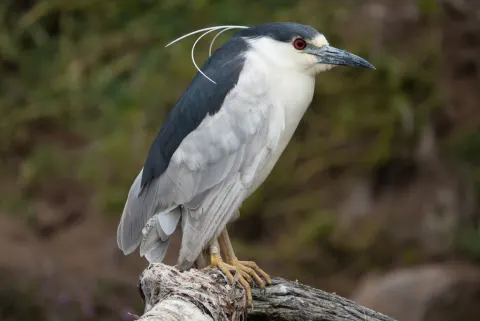
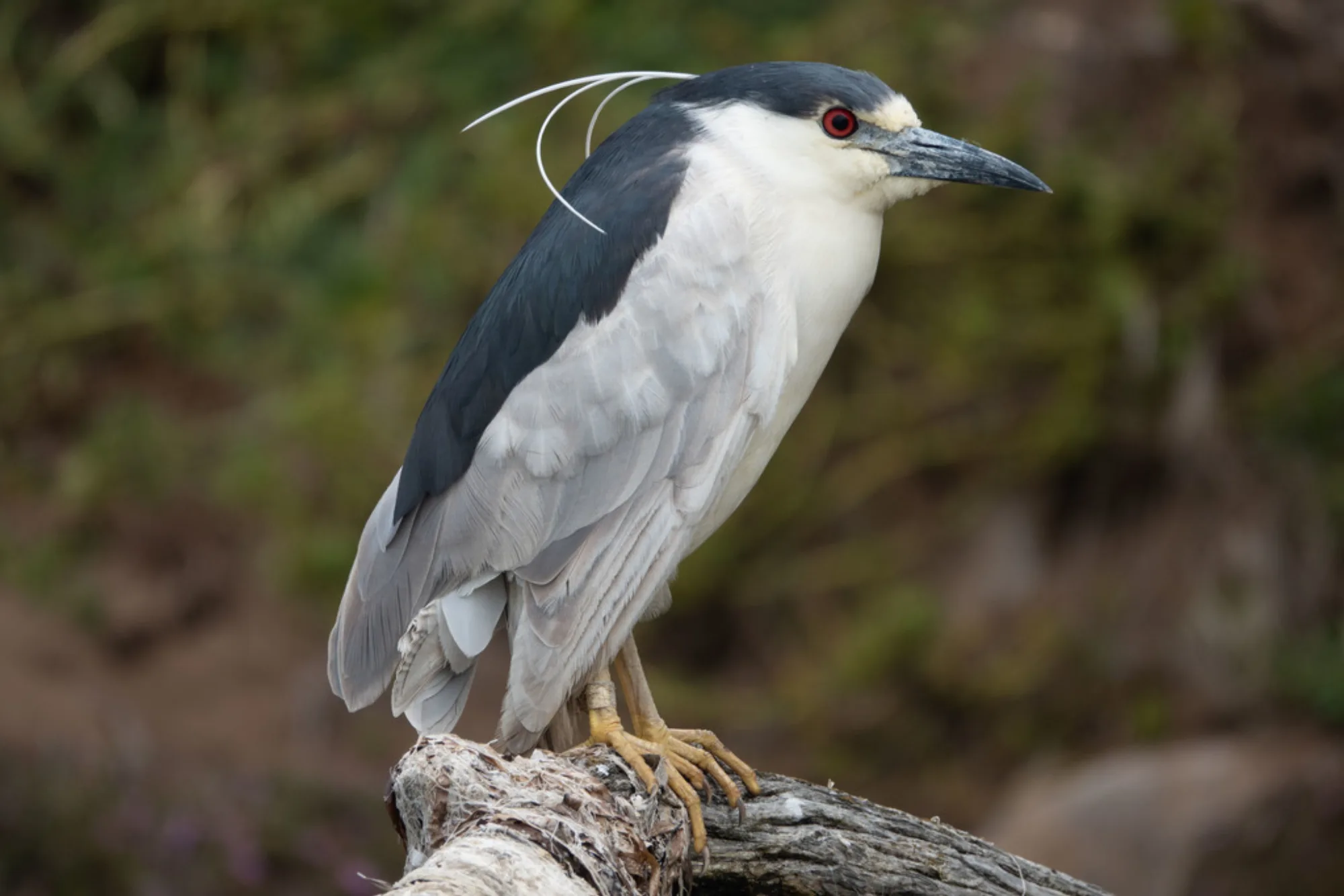
Stocky and often hunched at rest, the Black-crowned Night Heron has a shorter neck, legs and bill than its more familiar relatives, the egrets and day herons. Adults have a black crown and back, pale grey wings, white underparts, red eyes and short yellow legs. Long, slender white plumes extend from the back of the head and rise during greeting and courtship displays. Young birds look different, with grey-brown upperparts marked by pale teardrop spots, brown-streaked underparts and orange eyes.
This medium-sized heron lives across parts of Africa, Asia, Europe and the Americas, breeding in fresh and salt-water wetlands. Birds in northern parts of its range migrate, while others remain resident, including those in Patagonia. European birds generally spend the winter in Africa, although a few stay in southern Spain. Around San Francisco Bay, the herons live year-round, and the largest rookery is in Oakland.
Look for the bird at the water's edge, standing motionless before striking, especially after dark and around dawn or dusk. Its varied diet includes small fish, frogs, insects, crustaceans, small mammals and eggs, as well as carrion and plant material. Some have been observed tossing floating objects onto the water to lure or distract fish within striking range. By day, the birds rest in dense trees or bushes. They nest in noisy colonies, building stick platforms in trees or nesting on the ground in protected places such as islands and reedbeds. A clutch contains three to eight eggs.
Written from the English Wikipedia article Black-crowned night heron (CC BY-SA 4.0).
- Records
- 1,316,896
- Countries
- 19
No atlas park has a record of the Black-crowned Night Heron in or around it yet.
These are open occurrence records, so they show where people looked for and recorded the Black-crowned Night Heron as much as where it lives. Cells are up to 25 km across, and every location is generalised to its cell.
Generalised encounter areas, not exact locations. Each shape is a grid cell coloured by how likely the species is there.
- Very likelyUnited States25 km zone · high confidence · 917671 records · updated 82 days ago
- Very likelyTaiwan25 km zone · high confidence · 216906 records · updated 82 days ago
- Very likelyCanada25 km zone · high confidence · 84986 records · updated 82 days ago
- Very likelyIndia25 km zone · high confidence · 26575 records · updated 82 days ago
- Very likelyChina25 km zone · high confidence · 15706 records · updated 82 days ago
- Very likelyMexico25 km zone · high confidence · 9597 records · updated 82 days ago
- Very likelyChile25 km zone · high confidence · 6572 records · updated 82 days ago
- Very likelyArgentina25 km zone · high confidence · 5497 records · updated 82 days ago
- Very likelyJordan25 km zone · high confidence · 4393 records · updated 82 days ago
- Very likelyVenezuela25 km zone · high confidence · 3765 records · updated 82 days ago
Conservation status not assessed here yet, so every location is generalised to its grid cell.