Great Potoo
Nyctibius grandis
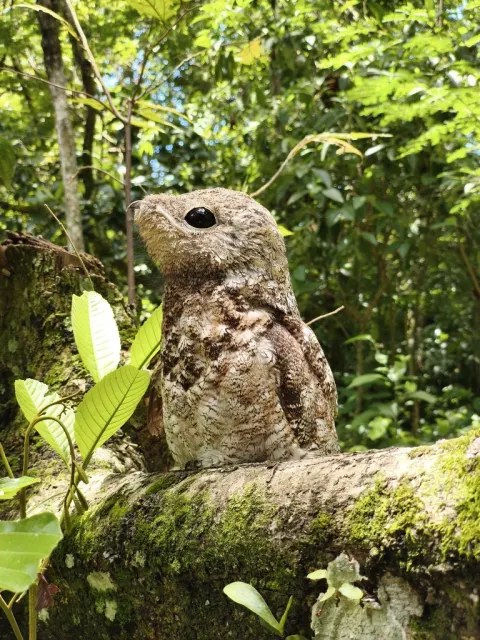
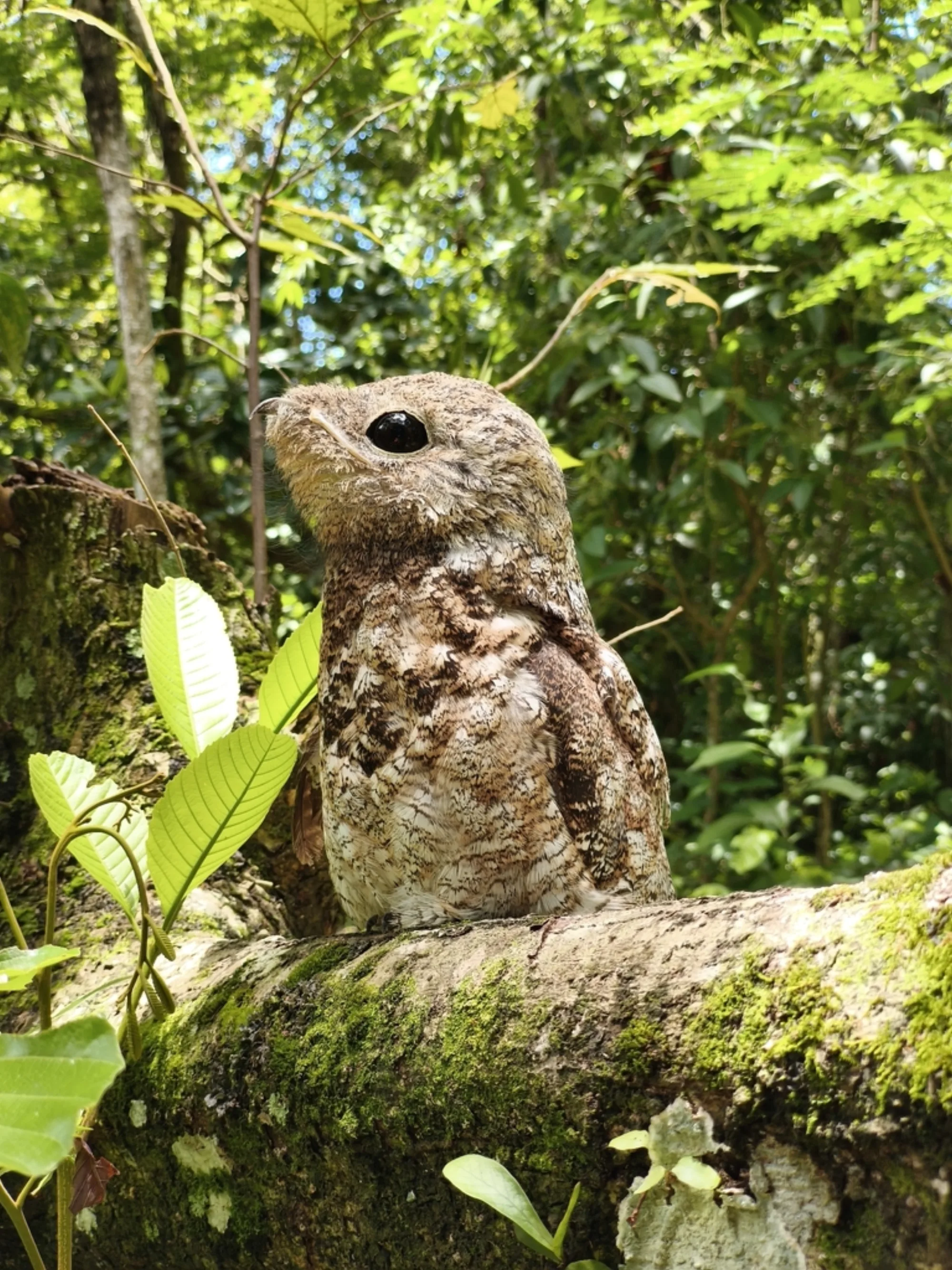
A large head, dark brown eyes and a short, broad beak give the Great Potoo a distinctive appearance, although it can be difficult to pick out against a tree. The largest of the potoos, it has a long tail and plumage coloured white, grey, black and burgundy, with white bars across the tail. Shy and solitary, it normally spends the day upright on a tree stump, where its colouring and posture help it blend into its surroundings. At night, a light may reveal the reflection from its eyes as it sits upright on a post, roost or sloping trunk.
Its range extends from southern Mexico through much of Central America and south to southeastern Brazil and Bolivia. Look for it in humid to semi-humid forest, especially dense lowland forest, forest edges and clearings. It also occurs in open woodland and second-growth, and sometimes around meadows, but needs trees or similar perches for camouflage. Usually active at night, it waits on an exposed perch for passing prey, then flies out to catch it and returns to the branch. Large flying insects make up most of its diet, especially beetles, katydids, crickets and grasshoppers; it occasionally takes bats and birds. Its moaning growl can carry through the night.
Breeding is typically recorded from February to August, though timing varies across its range. A single white, slightly spotted egg is laid in a shallow hollow on a thick branch at least 10 m above ground. Adults stay near the nest during the day and rely on camouflage to protect their young, although eggs and young birds are taken by predators. Forest clearing threatens the species, and in rural Brazil people sometimes hunt potoos for food and body parts used in ceremonies.
Written from the English Wikipedia article Great potoo (CC BY-SA 4.0).
- Records
- 38,199
- Countries
- 14
- Atlas places
- 7
These are open occurrence records, so they show where people looked for and recorded the Great Potoo as much as where it lives. Cells are up to 25 km across, and every location is generalised to its cell.
Generalised encounter areas, not exact locations. Each shape is a grid cell coloured by how likely the species is there.
- Very likelyCosta Rica25 km zone · high confidence · 9954 records · updated 80 days ago
- Very likelyColombia25 km zone · high confidence · 5932 records · updated 80 days ago
- Very likelyEcuador25 km zone · high confidence · 5056 records · updated 80 days ago
- Very likelyPanama25 km zone · high confidence · 5012 records · updated 80 days ago
- Very likelyPeru25 km zone · high confidence · 4831 records · updated 80 days ago
- Very likelyBrazil25 km zone · high confidence · 4237 records · updated 80 days ago
- Very likelyHonduras25 km zone · high confidence · 1141 records · updated 80 days ago
- Very likelyVenezuela25 km zone · high confidence · 812 records · updated 80 days ago
- Very likelyGuyana25 km zone · high confidence · 428 records · updated 80 days ago
- Very likelyBolivia25 km zone · high confidence · 279 records · updated 80 days ago
Conservation status not assessed here yet, so every location is generalised to its grid cell.