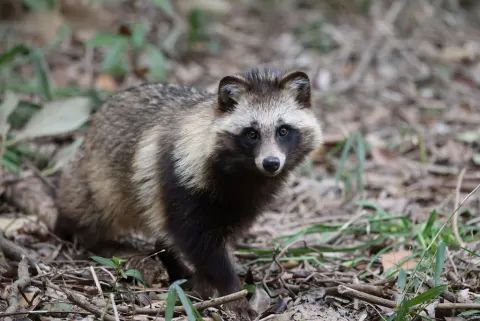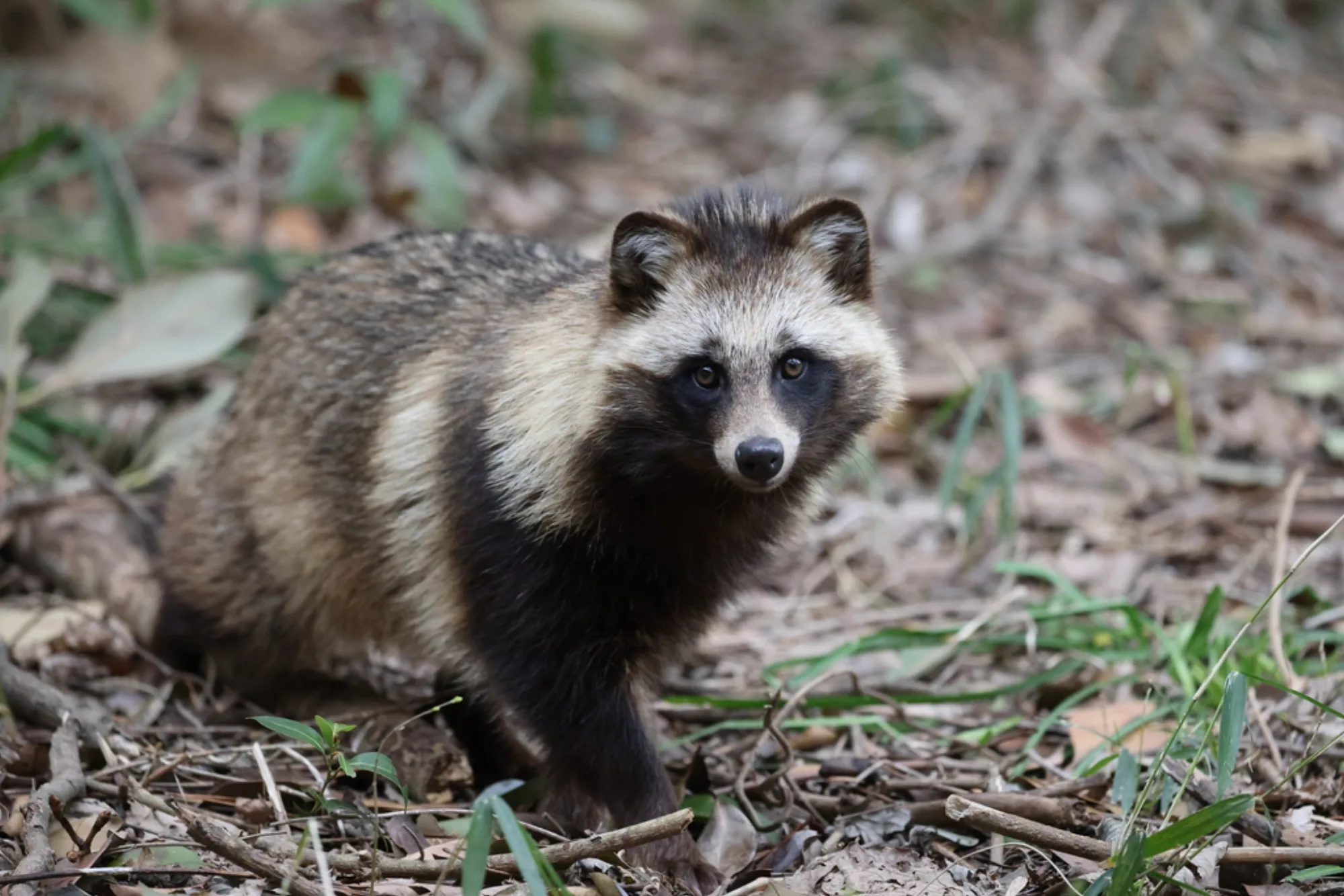
Nyctereutes viverrinus
Known in Japan as the tanuki, Nyctereutes viverrinus is a canid found only in Japan. Its fur is shorter and less insulating than that of mainland raccoon dogs, and a rare white colour type occurs. Mainly active at night, it can growl or make groaning sounds with pitches like those of a domestic cat. When faced with another animal, it may arch its back to intimidate it, or lower its body and expose its belly in submission.
Tanuki are widespread in Japan, and their range includes Hokkaido. In one Hokkaido study, they favoured the interiors of forests, while invasive raccoons preferred farmland at the forest edge. Tanuki have been seen climbing trees in search of fruit and berries, using their curved claws to make the ascent. In satoyama areas, the presence of invasive raccoons has led them to eat more fruit. Their social groups usually consist of a breeding pair, although unpaired animals may remain together until they find mates.
Breeding takes place between February and April, and after a pregnancy of 9 weeks a litter typically contains 4 to 6 pups. Both parents care for the young at a den for around one month, then continue looking after them for another month once they have left it. In Japan, people hunt tanuki mainly to prevent crop damage, and their fur is also sought for calligraphy brushes. Roads take a heavy toll: a conservative estimate puts annual vehicle deaths in Japan at up to 370,000.
Written from the English Wikipedia article Japanese raccoon dog (CC BY-SA 4.0).
- Records
- 5
- Countries
- 1
No atlas park has a record of the Nyctereutes viverrinus in or around it yet.
These are open occurrence records, so they show where people looked for and recorded the Nyctereutes viverrinus as much as where it lives. Cells are up to 25 km across, and every location is generalised to its cell.
Generalised encounter areas, not exact locations. Each shape is a grid cell coloured by how likely the species is there.
- Very likelyJapan25 km zone · medium confidence · 5 records · updated 80 days ago
Conservation status not assessed here yet, so every location is generalised to its grid cell.