Raccoon Dog
Nyctereutes procyonoides
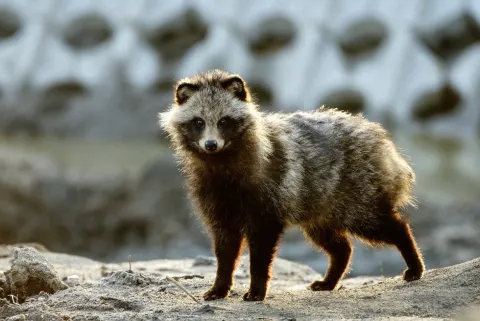
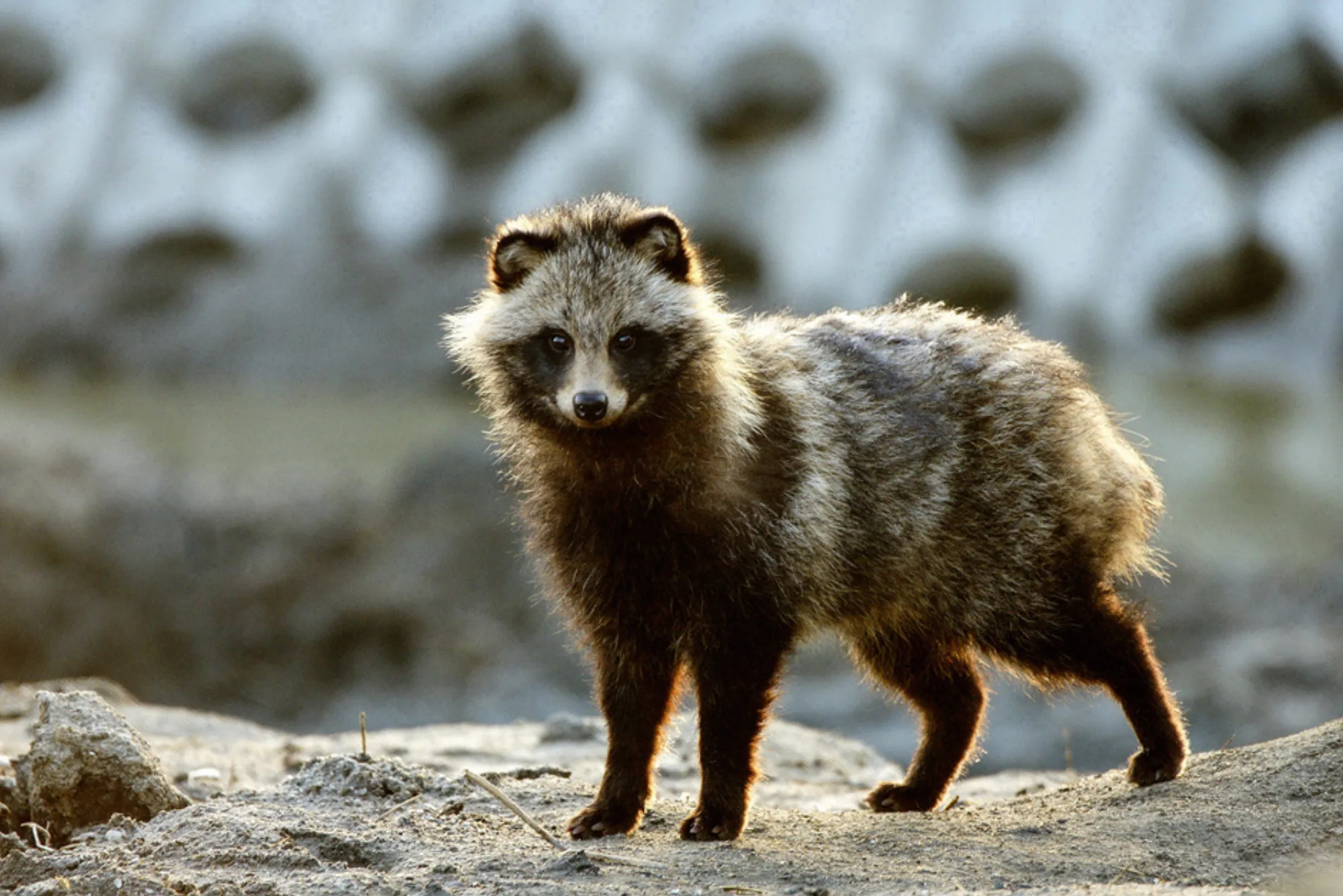
With its masked face and stocky, fox-like build, the Raccoon Dog can look like a raccoon, though its closest relatives are foxes. It has a long body, short legs and small ears that barely rise above its fur. Its winter coat is thick and earth-brown or brownish-grey, with a dark stripe that widens across the shoulders. In summer, the fur becomes brighter and reddish straw-coloured.
Native to East Asia, it has also been introduced widely in Europe for the fur trade, and is abundant in Finland and the Baltic states. The places where it feeds include swampy areas and flatlands; it also uses burrows and can climb trees. Usually silent, it hibernates during cold winters, although in some areas it does so only during severe snowstorms. Its varied diet includes insects, rodents, amphibians, birds, fish, carrion, fruit, nuts and berries. Food choices change with the seasons: rodents and carrion are among its main foods in late autumn and winter, while spring meals are dominated by amphibians, insects and fruit.
Pairs usually form in autumn, and pups are born in April or May, typically in litters of six to eight. Males help raise the young, which leave their parents in late August or September. Wolves are the main predators, while red foxes can kill pups and adults. People also hunt Raccoon Dogs, sometimes catching them incidentally during hunts for other species in their introduced range. Harsh winters and scarce food have contributed to poor outcomes for introduced populations in several regions, including Altai and Trans-Baikaliya.
Written from the English Wikipedia article Common raccoon dog (CC BY-SA 4.0).
- Records
- 13,890
- Countries
- 17
No atlas park has a record of the Raccoon Dog in or around it yet.
These are open occurrence records, so they show where people looked for and recorded the Raccoon Dog as much as where it lives. Cells are up to 25 km across, and every location is generalised to its cell.
Generalised encounter areas, not exact locations. Each shape is a grid cell coloured by how likely the species is there.
- Very likelyJapan25 km zone · medium confidence · 9572 records · updated 86 days ago
- Very likelyGermany25 km zone · high confidence · 1419 records · updated 86 days ago
- Very likelyFinland25 km zone · high confidence · 989 records · updated 86 days ago
- Very likelyEstonia25 km zone · medium confidence · 812 records · updated 86 days ago
- Very likelyDenmark25 km zone · high confidence · 770 records · updated 86 days ago
- Very likelyRussia25 km zone · medium confidence · 103 records · updated 86 days ago
- Very likelyUkraine25 km zone · medium confidence · 64 records · updated 86 days ago
- LikelySouth Korea25 km zone · medium confidence · 71 records · updated 86 days ago
- LikelySwitzerland25 km zone · medium confidence · 27 records · updated today
- LikelySweden25 km zone · medium confidence · 15 records · updated 86 days ago
Conservation status not assessed here yet, so every location is generalised to its grid cell.