Broadnose Sevengill Shark
Notorynchus cepedianus
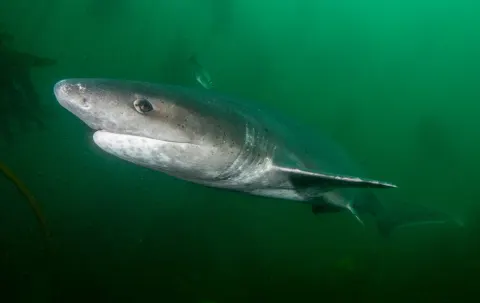
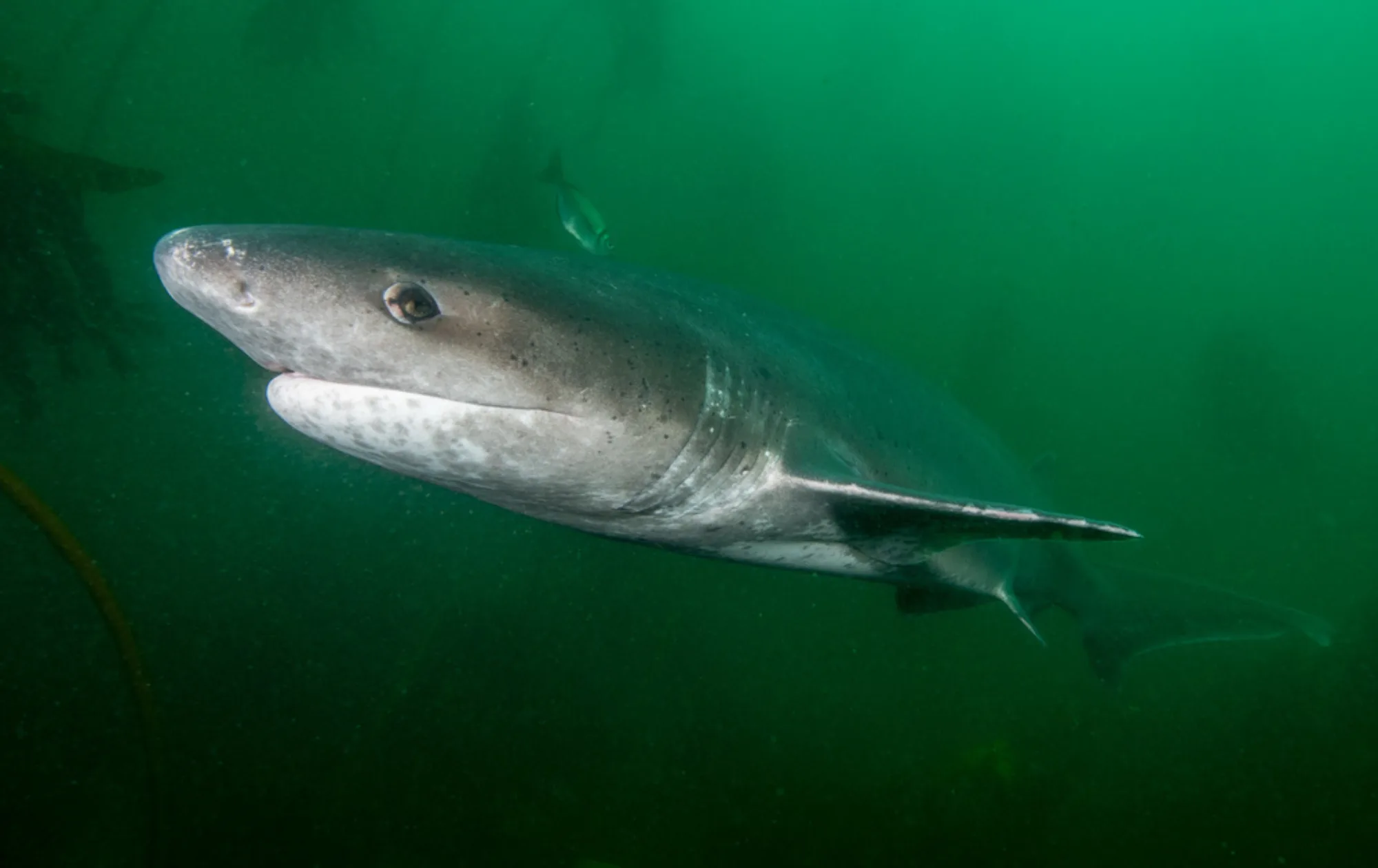
Seven gill slits give the Broadnose Sevengill Shark its name and distinguish it from most other sharks, which have five. It has a thick body, broad head and blunt snout, with a single fin set far back on its upper side. Its back ranges from silvery grey to brown, its underside is very pale, and small black and white spots scatter across its body and fins. The largest recorded length is 3.0 metres.
This shark has been found across the western and eastern Pacific, from Japan and New Zealand to Canada and Chile, and in the southern Atlantic off Argentina and South Africa. In San Francisco Bay, it is commonly found around Alcatraz Island and the Golden Gate Bridge. Most live in deep bay channels, or in relatively shallow estuaries and waters over continental shelves, often cruising close to the seabed. Off South Africa, those nearer the coast tend to favour open, sandy ground with sparse kelp. It eats a wide range of prey, including sharks, rays, marine mammals and bony fish, as well as carrion. Sevengills sometimes hunt together to take larger animals, and can go for weeks between meals. After a 12-month pregnancy, a female gives birth in a shallow bay or estuary to between 82 and 95 pups, each measuring 40 to 45 cm.
Larger sharks and orcas prey on sevengills, and cannibalism has also been recorded. Fishing puts pressure on the species, including through frequent accidental catches, while water pollution and hunting for its liver oil and hide are further threats. In San Francisco Bay, intense fishing caused a local decline in the early 1980s.
Written from the English Wikipedia article Broadnose sevengill shark (CC BY-SA 4.0).
- Records
- 43,295
- Countries
- 9
- Atlas places
- 10
- Channel Islands National Park· United States
- Table Mountain National Park· South Africa
- Freycinet National Park· Australia
- Península Valdés· Argentina
- Blue Mountains National Park· Australia
- Fiordland National Park· New Zealand
- Flinders Chase National Park· Australia
- Garden Route National Park· South Africa
- Rakiura National Park· New Zealand
- Wilsons Promontory National Park· Australia
These are open occurrence records, so they show where people looked for and recorded the Broadnose Sevengill Shark as much as where it lives. Cells are up to 25 km across, and every location is generalised to its cell.
Generalised encounter areas, not exact locations. Each shape is a grid cell coloured by how likely the species is there.
- Very likelyUnited States25 km zone · high confidence · 37248 records · updated 80 days ago
- Very likelyAustralia25 km zone · high confidence · 3172 records · updated 80 days ago
- Very likelySouth Africa25 km zone · medium confidence · 2807 records · updated 80 days ago
- LikelyArgentina25 km zone · medium confidence · 38 records · updated 80 days ago
- LikelyNew Zealand25 km zone · medium confidence · 18 records · updated 80 days ago
- LikelyMexico25 km zone · medium confidence · 5 records · updated 80 days ago
- LikelySt. Helena25 km zone · medium confidence · 4 records · updated 80 days ago
- LikelyChile25 km zone · medium confidence · 3 records · updated 80 days ago
- PossiblePeru25 km zone · low confidence · 0 records · updated 80 days ago
Conservation status not assessed here yet, so every location is generalised to its grid cell.