Eastern Newt
Notophthalmus viridescens
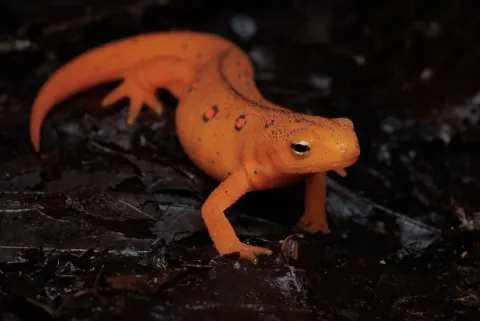
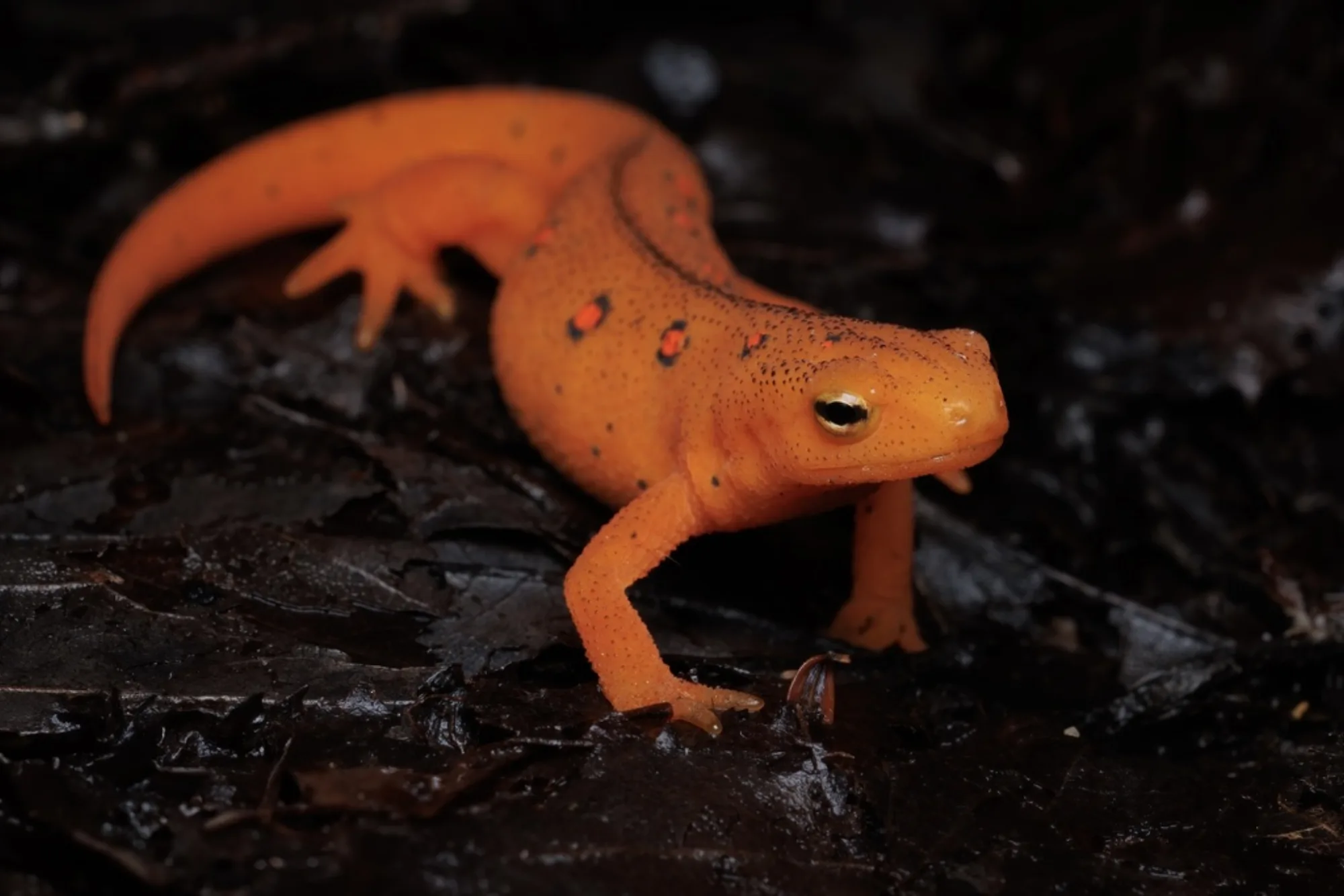
Across eastern North America, the Eastern Newt moves between water and woodland during its life. It can grow to 13 cm, but its appearance changes so much that a young newt and an adult may look like different animals. The land-dwelling juvenile, known as a red eft, is bright orange-red with darker red spots edged in black. Adults are dull olive green above and yellow below, keeping the black-rimmed red spots of their youth.
Look for newts around small lakes, ponds and quiet stretches of streams, especially where submerged plants are plentiful and damp woodland is close by. Red efts can often be seen on the forest floor after rain. They are most active in warm, rainy weather and shelter under leaf litter when conditions are dry. An eft may travel a long way before finding a pond and becoming an aquatic adult after two or three years. Adults favour muddy water, though they may move onto land during dry spells. Newts eat small animals, including insects, worms and snails, while larvae feed on tiny aquatic invertebrates. Breeding runs from late autumn to early spring, and females attach their eggs to underwater plants or other objects.
The newt's skin contains a toxin that discourages some predators, and its conspicuous colours serve as a warning. Even so, fish, snakes, birds and larger salamanders prey on eastern newts, and larvae suffer heavy losses. Populations face threats from deforestation, fragmented habitat and pollution, as well as climate change, invasive species, over-exploitation and infectious diseases.
Written from the English Wikipedia article Eastern newt (CC BY-SA 4.0).
- Records
- 6,819
- Countries
- 2
- Atlas places
- 1
These are open occurrence records, so they show where people looked for and recorded the Eastern Newt as much as where it lives. Cells are up to 25 km across, and every location is generalised to its cell.
Generalised encounter areas, not exact locations. Each shape is a grid cell coloured by how likely the species is there.
- Very likelyUnited States25 km zone · high confidence · 6503 records · updated 80 days ago
- Very likelyCanada25 km zone · medium confidence · 316 records · updated 80 days ago
Conservation status not assessed here yet, so every location is generalised to its grid cell.