Black Tiger Snake
Notechis scutatus
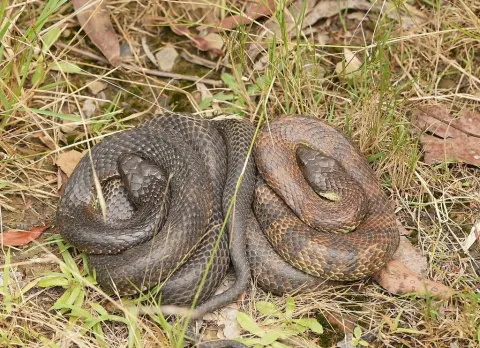
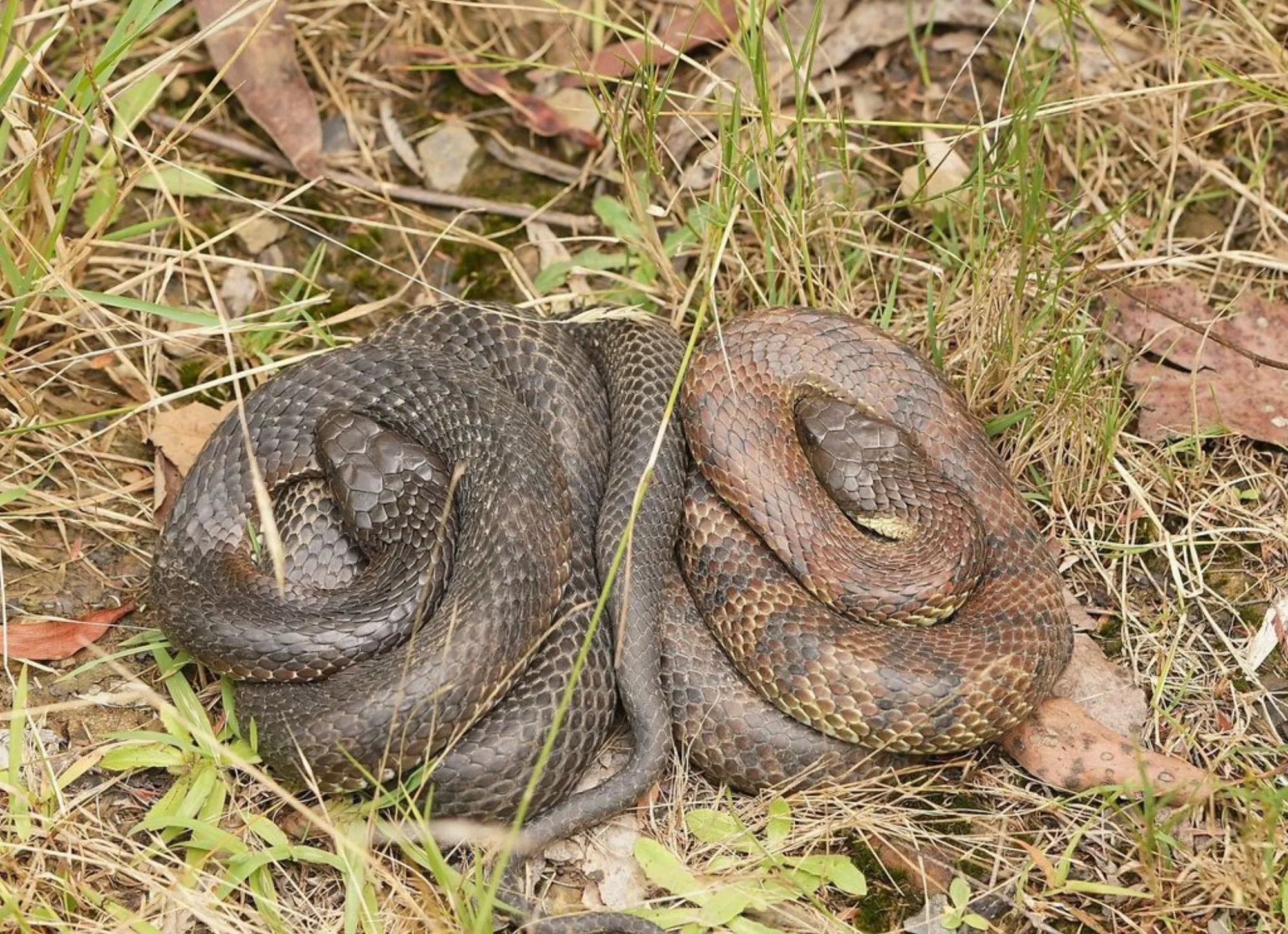
Across southern Australia, the Black Tiger Snake (Notechis scutatus) is a large, highly venomous snake whose appearance can vary considerably from place to place and from one individual to another. Its familiar dark bands may contrast strongly with the surrounding colour or be hard to distinguish, and some snakes have no bands at all. Colours range from olive, yellow and orange-brown to jet black, with a light yellow or orange underside. Typically, a tiger snake measures about 1.2 metres in total length, although different populations vary greatly in size.
Its range extends from southern Western Australia through South Australia and Tasmania, and north through Victoria and New South Wales, including coastal islands. Often found near the coast, it favours wetlands, creeks, dams and other places beside watercourses, as well as shelter near permanent water in pastoral areas. Places with plentiful prey can support large populations. Although usually encountered on the ground, it can swim and climb into trees and buildings, and can also be active after dark on warm nights. If threatened, it flattens its body, lifts its head and may bite an aggressor. Its venom can be fatal to humans and is also used to kill prey.
Tiger snakes usually mate in spring and give birth to live young in summer. A female typically produces 20 to 30 young, although one eastern female was recorded giving birth to 64. In most Australian states, tiger snakes are protected, and killing or injuring one can incur a fine.
Written from the English Wikipedia article Tiger snake (CC BY-SA 4.0).
- Records
- 4,181
- Countries
- 1
- Atlas places
- 7
These are open occurrence records, so they show where people looked for and recorded the Black Tiger Snake as much as where it lives. Cells are up to 25 km across, and every location is generalised to its cell.
Generalised encounter areas, not exact locations. Each shape is a grid cell coloured by how likely the species is there.
- Very likelyAustralia25 km zone · high confidence · 4181 records · updated 80 days ago
Conservation status not assessed here yet, so every location is generalised to its grid cell.