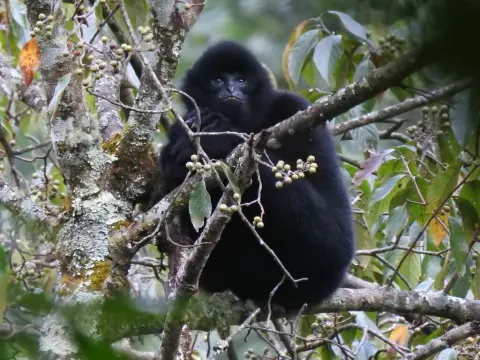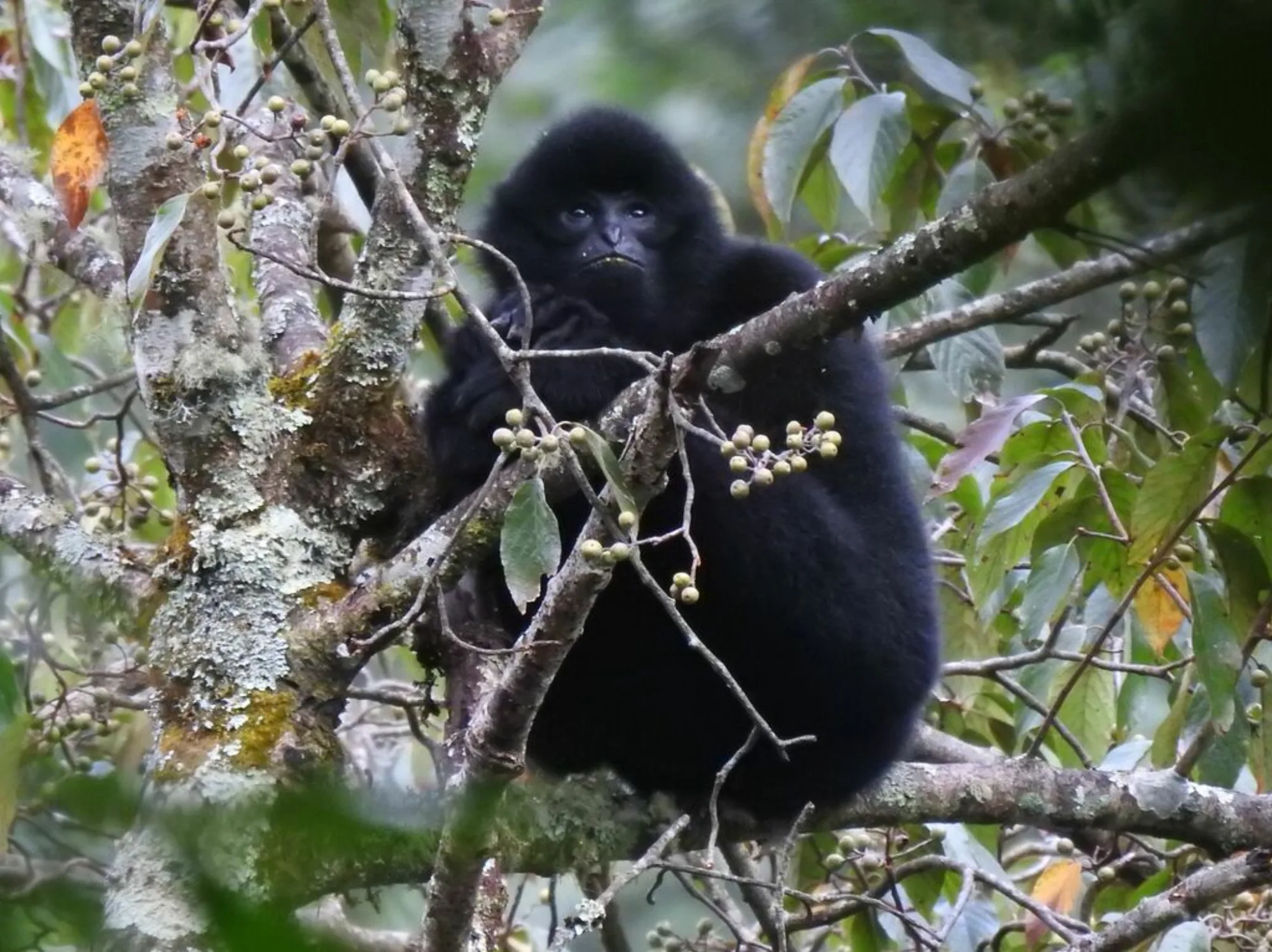
Black Crested Gibbon
Nomascus concolor
Spanning parts of China, Laos, and northern Vietnam, the Black Crested Gibbon is an arboreal primate with a striking difference between the sexes. Males are entirely black, while females have golden or buff coats marked with occasional dark patches and a distinct streak on their heads. These slender apes weigh between 6.9 and 10 kg and measure 43 to 54 cm in length. They are masters of movement through the canopy, primarily using their long arms to swing between branches, though they also climb, leap, and walk on two legs.
Social life usually revolves around small family groups. While many consist of a single pair and their young, some males live with up to four females. These groups are known for their loud, coordinated singing, which often takes place in tall trees to help the sound carry. These vocal displays serve to defend territory and strengthen the bonds between mates. Their diet is mostly fruit, but they also eat flowers, leaves, and buds, especially when fruit is scarce. Occasionally, they may even consume insects, eggs, or small mammals.
These primates prefer high-altitude habitats, living in subtropical and mountainous forests between 2100 and 2400 m above sea level, though they can be found at lower elevations in Laos and Vietnam. Survival is difficult as their preferred evergreen broad-leaved forests take a long time to grow back, making it hard for isolated groups to meet. They also face competition from gray langurs, which have broader diets and larger groups. With only 1300 to 2000 individuals remaining in the wild, conservationists have established ecological corridors to help these separated populations reconnect.
Written from the English Wikipedia article Black crested gibbon (CC BY-SA 4.0).
- Records
- 0
- Countries
- 1
- Atlas places
- 0
These are open occurrence records, so they show where people looked for and recorded the Black Crested Gibbon as much as where it lives. Cells are up to 25 km across, and every location is generalised to its cell.
Generalised encounter areas, not exact locations. Each shape is a grid cell coloured by how likely the species is there.
- Very likelyChina50 km zone · low confidence · 0 records · updated 4 days ago