Crested Ibis
Nipponia nippon
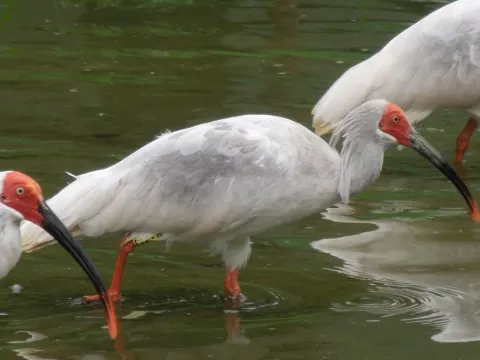
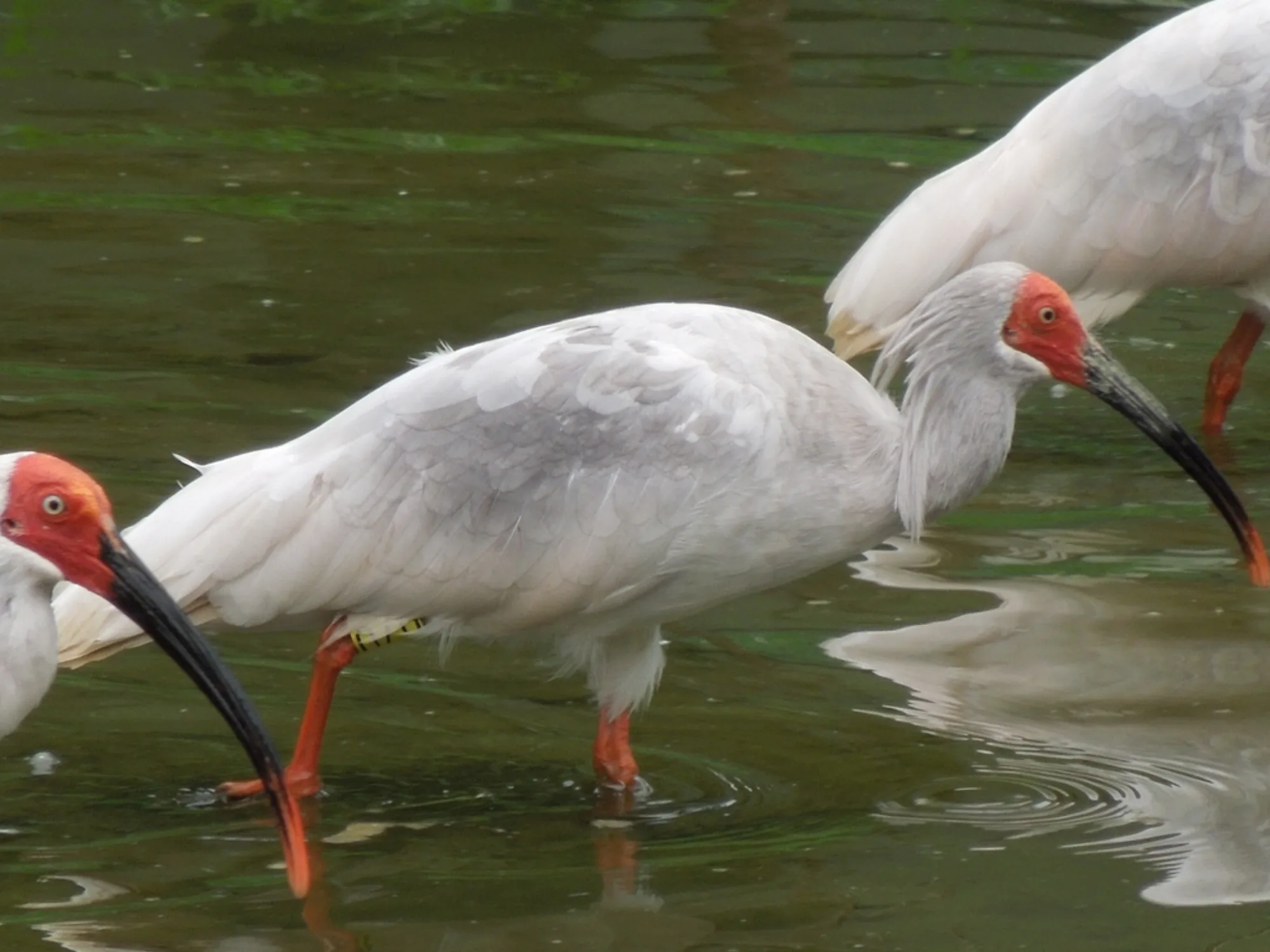
A bare red face, a long, downcurved black bill with a red tip, and a crest of plumes help identify the Crested Ibis. This medium-sized to large bird measures 55 to 78.5 cm and has red legs and feet. Its winter plumage is mostly white, with salmon-pink colouring on the tail and wings. In summer, grey covers the upperparts and breast, while the underside is white with a pink tinge. When the bird flies, the undersides of its flight feathers show a strong flush of pink.
The bird once ranged widely through Japan, the Korean Peninsula and eastern China. Its wild range had shrunk to Yangxian in China's Shaanxi Province by the end of the 20th century. Reintroduced birds now live in South Korea, as well as on Japan's Sado Island and Noto Peninsula. The ibis inhabits temperate mountain forests and hilly country, often moving near wetlands, rice paddies and mountain streams. It is usually quiet and seen alone, in pairs or in small groups. By day it searches wetlands for food, moving slowly on land or probing shallow water and mud with its bill. Its varied diet includes small fish, frogs, crabs, snails, earthworms and insects, along with other small animals.
From March to May, pairs defend territories and build simple nests in tall trees near water, using dead branches and a soft lining of grass and moss. Both parents incubate the eggs and feed the chicks, which remain near the nest with them after leaving it. Overhunting, pesticides and habitat loss contributed to a severe decline, compounded by the bird's small population and limited range, winter starvation and persecution.
Written from the English Wikipedia article Crested ibis (CC BY-SA 4.0).
- Records
- 1,022
- Countries
- 3
No atlas park has a record of the Crested Ibis in or around it yet.
These are open occurrence records, so they show where people looked for and recorded the Crested Ibis as much as where it lives. Cells are up to 25 km across, and every location is generalised to its cell.
Generalised encounter areas, not exact locations. Each shape is a grid cell coloured by how likely the species is there.
- Very likelyChina25 km zone · high confidence · 726 records · updated 80 days ago
- Very likelyJapan25 km zone · high confidence · 177 records · updated 80 days ago
- Very likelySouth Korea25 km zone · high confidence · 119 records · updated 80 days ago
Conservation status not assessed here yet, so every location is generalised to its grid cell.