Powerful Owl
Ninox strenua
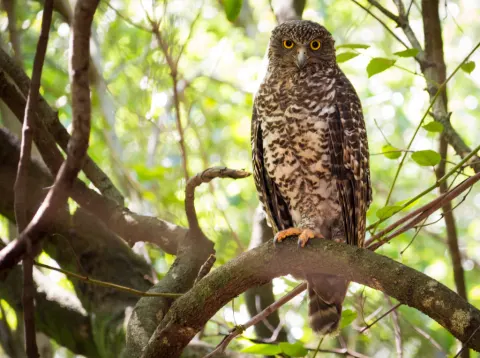
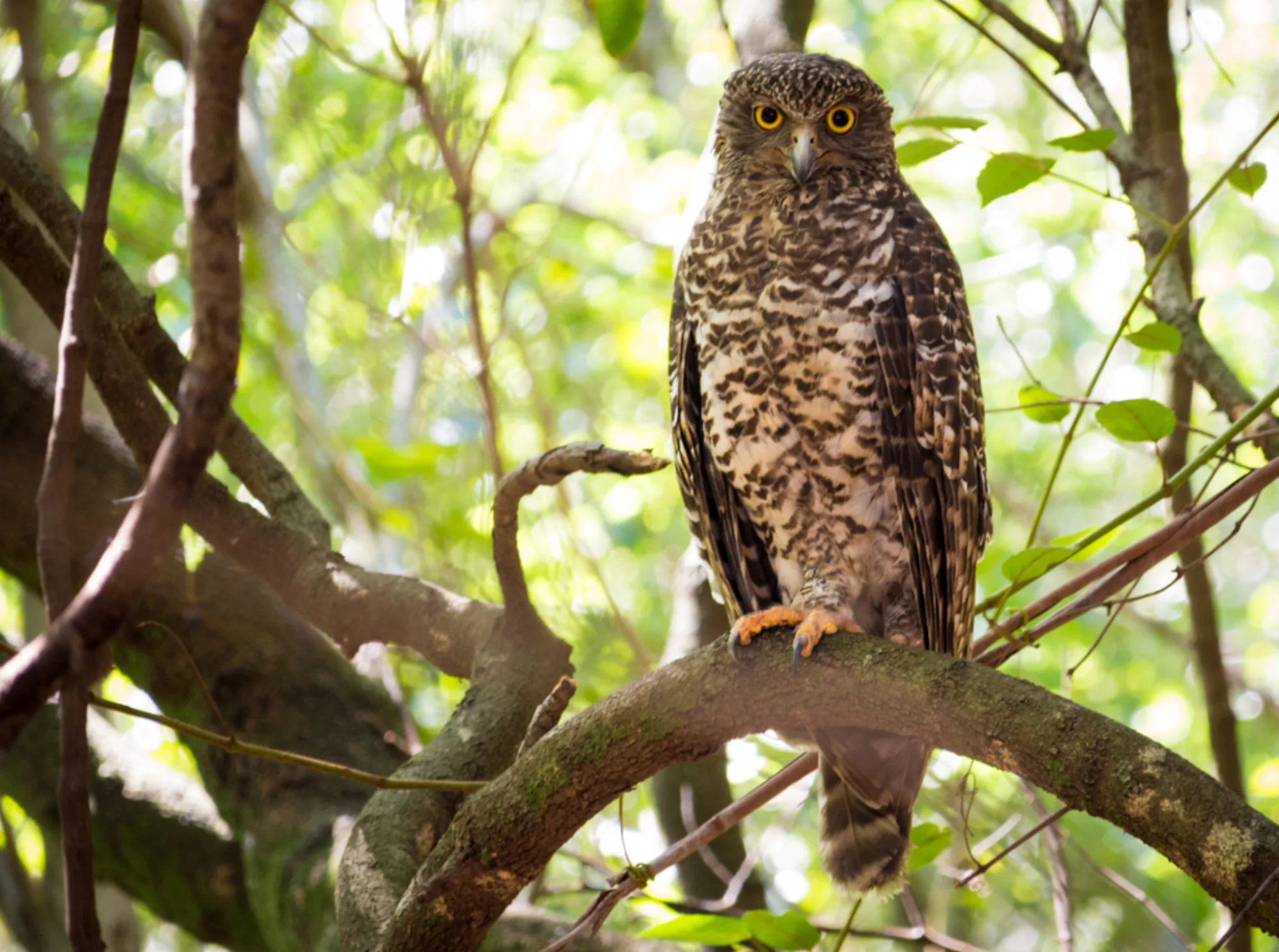
Australia's largest owl, the Powerful Owl cuts a striking silhouette with its long tail and small head. Its dark grey-brown upperparts are mottled and marked with whitish bars, while bold grey-brown chevrons cross its white underparts. Large yellow eyes and heavy claws add to its distinctive appearance. It measures 45 to 65 cm long, with a wingspan of 112 to 135 cm. Listen for the male's deep double hoot, which carries far and usually rises on the second note; pairs often call together as breeding begins.
The owl lives in eastern and south-eastern Australia, from Queensland south to Victoria and west to South Australia. It inhabits coastal areas and the Great Dividing Range, seldom venturing beyond 200 km inland. Look for it in tall, humid forest, wooded gullies and coastal woodland, although it also uses some drier woodlands, parks and gardens. Streams between ridges covered in eucalyptus forest are often prime habitat. During the day, it frequently roosts on branches in tall, open trees, sometimes still holding prey caught the night before. At night it hunts mainly tree-dwelling mammals, including possums, gliders and flying foxes, watching for movement as it glides between perches.
Adult owls live in permanent breeding pairs, occupying large territories. Breeding takes place mainly in May and June, usually in a large tree hollow, and the clutch is most often two eggs. Young birds fledge at 6 to 8 weeks but remain dependent on their parents for several months. Heavily developed areas and single-species plantations are poor habitat for these owls, largely because their prey depends on diverse native forests.
Written from the English Wikipedia article Powerful owl (CC BY-SA 4.0).
- Records
- 32,191
- Countries
- 1
- Atlas places
- 4
These are open occurrence records, so they show where people looked for and recorded the Powerful Owl as much as where it lives. Cells are up to 25 km across, and every location is generalised to its cell.
Generalised encounter areas, not exact locations. Each shape is a grid cell coloured by how likely the species is there.
- Very likelyAustralia25 km zone · high confidence · 32191 records · updated 80 days ago
Conservation status not assessed here yet, so every location is generalised to its grid cell.