Southern Boobook
Ninox boobook
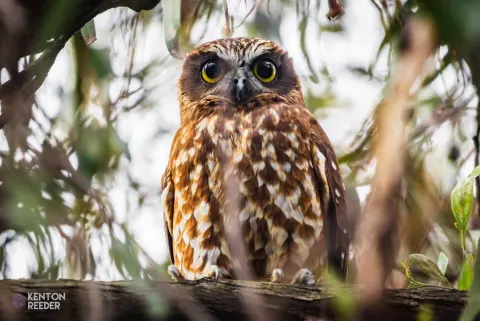
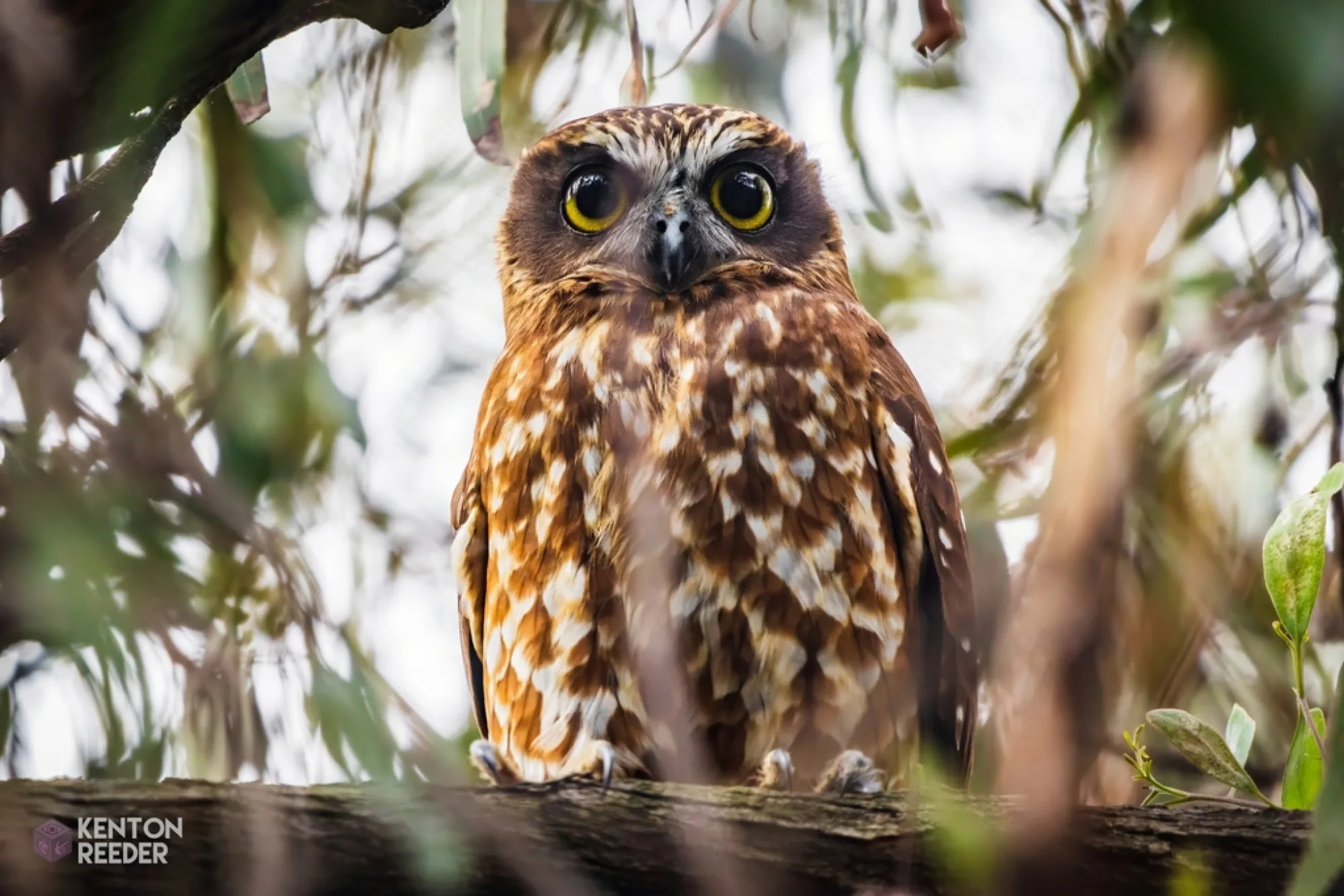
A two-note boo-book call often gives away the Southern Boobook before the owl itself comes into view. Heard mainly at night, the call can carry up to 1 km, with the second note usually lower than the first. This compact owl is 27 to 36 cm long, with mostly dark brown feathers, pale spots and grey-green or yellow-green eyes. Look for its squat posture and the pale border around its face.
The species lives across mainland Australia, as well as in southern New Guinea, Timor and nearby Indonesian islands. It uses habitats from forest and open woodland to scrub and semidesert, and in Australia favours eucalypt forests. It also lives in farmland and suburbs where scattered trees remain, while in drier country it is often found along watercourses. By day it roosts among dense foliage, sometimes using several different sites, or shelters on ledges and in caves where suitable trees are absent. It hunts from a perch, dropping onto prey before carrying it to an elevated place to eat. Mice, insects and small birds are among its prey, and it often hunts in open ground near trees.
Across Australia, breeding runs from July to February, with a peak in October. The owls nest in tree hollows, often in eucalypts, and usually lay two or three white eggs. The female incubates while the male brings her food, and the young leave the nest five to six weeks after hatching. Introduced cats and rats raid nests, birds of prey take young owls, and juveniles face greater danger after bushfires. North of Perth, on the Swan Coastal Plain, boobooks have died after eating rodents killed with anticoagulant rat poison.
Written from the English Wikipedia article Australian boobook (CC BY-SA 4.0).
- Records
- 38,378
- Countries
- 1
- Atlas places
- 9
- Blue Mountains National Park· Australia
- Grampians (Gariwerd) National Park· Australia
- Great Sandy National Park (K'gari)· Australia
- Kakadu National Park· Australia
- Lamington National Park· Australia
- Daintree National Park· Australia
- Flinders Chase National Park· Australia
- Kosciuszko National Park· Australia
- Wilsons Promontory National Park· Australia
These are open occurrence records, so they show where people looked for and recorded the Southern Boobook as much as where it lives. Cells are up to 25 km across, and every location is generalised to its cell.
Generalised encounter areas, not exact locations. Each shape is a grid cell coloured by how likely the species is there.
- Very likelyAustralia25 km zone · high confidence · 38378 records · updated 80 days ago
Conservation status not assessed here yet, so every location is generalised to its grid cell.