Nilgiri Tahr
Nilgiritragus hylocrius
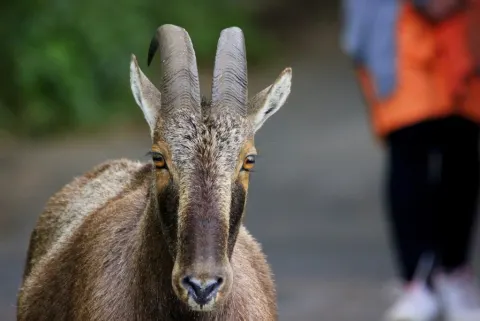
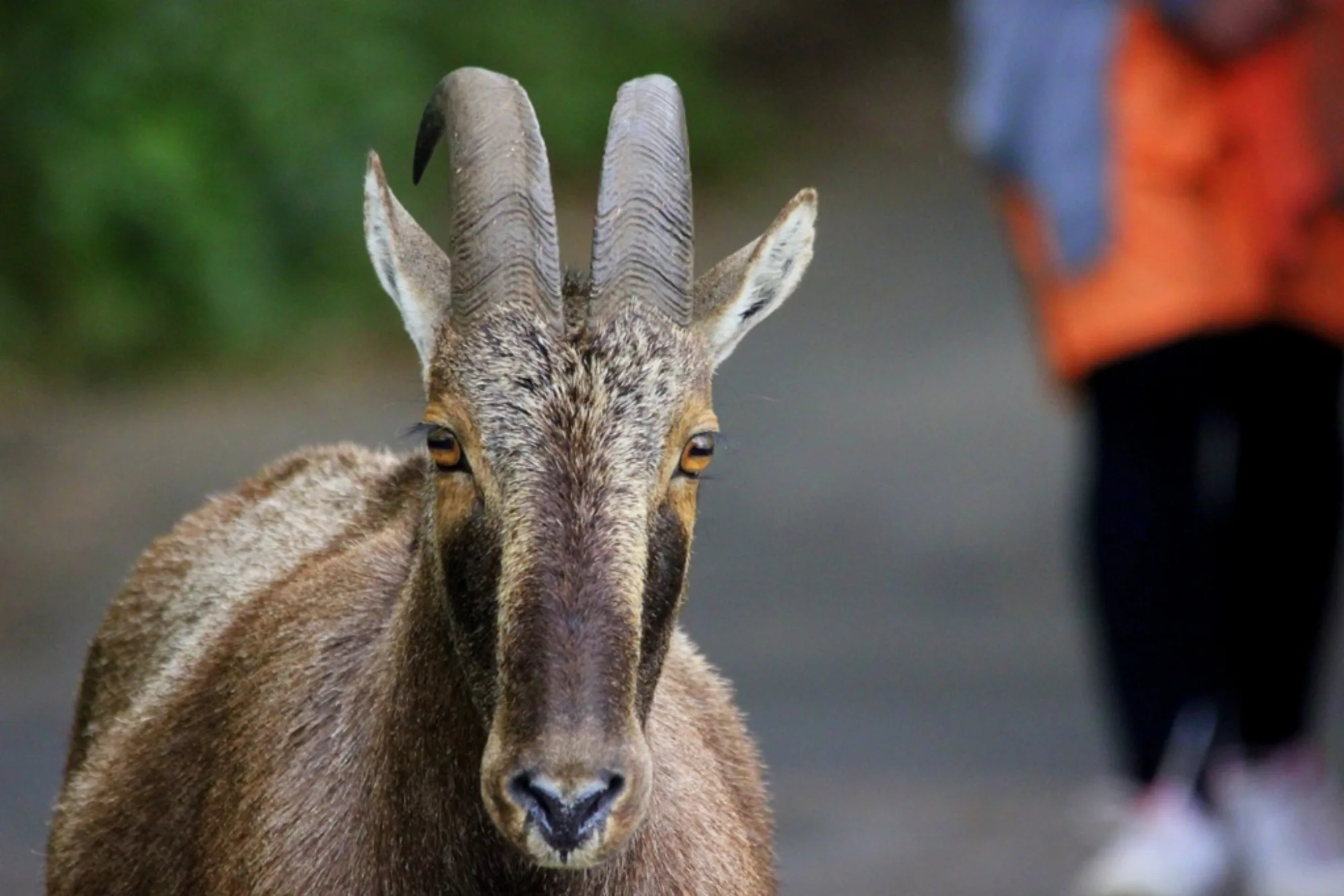
Stocky and sure-footed, the Nilgiri Tahr has a short, rough coat in shades of yellow and brown. Males are larger than females and develop darker coats, bristly manes on the back of the neck and dark patches across their backs. Females and young may look greyish, while both sexes carry horns that curve backwards. These agile climbers can balance along high, narrow ridges and have keen eyesight.
Found only in the southern Western Ghats of India, the tahr lives in the hills of Tamil Nadu and Kerala. Eravikulam National Park in Kerala holds the largest population, while Mukurthi and Grass Hills National Park are important strongholds in Tamil Nadu. Smaller, isolated groups live in places including the Ponmudi Hills and Parambikulam in Kerala. Look for the animals in high-altitude grasslands broken by pockets of stunted shola forest, particularly around rocky cliffs and open plateaus. They generally occupy rocky outcrops and precipices between 1,200 and 2,600 m, although they sometimes occur lower down.
Tahrs usually feed on grasses and small shrubs at the edges of rocky plateaus and grasslands in the morning and evening, then rest on ridges during the day. They often feed together, with an older female keeping watch, and groups usually number 150 to 200 animals. Breeding peaks during the monsoon from June to September, although it occurs throughout the year; young are usually born in January or February. Hunting and habitat loss caused a sharp historical decline, and the species still faces habitat loss and disturbance from invasive species, as well as livestock grazing, poaching and landscape fragmentation in some places.
Written from the English Wikipedia article Nilgiri tahr (CC BY-SA 4.0).
- Records
- 135
- Countries
- 1
- Atlas places
- 1
These are open occurrence records, so they show where people looked for and recorded the Nilgiri Tahr as much as where it lives. Cells are up to 25 km across, and every location is generalised to its cell.
Generalised encounter areas, not exact locations. Each shape is a grid cell coloured by how likely the species is there.
- Very likelyIndia25 km zone · medium confidence · 135 records · updated 80 days ago
Conservation status not assessed here yet, so every location is generalised to its grid cell.