Pink Pigeon
Nesoenas mayeri
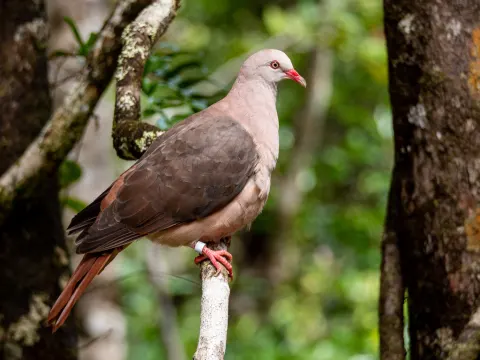
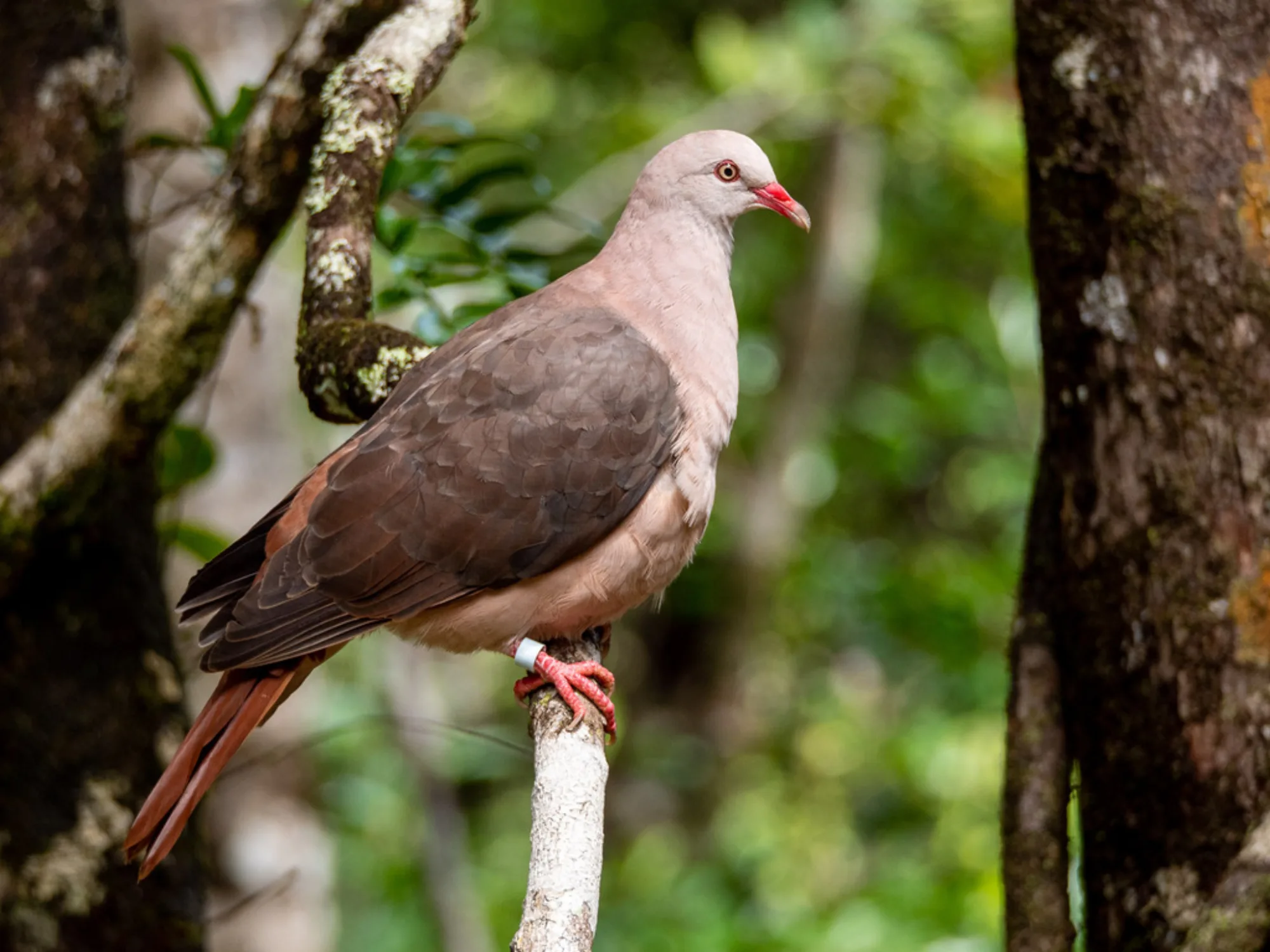
On Mauritius, the Pink Pigeon stands out for its pale pinkish-grey head, shoulders and underside, set against dark brown wings and a broad, rust-coloured tail. Its feet are pink, and its dark pink beak has a white tip. An adult measures about 36 to 38 centimetres from beak to tail. Listen for a short “hoo hoo” in flight, or a series of coos from a territorial male.
This pigeon lives only on Mauritius and Île aux Aigrettes, a tiny island just off the east coast. It does not migrate and favours upland evergreen forest, though it also lives in coastal forest where native vegetation dominates. On the ground, it turns over leaf litter as it searches for food. Its plant diet includes buds, flowers, leaves, shoots, fruit and seeds, taken from both native and introduced plants. Breeding begins in August or September, but can take place throughout the year. Pairs generally stay together for life, making a slight platform for a nest and protecting the space immediately around it. The female usually lays two white eggs, which the parents take turns incubating.
Habitat destruction and introduced predators drove the population down to 10 birds in 1991. Captive breeding and reintroduction helped bring the wild population to about 400 by 2018. Habitat degradation, predators and wildlife disease remain major threats. Introduced guava and privet can crowd out native forest plants, making food and nesting sites harder to find. Macaques, mongooses, rats and feral cats prey on the birds, while cyclones can cause further damage to their habitat. Supplementary feeding helps support the population, but gatherings at feeding stations may also increase disease transmission.
Written from the English Wikipedia article Pink pigeon (CC BY-SA 4.0).
- Records
- 1,218
- Countries
- 2
No atlas park has a record of the Pink Pigeon in or around it yet.
These are open occurrence records, so they show where people looked for and recorded the Pink Pigeon as much as where it lives. Cells are up to 25 km across, and every location is generalised to its cell.
Generalised encounter areas, not exact locations. Each shape is a grid cell coloured by how likely the species is there.
- Very likelyMauritius25 km zone · high confidence · 1135 records · updated 80 days ago
- LikelySouth Africa25 km zone · high confidence · 83 records · updated 80 days ago
Conservation status not assessed here yet, so every location is generalised to its grid cell.