Northern Water Snake
Nerodia sipedon
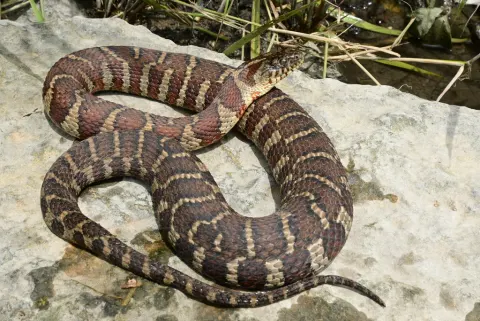
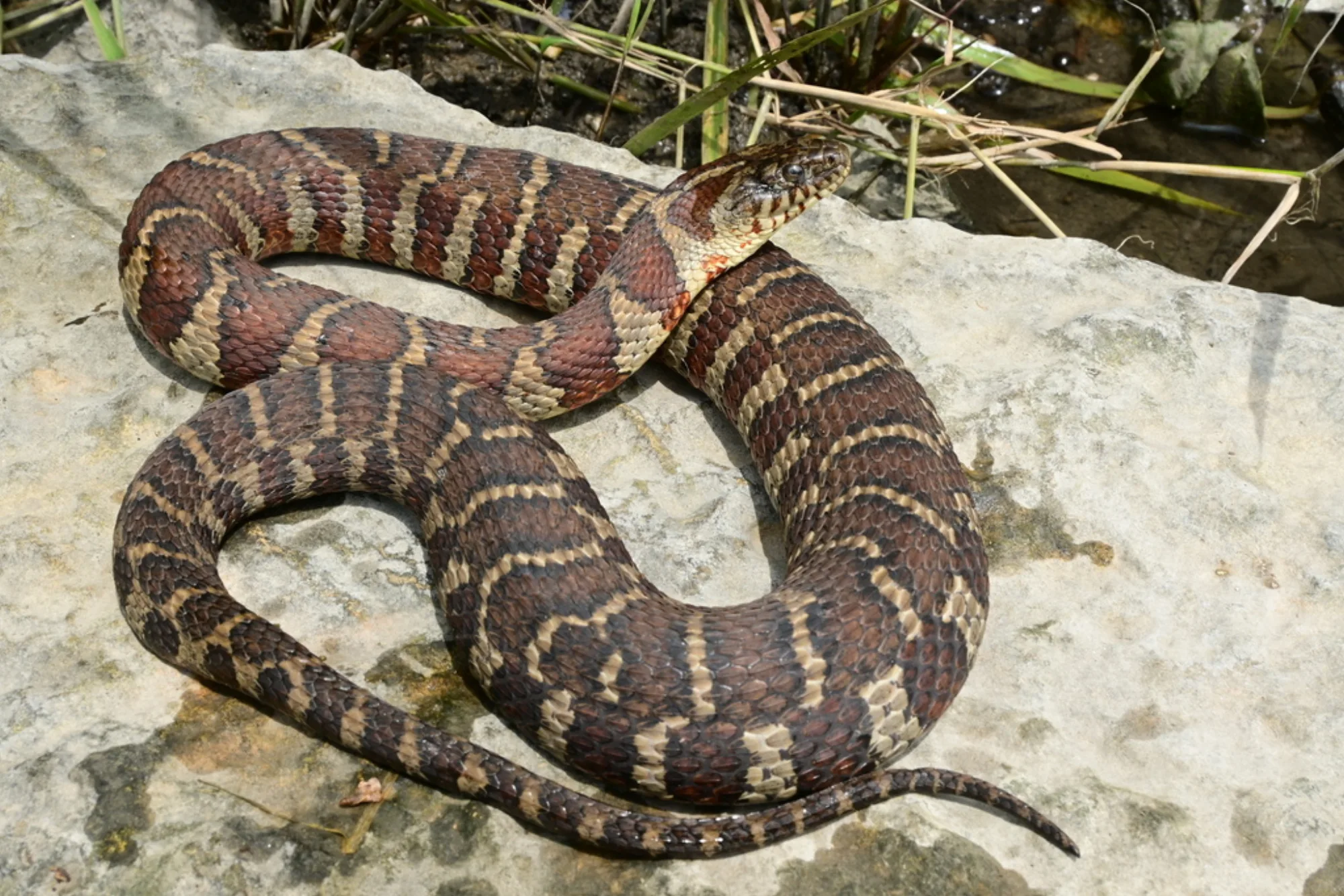
Often seen beside the water, the Northern Water Snake is a large, nonvenomous North American snake that can reach 135 cm in total length. Its colour ranges from brown and reddish to brownish-black or grey, with dark bands across the neck and blotches along the body. The pattern fades as the snake gets darker with age, and some individuals become almost black. Its belly can be white, yellow or grey, usually marked with reddish or black crescents. People sometimes mistake it for a venomous cottonmouth, although the water snake has a more slender body and a head no wider than its neck.
Across eastern and central North America, it lives in streams, lakes, ponds and wetlands, ranging from southern Ontario and southern Quebec to Texas and Florida. Look for it basking on rocks, stumps, brush or stream banks, often ready to dive into the water at a disturbance. Active by day and night, it uses sight and smell to hunt. By day it searches vegetation at the water's edge for prey including small fish, frogs, tadpoles, crayfish and insects. After dark, it hunts minnows and other small fish as they rest in the shallows. It usually flees danger, but may bite repeatedly and release musk if picked up.
Mating takes place from April through June, and females give birth to live young between August and October. A female can have up to 30 young, though the average is eight, and the mother provides no further care. Predators include birds, raccoons, foxes, snapping turtles and other snakes. People also kill water snakes out of fear, while habitat loss and degradation contributed to a decline of the Lake Erie subspecies.
Written from the English Wikipedia article Common watersnake (CC BY-SA 4.0).
- Records
- 2,836
- Countries
- 2
- Atlas places
- 2
These are open occurrence records, so they show where people looked for and recorded the Northern Water Snake as much as where it lives. Cells are up to 25 km across, and every location is generalised to its cell.
Generalised encounter areas, not exact locations. Each shape is a grid cell coloured by how likely the species is there.
- Very likelyUnited States25 km zone · high confidence · 2469 records · updated 80 days ago
- Very likelyCanada25 km zone · medium confidence · 367 records · updated 80 days ago
Conservation status not assessed here yet, so every location is generalised to its grid cell.