Egyptian Vulture
Neophron percnopterus
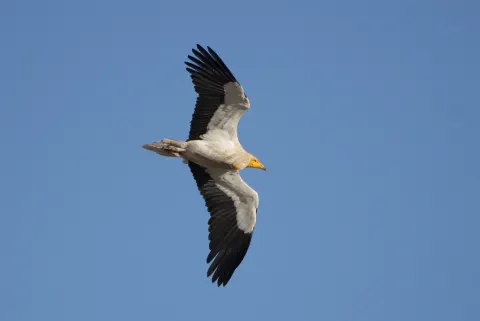
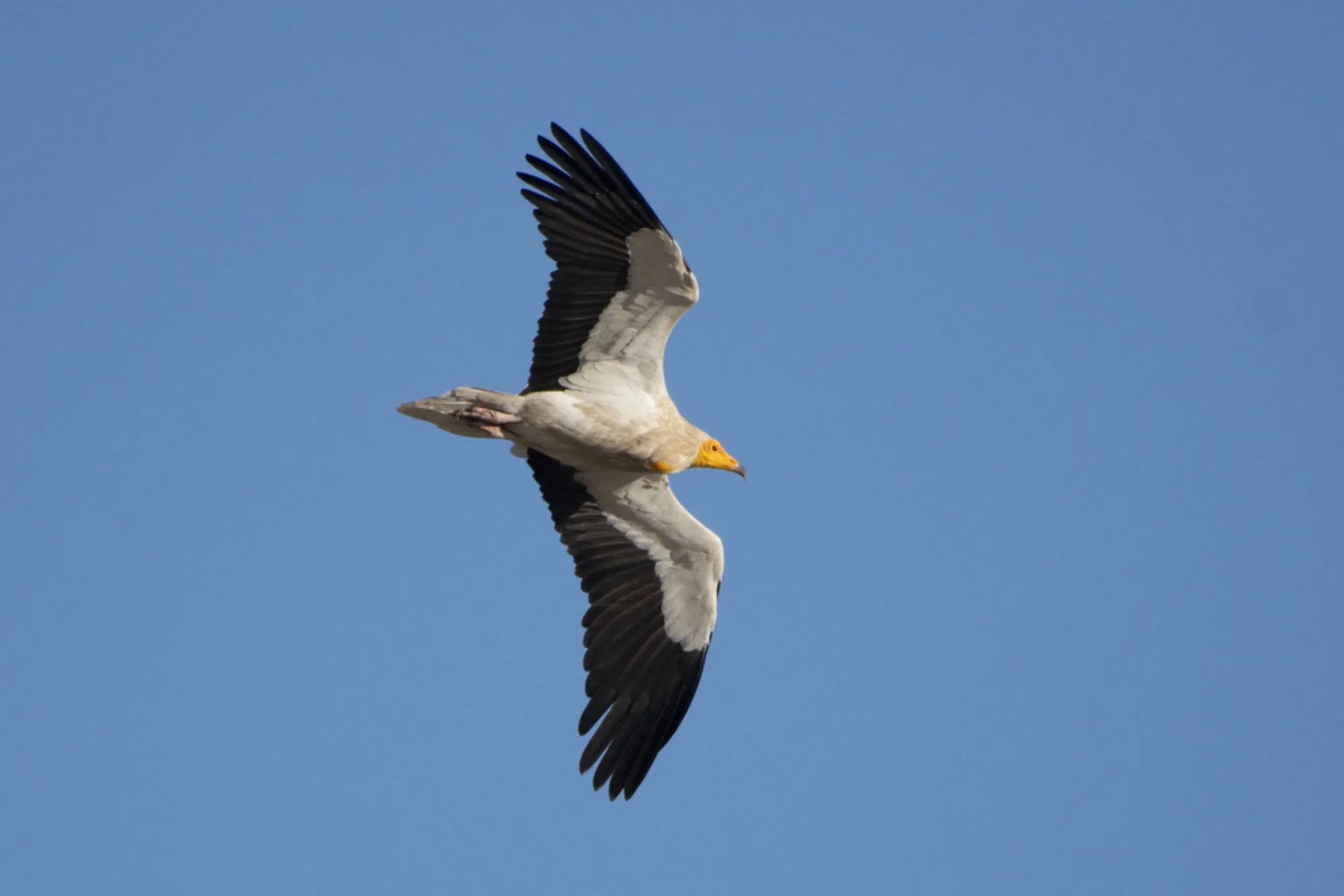
Soaring on warm air, the Egyptian Vulture can be picked out by its contrasting underwings and wedge-shaped tail. This small Old World vulture has white adult plumage, black flight feathers and a bare yellow face, although mud or iron-rich soil often stains the white feathers rusty or brown. Juveniles have dark, chocolate-brown or blackish plumage broken by patches of black and white. The species breeds from southern Europe and northern Africa eastwards into western and southern Asia, favouring low hills and arid plains. In the Himalayas it reaches about 2,000 m in summer. Birds breeding in temperate regions migrate south for winter, while tropical populations tend to stay put.
Usually seen alone or in pairs, Egyptian Vultures soar alongside other scavengers and birds of prey, or perch on the ground or on buildings. They also gather to roost on large trees, buildings or cliffs, often close to a place where they can find food. Carrion is their main food, but they also take small mammals, birds and reptiles, and eat insects, vegetable matter and dung. Some birds use pebbles to crack large eggs, and twigs to gather wool for their nests. In spring, pairs build untidy platforms of twigs lined with rags, usually on cliff ledges, though buildings and large trees are also used. Both parents take turns incubating the usual clutch of two eggs.
Populations have declined across most of the range. Hunting, poisoning, pesticides, lead from gunshot in carcasses and collisions with power lines all take a toll, while electrocution and windfarms present further threats.
Written from the English Wikipedia article Egyptian vulture (CC BY-SA 4.0).
- Records
- 99,125
- Countries
- 21
- Atlas places
- 4
These are open occurrence records, so they show where people looked for and recorded the Egyptian Vulture as much as where it lives. Cells are up to 25 km across, and every location is generalised to its cell.
Generalised encounter areas, not exact locations. Each shape is a grid cell coloured by how likely the species is there.
- Very likelySpain25 km zone · high confidence · 47785 records · updated 80 days ago
- Very likelyIndia25 km zone · high confidence · 23730 records · updated 80 days ago
- Very likelyFrance25 km zone · high confidence · 7971 records · updated 80 days ago
- Very likelyPortugal25 km zone · high confidence · 5189 records · updated 80 days ago
- Very likelyUnited Arab Emirates25 km zone · high confidence · 5098 records · updated 80 days ago
- Very likelyIsrael25 km zone · high confidence · 2913 records · updated 80 days ago
- Very likelyNepal25 km zone · high confidence · 1514 records · updated 80 days ago
- Very likelyPalestinian Territories25 km zone · high confidence · 750 records · updated 80 days ago
- Very likelyBulgaria25 km zone · high confidence · 704 records · updated 80 days ago
- Very likelyJordan25 km zone · high confidence · 646 records · updated 80 days ago
Conservation status not assessed here yet, so every location is generalised to its grid cell.