Round Goby
Neogobius melanostomus
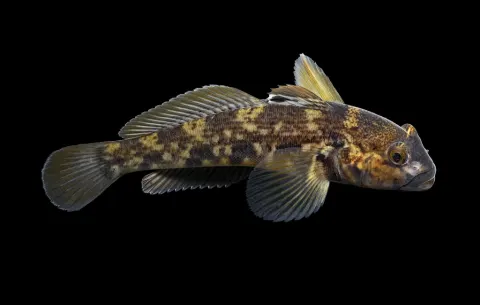
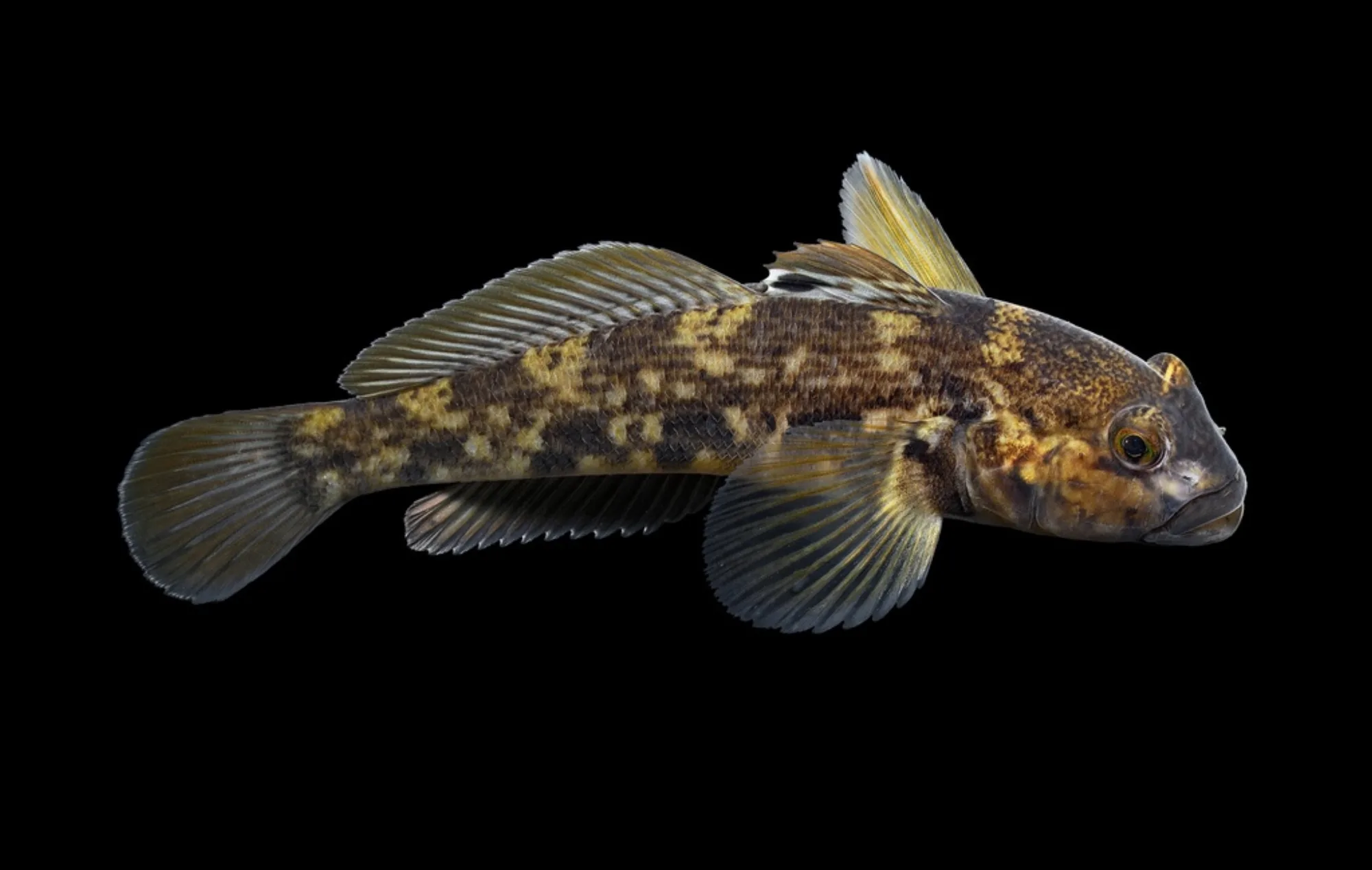
Look for the Round Goby close to the bottom, where its large, slightly protruding eyes and a black spot on its first dorsal fin help distinguish this small, soft-bodied fish. Young fish are grey, while adults develop a mottled pattern of grey, black, brown and olive green. Males are larger than females, and during the spawning season they turn inky black and develop swollen cheeks. Round gobies range from 10 to 25 centimetres in length.
Native to Central Eurasia, including the Black and Caspian seas, the fish also lives in the Sea of Marmara, the Sea of Azov and their associated waters. Beyond its native range, it has established large populations in the Baltic Sea, the Great Lakes of North America and several large rivers across Eurasia. At home in fresh water and the sea, it commonly occupies sandy or rocky bottoms on continental shelves, where there is little silt. It feeds by day and night, and is believed to detect prey while stationary. Its food includes molluscs, crustaceans, worms, insect larvae and other small animals living on the beds of lakes and streams.
In most areas, the spawning season runs from April to September, with each female able to spawn as many as six times. Males move from deeper overwintering waters to shallower breeding grounds, where they guard eggs laid in crevices between rocks. Predatory fish eat round gobies, including burbot in Lake Erie, where predation is a primary control on their population. Parasites also occur in round gobies across their native range and in introduced populations.
Written from the English Wikipedia article Round goby (CC BY-SA 4.0).
- Records
- 33,935
- Countries
- 15
- Atlas places
- 1
These are open occurrence records, so they show where people looked for and recorded the Round Goby as much as where it lives. Cells are up to 25 km across, and every location is generalised to its cell.
Generalised encounter areas, not exact locations. Each shape is a grid cell coloured by how likely the species is there.
- Very likelyUnited States25 km zone · high confidence · 11367 records · updated 80 days ago
- Very likelyFrance25 km zone · high confidence · 10701 records · updated 80 days ago
- Very likelyGermany25 km zone · high confidence · 5741 records · updated 80 days ago
- Very likelyCanada25 km zone · high confidence · 3322 records · updated 80 days ago
- Very likelyFinland25 km zone · medium confidence · 1492 records · updated 80 days ago
- Very likelyNetherlands25 km zone · high confidence · 421 records · updated 80 days ago
- Very likelySweden25 km zone · high confidence · 410 records · updated 80 days ago
- Very likelyLuxembourg25 km zone · high confidence · 93 records · updated 80 days ago
- LikelyBelgium25 km zone · medium confidence · 210 records · updated 80 days ago
- LikelyUkraine25 km zone · medium confidence · 51 records · updated 80 days ago
Conservation status not assessed here yet, so every location is generalised to its grid cell.