Neogale vison
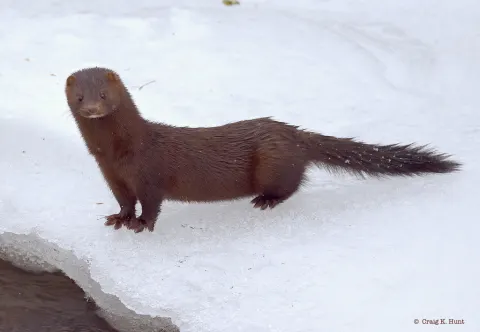
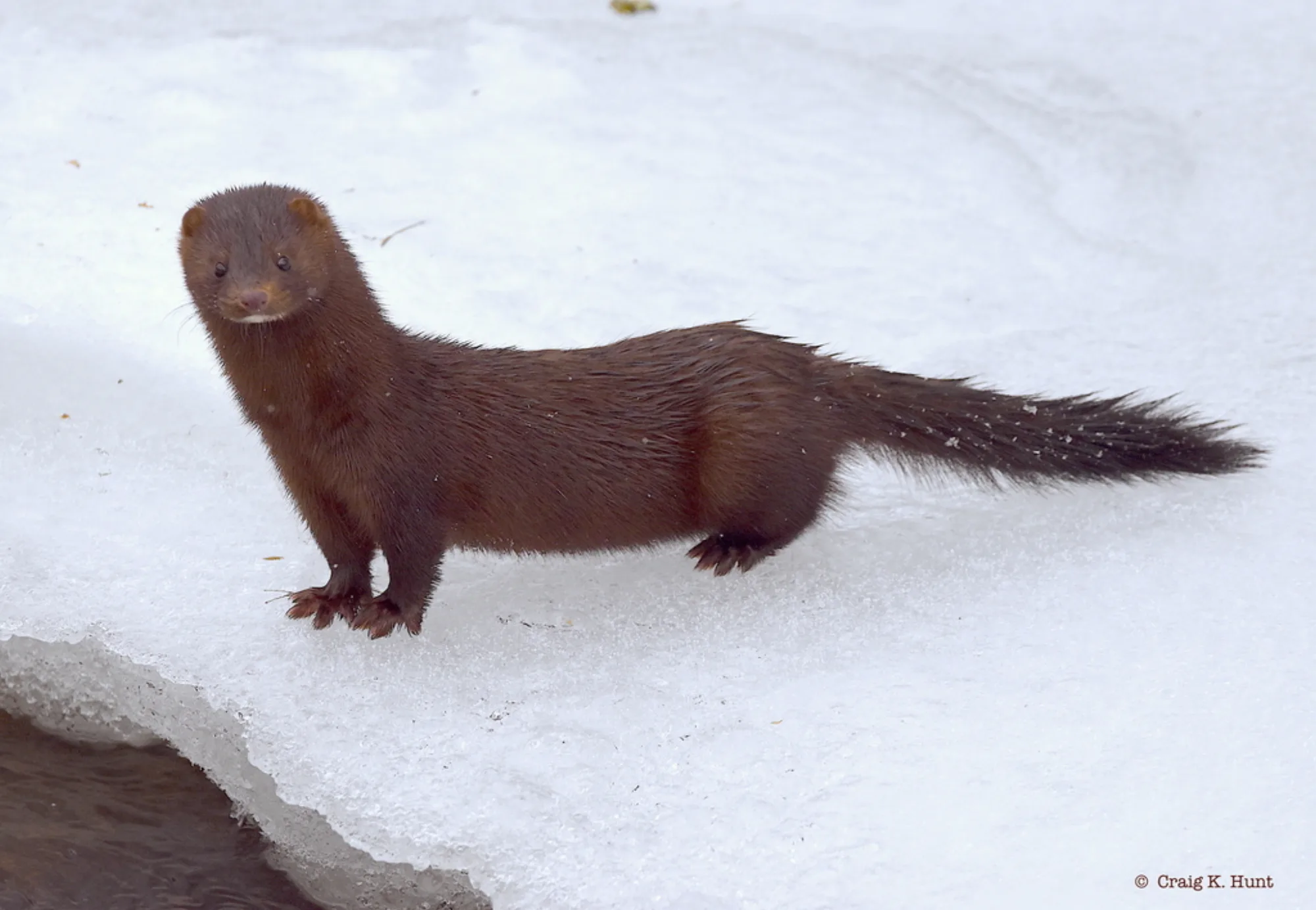
With its long body, bushy tail and dark coat, the American mink, Neogale vison, is built for life beside water. Its winter fur ranges from light tawny to nearly blackish, with a darker tail and a white chin and lower lip. In summer, the coat is shorter, thinner and duller. Broad, webbed feet help distinguish this swimmer, which also climbs trees and bounds across land.
Native to much of North America, the mink has also been introduced to parts of Europe, Asia and South America. Look for suitable habitat along rocky coasts with dense cover, as well as estuaries, rivers and canals, sometimes close to towns. Dens near water can be tucked beneath logs or roots, inside hollow trees, or in riverbank burrows. Mink live alone and defend territories, although the ranges of males and females overlap extensively. They hunt by sight, taking rodents, fish, crustaceans, frogs and birds. Fish are the main prey in the species' native range, while mink in prairie wetlands chiefly hunt frogs, tadpoles and mice.
Young are born between April and June, with an average of four kits per litter. Blind at birth, the kits start hunting after eight weeks and remain close to their mother until autumn. Large birds of prey sometimes hunt mink, and white-tailed eagles in Finland can limit their breeding through predation. In much of Europe, people hunt American mink to manage their effects on wildlife. Escaped domestic mink can also compete with wild mink for territory, leading to injuries and starvation.
Written from the English Wikipedia article American mink (CC BY-SA 4.0).
- Records
- 9,947
- Countries
- 12
- Atlas places
- 1
These are open occurrence records, so they show where people looked for and recorded the Neogale vison as much as where it lives. Cells are up to 25 km across, and every location is generalised to its cell.
Generalised encounter areas, not exact locations. Each shape is a grid cell coloured by how likely the species is there.
- Very likelyNorway25 km zone · medium confidence · 4600 records · updated 80 days ago
- Very likelyUnited Kingdom25 km zone · high confidence · 3103 records · updated 80 days ago
- Very likelyFinland25 km zone · medium confidence · 372 records · updated 80 days ago
- Very likelyFrance25 km zone · medium confidence · 353 records · updated 80 days ago
- Very likelySpain25 km zone · medium confidence · 315 records · updated 80 days ago
- Very likelyChile25 km zone · high confidence · 310 records · updated 80 days ago
- Very likelyArgentina25 km zone · high confidence · 283 records · updated 80 days ago
- Very likelyIreland25 km zone · medium confidence · 199 records · updated 80 days ago
- Very likelyUnited States25 km zone · medium confidence · 153 records · updated 80 days ago
- Very likelyCanada25 km zone · medium confidence · 132 records · updated 80 days ago
Conservation status not assessed here yet, so every location is generalised to its grid cell.