Neogale frenata
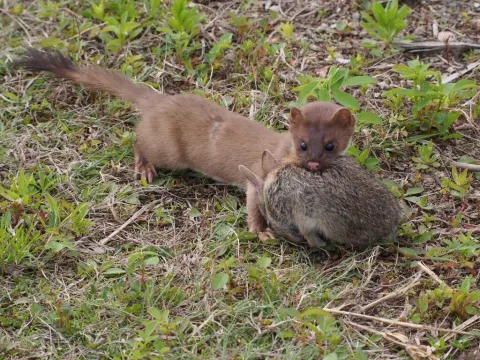
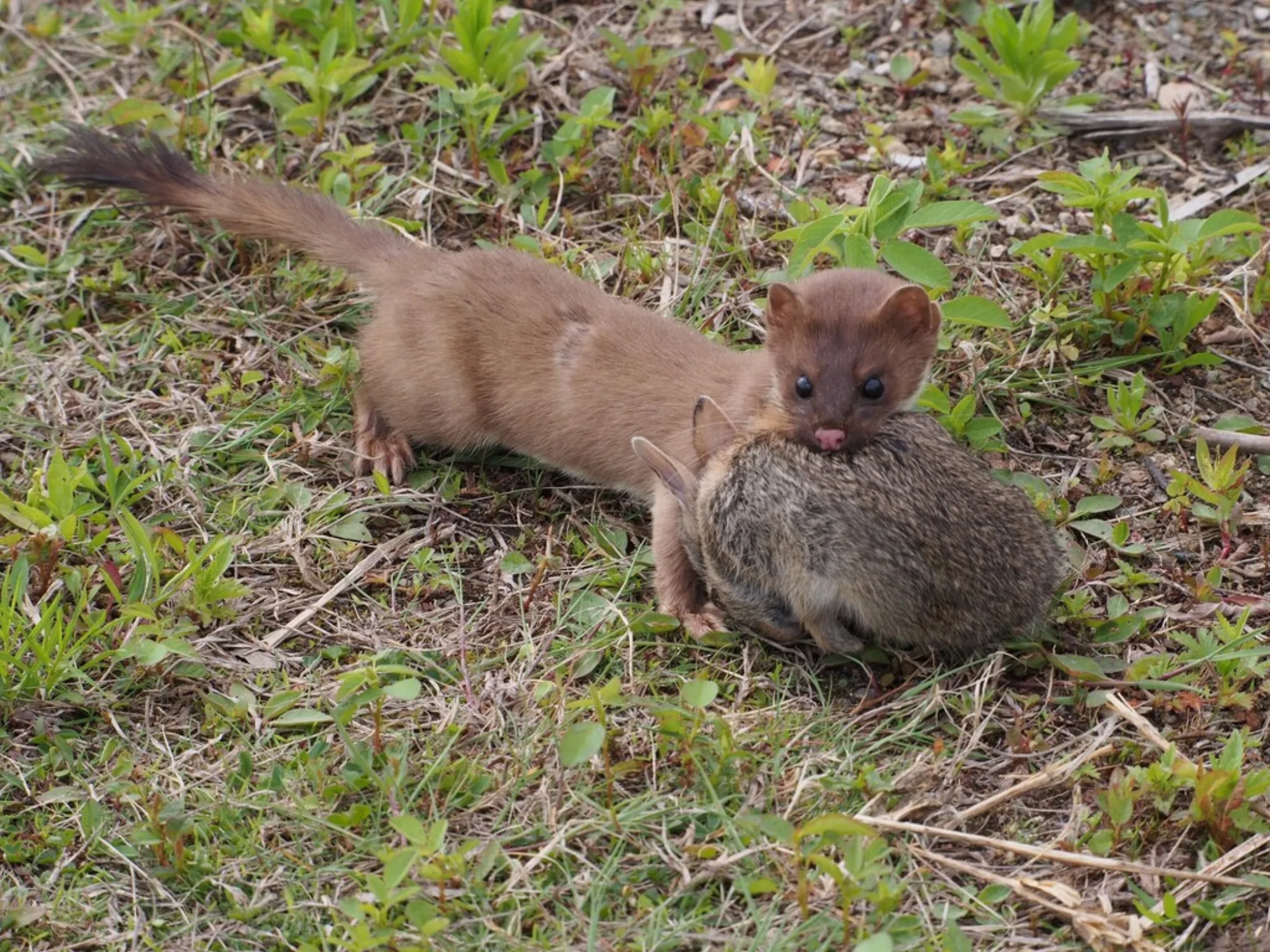
The long-tailed weasel, Neogale frenata, has a slender, elongated body and a black tip to its tail. In summer its back and sides are brown, while its belly is yellowish white. In northern areas its coat turns white in winter, sometimes with a yellow tint, but the tail keeps its black tip. Some individuals in Florida and the southwestern US have white or yellowish facial markings. Its tracks can offer clues: usually only four toes show, although all five may be visible in snow or mud. A tail can also leave wavy marks in snow.
The species ranges from southern Canada to central Bolivia, including the United States, Mexico and Central America. It favours open forests, wooded areas and shrublands, where cover helps it live and hunt. Forest patches, fencerows and drainage ditches are favoured, while agricultural fields are avoided. Usually solitary, it dens in burrows, under stumps or beneath rock piles, often using holes abandoned by other mammals. Its prey includes rabbits and small mammals such as mice, shrews and squirrels; it also sometimes eats birds, eggs, reptiles, amphibians, fish, earthworms and insects. When stalking, it moves its head from side to side to pick up a scent. Litters generally contain 5 to 8 kits, born in April or May. The young accompany their mother on hunting trips and are fully grown by autumn, when the family separates. Foxes, coyotes, bobcats, owls, hawks and snakes are among its predators. Habitat fragmentation is also a concern, as the weasel avoids farmland.
Written from the English Wikipedia article Long-tailed weasel (CC BY-SA 4.0).
- Records
- 430
- Countries
- 5
- Atlas places
- 9
- Rocky Mountain National Park· United States
- Grand Teton National Park· United States
- Yellowstone National Park· United States
- Yosemite National Park· United States
- Glacier National Park· United States
- Olympic National Park· United States
- Redwood National and State Parks· United States
- Sequoia National Park· United States
- Zion National Park· United States
These are open occurrence records, so they show where people looked for and recorded the Neogale frenata as much as where it lives. Cells are up to 25 km across, and every location is generalised to its cell.
Generalised encounter areas, not exact locations. Each shape is a grid cell coloured by how likely the species is there.
- Very likelyUnited States25 km zone · medium confidence · 303 records · updated 80 days ago
- Very likelyCanada25 km zone · medium confidence · 62 records · updated 80 days ago
- Very likelyMexico25 km zone · medium confidence · 49 records · updated 80 days ago
- Very likelyColombia25 km zone · medium confidence · 13 records · updated 80 days ago
- Very likelyPeru25 km zone · medium confidence · 3 records · updated 80 days ago
Conservation status not assessed here yet, so every location is generalised to its grid cell.