Clouded Leopard
Neofelis nebulosa
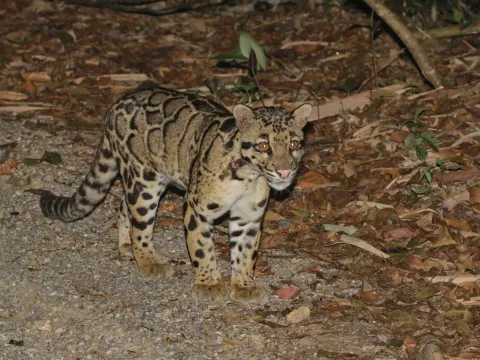
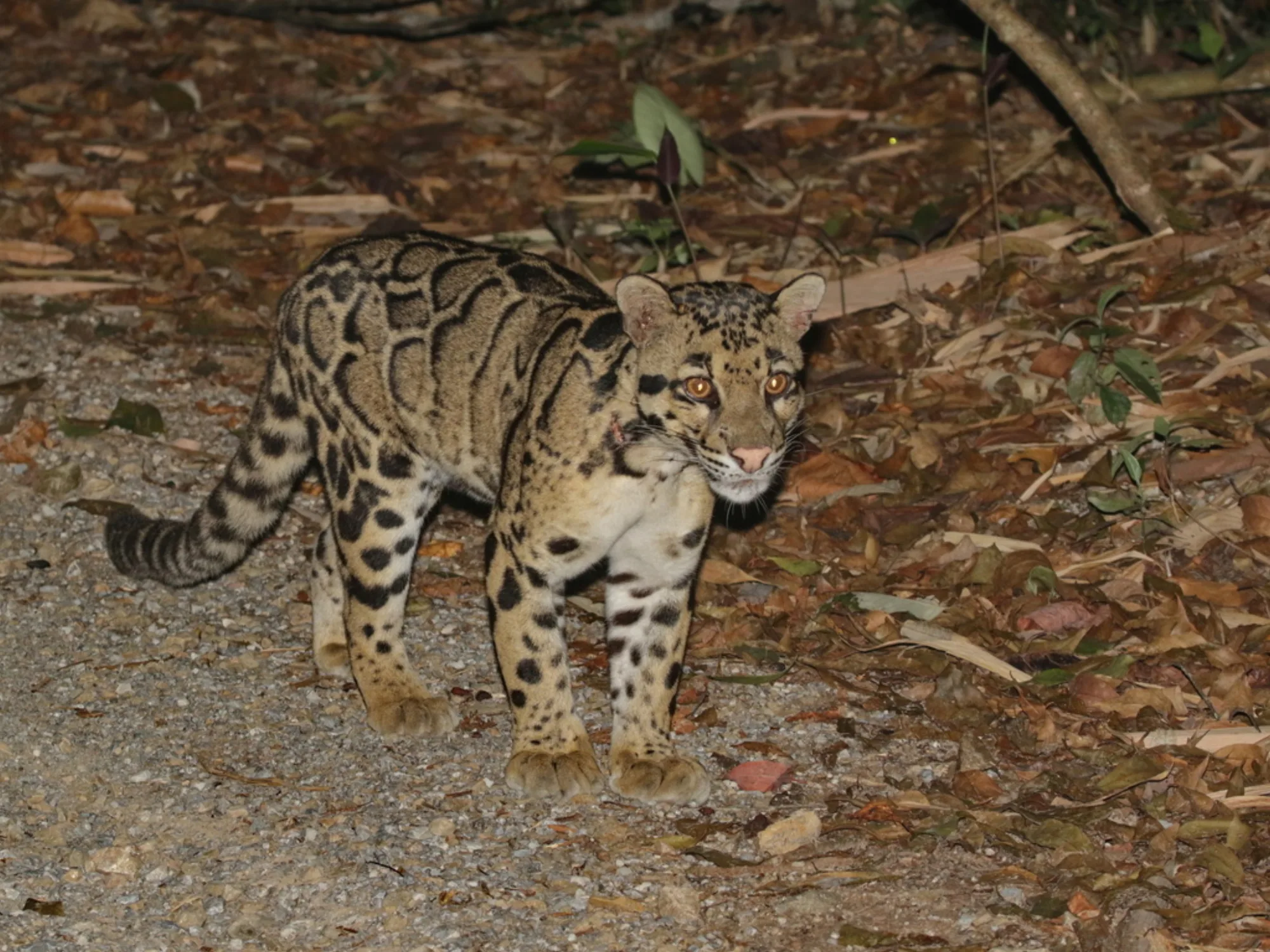
Dusky, cloud-like blotches give the Clouded Leopard its name and make this wild cat distinctive among the forests of mainland Asia. Its coat can be dark grey or ochre, with black spots on the head, black ears and irregular markings along the flanks. Short, sturdy legs and broad paws support its life among trees, while a long tail helps it balance as it moves through the branches. Adults weigh 11.5 to 23 kg, and females are slightly smaller than males.
Its range extends from the Himalayan foothills through parts of South and Southeast Asia to southern China. Although associated with dense forest, it has also been recorded in habitats ranging from relatively open, dry tropical forest to evergreen and deciduous forests. The cat has disappeared from both Singapore and Taiwan. Solitary and secretive, the cat rests in trees by day and hunts on the ground at night. It can descend a vertical trunk head first, and after feeding it usually returns to the trees to rest and digest. It stalks prey or waits for an animal to approach, taking creatures that live both in trees and on the ground. Recorded prey includes macaques, deer, porcupines, pangolins and pheasants.
A female can have one litter a year, usually of three cubs, though litters range from one to five. The cubs become independent at around 10 months, and the male takes no part in raising them. Large areas of intact forest are important for the species, but deforestation is destroying habitat. Commercial poaching for the wildlife trade is another threat, with body parts sold for decoration and clothing.
Written from the English Wikipedia article Clouded leopard (CC BY-SA 4.0).
- Records
- 6
- Countries
- 2
No atlas park has a record of the Clouded Leopard in or around it yet.
These are open occurrence records, so they show where people looked for and recorded the Clouded Leopard as much as where it lives. Cells are up to 25 km across, and every location is generalised to its cell.
Generalised encounter areas, not exact locations. Each shape is a grid cell coloured by how likely the species is there.
- Very likelyUnited States25 km zone · medium confidence · 6 records · updated 80 days ago
- LikelyCambodia25 km zone · low confidence · 0 records · updated 80 days ago
Conservation status not assessed here yet, so every location is generalised to its grid cell.