Sunda Clouded Leopard
Neofelis diardi
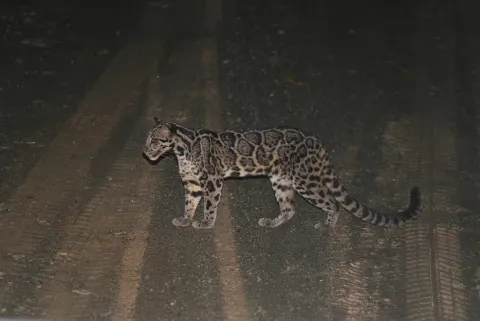
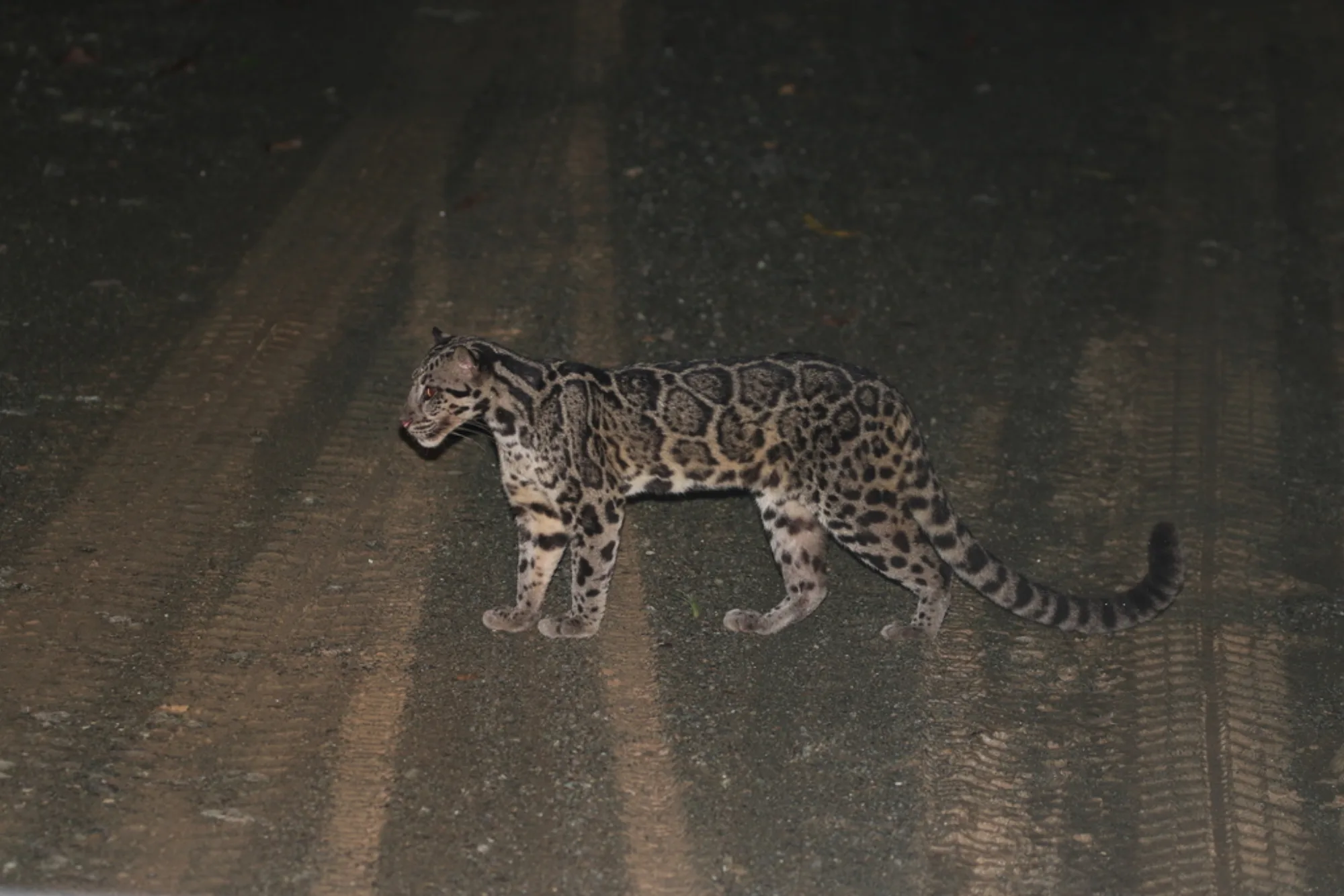
This medium-sized wild cat is found only on the islands of Borneo and Sumatra. Weighing between 12 and 26 kg, the Sunda clouded leopard is recognizable by its stocky frame and a coat that ranges from gray to grayish yellow. Its fur features a double midline along the back and small, irregular cloud-like patterns on the shoulders. These markings often contain spots and are smaller than those of its mainland relatives. Notably, its tail can be as long as its entire body to help it stay balanced, and its 2 in canine teeth are longer in proportion to its skull than those of any other living cat.
In Borneo, the animal inhabits lowland rainforests and logged forests, while in Sumatra it is more common in hilly, montane regions. Because of its secretive nature, much of its life remains a mystery, though it is believed to be a solitary creature. While it is a skilled climber that uses trees to hide from danger, it primarily hunts on the ground. Its diet is varied, consisting of sambar deer, muntjacs, mouse deer, porcupines, bearded pigs, and primates.
Survival for this species is increasingly difficult due to the destruction of its forest home. On both islands, deforestation for human settlement and agriculture has fragmented the habitat. In Borneo, forest fires and illegal logging further reduce the available space. The cats also face pressure from the illegal wildlife trade. Poachers target them for their pelts, claws, and teeth, while some live individuals are captured for international buyers.
Written from the English Wikipedia article Sunda clouded leopard (CC BY-SA 4.0).
- Atlas places
- 0
These are open occurrence records, so they show where people looked for and recorded the Sunda Clouded Leopard as much as where it lives. Cells are up to 25 km across, and every location is generalised to its cell.
No encounter zones yet
Where and when you can expect to see Sunda Clouded Leopard is calculated from observation density. No zones have been computed for this species yet.