Lemon Shark
Negaprion brevirostris
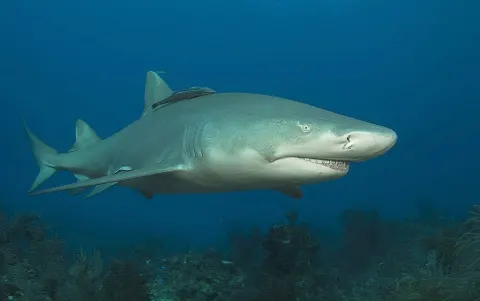
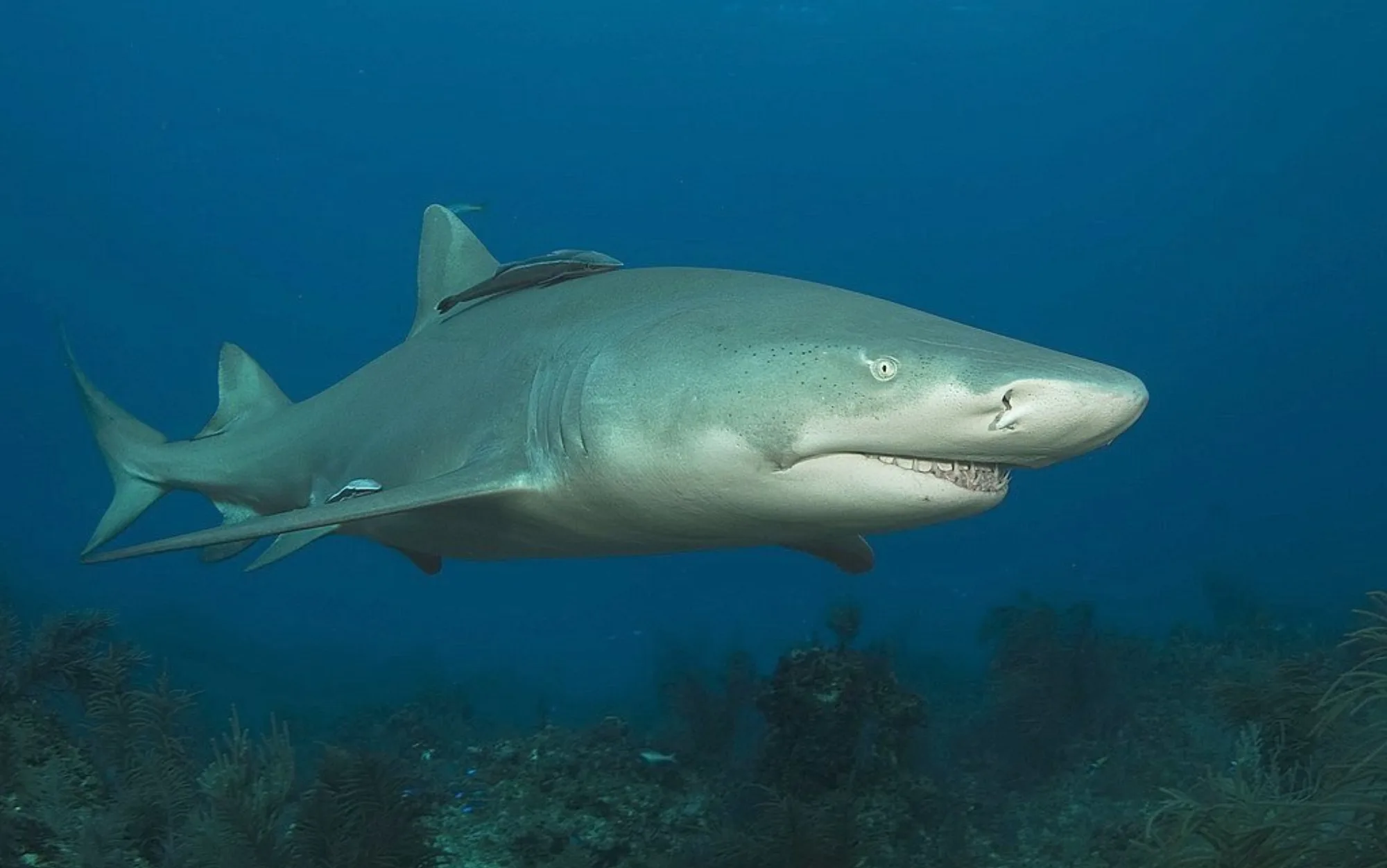
Yellowish skin gives the Lemon Shark its name and helps it blend with sand on the coastal seabed. It has a flattened head, a short, broad snout and two dorsal fins of almost equal size. Adults commonly reach 2.4 to 3.1 m long, although the largest recorded specimen measured 3.43 m. The similarly sized dorsal fins can help distinguish it from a bull shark.
Lemon sharks live in the tropical western Atlantic from New Jersey to southern Brazil and off west Africa; their eastern Pacific range extends from southern Baja California to Ecuador. They have also been found at Sal Island in Cape Verde. They favour warm, shallow water over sand or rock, including mangroves and coral reefs, as well as river mouths and sheltered bays. In the open ocean, they have been recorded as deep as 92 m, and generally enter open water during migrations. Young sharks may spend several years in shallow nursery areas before moving into deeper water.
These sharks often feed at night, using sensors that detect electrical pulses from potential prey. Fish make up most of their diet, but they also take crustaceans, smaller sharks, stingrays, molluscs and birds. They tend to stalk slower prey and select animals that are more abundant and available. Lemon sharks live in groups or loose gatherings, often with others of a similar size. Females return to shallow nursery waters to give birth to live pups, and breed on a two-year cycle. Overfishing is the main threat: commercial and recreational fishers target lemon sharks for their meat, fins and skin.
Written from the English Wikipedia article Lemon shark (CC BY-SA 4.0).
- Records
- 223
- Countries
- 10
- Atlas places
- 2
These are open occurrence records, so they show where people looked for and recorded the Lemon Shark as much as where it lives. Cells are up to 25 km across, and every location is generalised to its cell.
Generalised encounter areas, not exact locations. Each shape is a grid cell coloured by how likely the species is there.
- Very likelyUnited States25 km zone · medium confidence · 151 records · updated 80 days ago
- Very likelyMexico25 km zone · medium confidence · 35 records · updated 80 days ago
- Very likelyBrazil25 km zone · medium confidence · 18 records · updated 80 days ago
- Very likelyCape Verde25 km zone · medium confidence · 10 records · updated 80 days ago
- Very likelyGuadeloupe25 km zone · medium confidence · 6 records · updated 80 days ago
- LikelyBahamas25 km zone · medium confidence · 3 records · updated 80 days ago
- LikelyFrench Polynesia25 km zone · low confidence · 0 records · updated 80 days ago
- UncommonTurks & Caicos Islands25 km zone · low confidence · 0 records · updated 80 days ago
- RareAruba25 km zone · low confidence · 0 records · updated 80 days ago
- RareU.S. Virgin Islands25 km zone · low confidence · 0 records · updated 80 days ago
Conservation status not assessed here yet, so every location is generalised to its grid cell.