Mudpuppy
Necturus maculosus
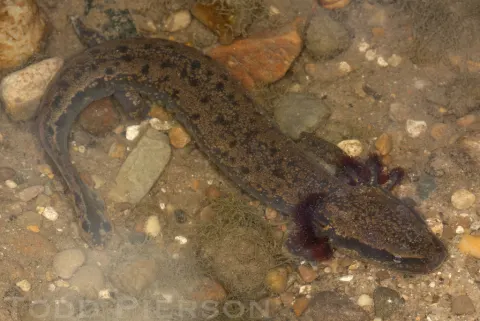
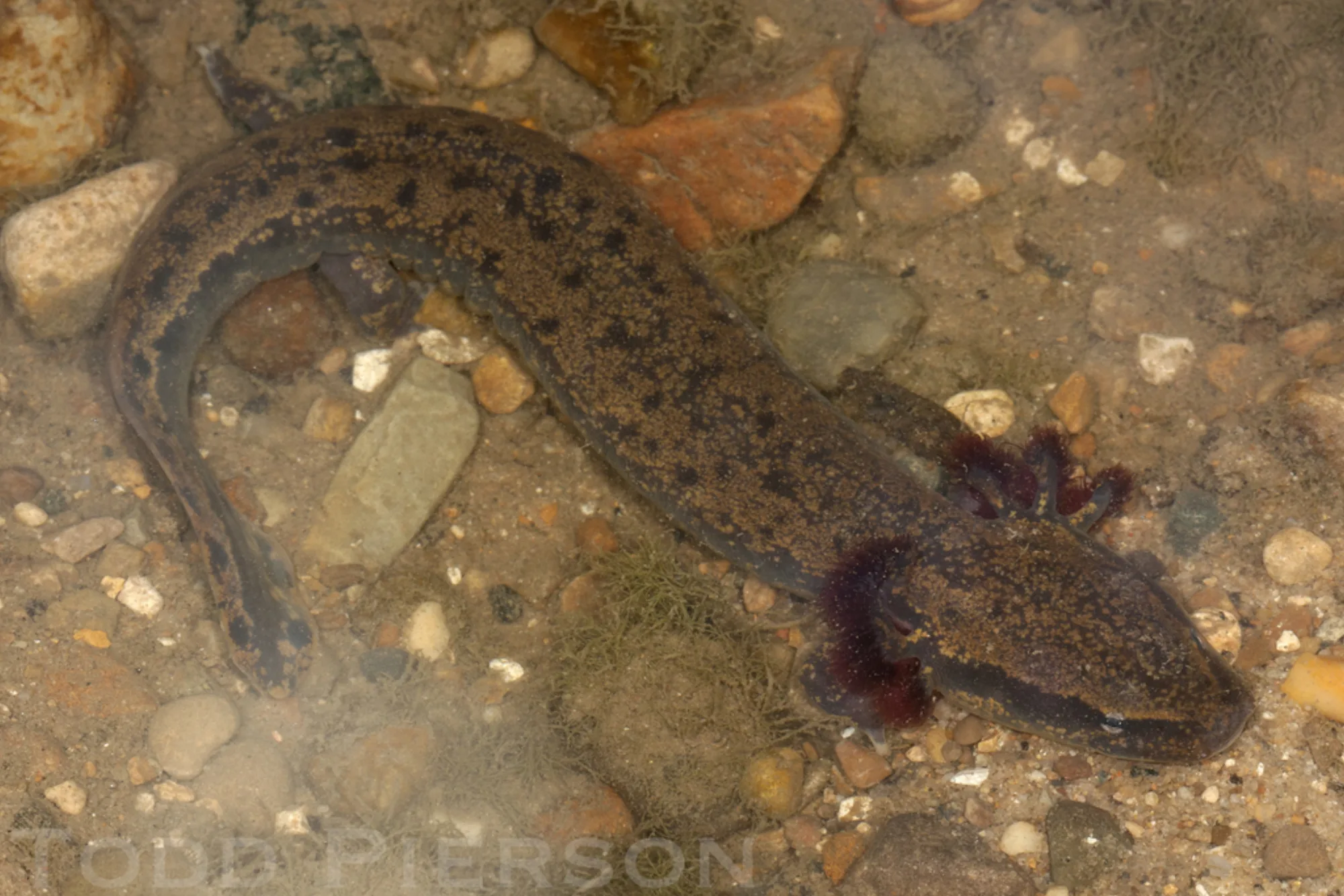
At home entirely underwater, the Mudpuppy is a North American salamander with feathery external gills and small, flattened limbs. Its colouring is usually rusty brown, sometimes mixed with grey and black, and it typically has blackish-blue spots. Adults average 33 cm in length, although specimens as long as 43.5 cm have been reported. Its gills are larger in still water and smaller in running streams.
Mudpuppies live in lakes, ponds and streams across eastern North America, from southern Canada to Georgia and west to the Midwest United States. An introduced population also lives in Maine. Shy and largely nocturnal, they shelter beneath rocks, logs and other underwater debris, though muddy water can bring them out during the day. They can live beneath the ice when lakes freeze and have been reported at depths of approximately 30 metres, although they tend to favour shallower water. On the bottom of a stream or pond, they walk slowly on their short limbs or make brief bursts of swimming.
These carnivores eat a wide range of prey, including insects, molluscs, crayfish, small fish, amphibians and earthworms. Their diet changes with the seasons: fish have been found in their stomachs in spring and winter, while summer and autumn contents have consisted only of invertebrates. Mating usually takes place in autumn, followed by egg laying in spring, often beneath a rock or log. A female lays an average of 60 eggs and stays with them during the roughly 40-day incubation period. Habitat degradation and chemical pollutants are contributing to population declines, while fish, crayfish, turtles and water snakes also prey on mudpuppies.
Written from the English Wikipedia article Common mudpuppy (CC BY-SA 4.0).
- Records
- 121
- Countries
- 2
- Atlas places
- 2
These are open occurrence records, so they show where people looked for and recorded the Mudpuppy as much as where it lives. Cells are up to 25 km across, and every location is generalised to its cell.
Generalised encounter areas, not exact locations. Each shape is a grid cell coloured by how likely the species is there.
- Very likelyCanada25 km zone · medium confidence · 61 records · updated 80 days ago
- Very likelyUnited States25 km zone · medium confidence · 60 records · updated 80 days ago
Conservation status not assessed here yet, so every location is generalised to its grid cell.