Hooded Vulture
Necrosyrtes monachus
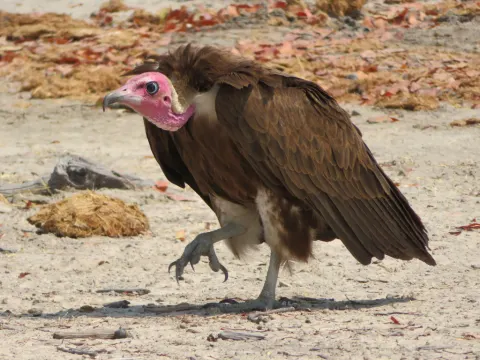
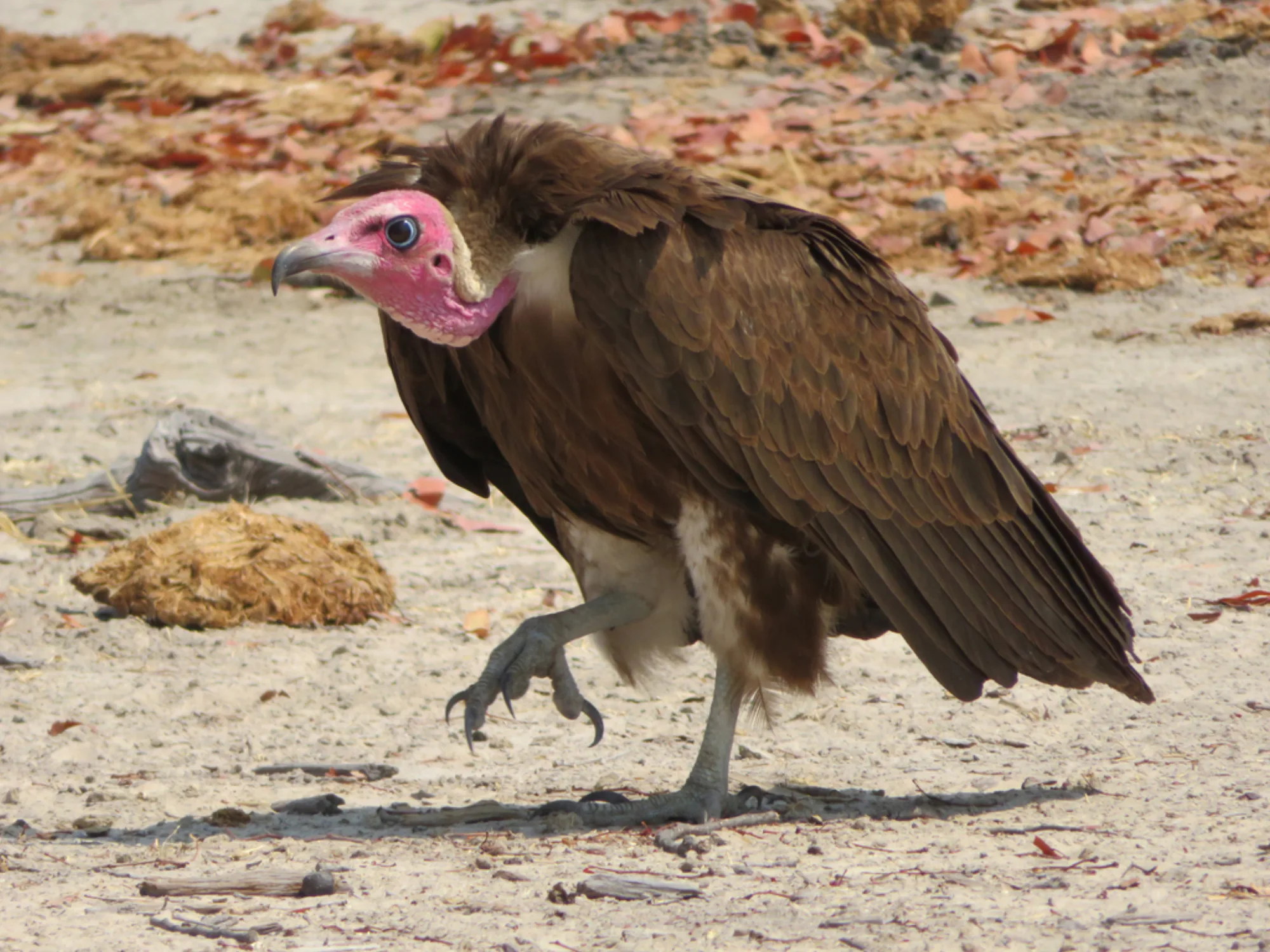
A small, scruffy scavenger with broad soaring wings, the Hooded Vulture has dark brown plumage and a long, thin bill. Its bare face is usually light red, while downy feathers cover the back of its neck. The head can flush red when the bird is agitated, and its short tail helps distinguish its outline. Adults of both sexes look alike, while juveniles are darker and plainer, with a purplish sheen to their body feathers.
Native to sub-Saharan Africa, this vulture ranges through parts of West, East and southern Africa. It occurs in habitats from open grassland and wooded savanna to forest edges, deserts and coasts. It soars over savanna and human settlements in search of animal carcasses and waste, including at rubbish tips and abattoirs. It also eats insects, gathering in large numbers when termites emerge. In West Africa, birds often forage in flocks, whereas in southern Africa they are usually solitary and secretive. Generally unafraid of people, they frequently gather around settlements. Most remain close to home, rarely travelling more than 200 km.
Breeding takes place during the dry summer season, with a single egg laid in a stick nest in a tree. Birds favour leafy trees beside watercourses, though they also nest in regions where tall trees are scarce. The egg takes 46-54 days to hatch, and the young bird fledges after 80-130 days. Poisoning has a major impact, including when vultures feed on animals killed by poison intended for other species. Hunting for traditional uses and food, habitat loss, and collisions with electricity infrastructure also threaten the birds.
Written from the English Wikipedia article Hooded vulture (CC BY-SA 4.0).
- Records
- 47,383
- Countries
- 22
- Atlas places
- 29
- Kruger National Park· South Africa
- Okavango Delta· Botswana
- Serengeti National Park· Tanzania
- Ngorongoro Conservation Area· Tanzania
- Chobe National Park· Botswana
- Maasai Mara National Reserve· Kenya
- Volcanoes National Park· Rwanda
- Hwange National Park· Zimbabwe
- South Luangwa National Park· Zambia
- Lower Zambezi National Park· Zambia
- Mana Pools National Park· Zimbabwe
- Samburu National Reserve· Kenya
- Zambezi National Park· Zimbabwe
- Nkasa Rupara National Park· Namibia
- Queen Elizabeth National Park· Uganda
- Ruaha National Park· Tanzania
- Tarangire National Park· Tanzania
- Aberdare National Park· Kenya
- Bwabwata National Park· Namibia
- Gonarezhou National Park· Zimbabwe
- iSimangaliso Wetland Park· South Africa
- Kidepo Valley National Park· Uganda
- Lake Manyara National Park· Tanzania
- Lake Mburo National Park· Uganda
- Mikumi National Park· Tanzania
- Mount Kenya National Park· Kenya
- Murchison Falls National Park· Uganda
- Nyerere National Park· Tanzania
- Udzungwa Mountains National Park· Tanzania
These are open occurrence records, so they show where people looked for and recorded the Hooded Vulture as much as where it lives. Cells are up to 25 km across, and every location is generalised to its cell.
Generalised encounter areas, not exact locations. Each shape is a grid cell coloured by how likely the species is there.
- Very likelySouth Africa25 km zone · high confidence · 12504 records · updated 80 days ago
- Very likelyGambia25 km zone · high confidence · 8286 records · updated 80 days ago
- Very likelyEthiopia25 km zone · high confidence · 5180 records · updated 80 days ago
- Very likelyZimbabwe25 km zone · high confidence · 3612 records · updated 80 days ago
- Very likelyKenya25 km zone · high confidence · 2660 records · updated 80 days ago
- Very likelyUganda25 km zone · high confidence · 2603 records · updated 80 days ago
- Very likelyGhana25 km zone · high confidence · 2589 records · updated 80 days ago
- Very likelySenegal25 km zone · high confidence · 2519 records · updated 80 days ago
- Very likelyTanzania25 km zone · high confidence · 2072 records · updated 80 days ago
- Very likelyBotswana25 km zone · high confidence · 1157 records · updated 80 days ago
Conservation status not assessed here yet, so every location is generalised to its grid cell.