Grass Snake
Natrix natrix
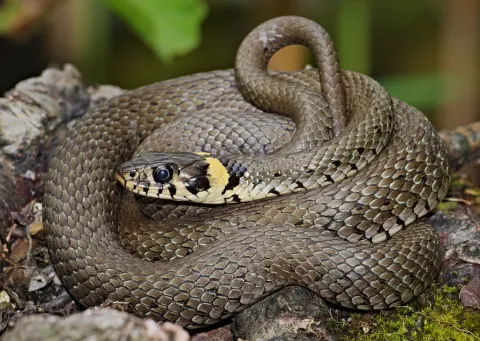
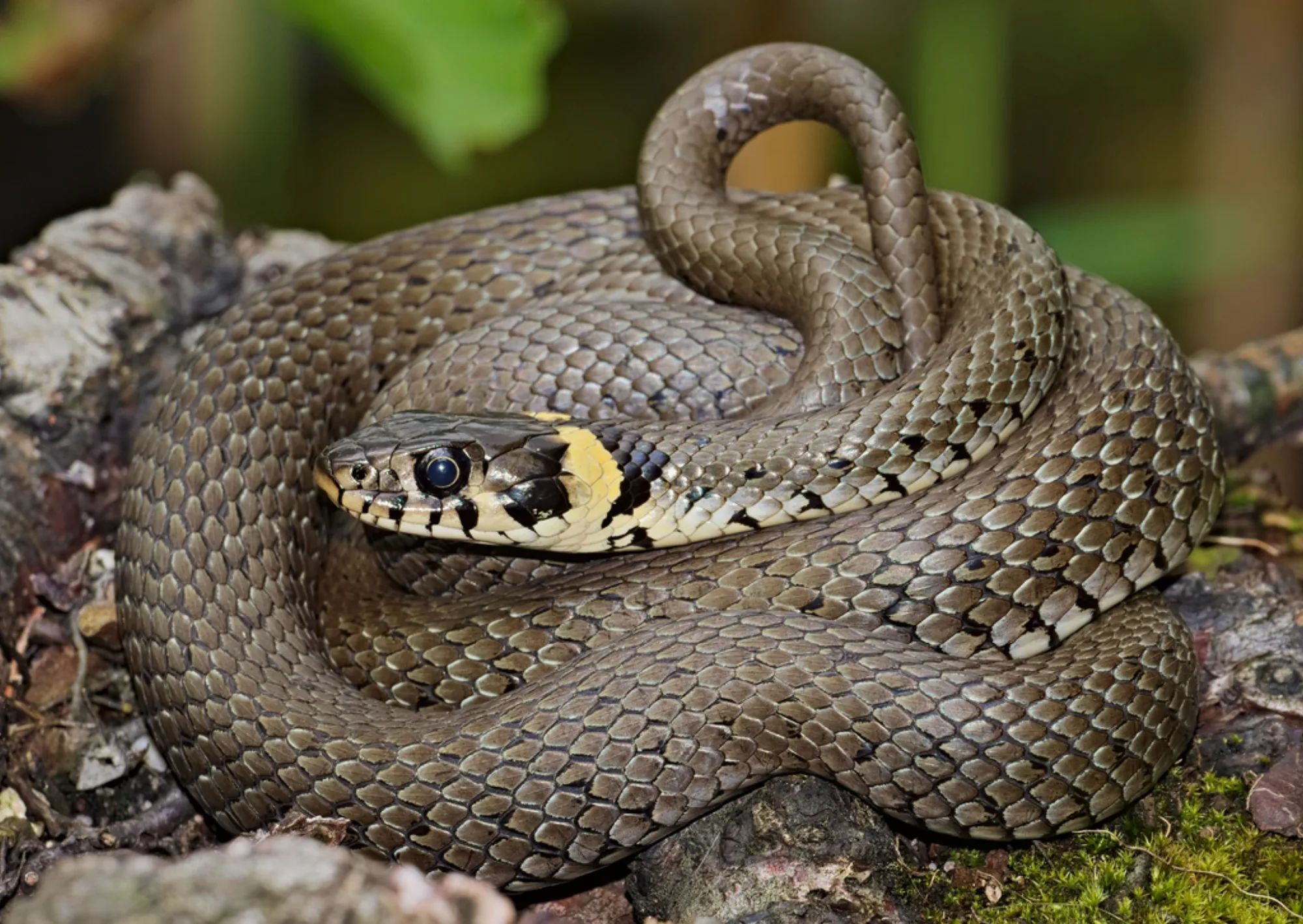
Often found close to water, the Grass Snake is a non-venomous, semi-aquatic snake with a wide Eurasian range. It is usually dark green or brown, with a yellow or white collar just behind its head, though its colour can vary from grey to black. The whitish underside has irregular black markings, another useful clue when identifying it. It can reach 1 m or more in length.
On mainland Europe, it ranges from mid Scandinavia to southern Italy, and it also occurs in the Middle East and northwestern Africa. Open woodland, field margins and woodland borders are favoured habitats, offering shelter as well as places to bask. Pond edges are another good place to look for this elusive snake, which is a strong swimmer. It hunts actively, often along the water's edge, using sight and smell to find prey. Amphibians make up most of its diet, especially common frogs and common toads, although it occasionally eats ants and larvae. After a large meal, it may remain in one place, basking while it digests its prey.
Grass snakes usually spend winter underground, where temperatures remain relatively stable and do not fall below freezing. As spring nears, males come out before females and bask for much of the day. Females lay batches of 8 to 40 leathery eggs between June and July, favouring rotting vegetation such as compost heaps. The eggs hatch after around 10 weeks, and the young are immediately independent. Predators include corvids, storks, owls, foxes and domestic cats. When threatened, the snake may play dead, release a garlic-smelling fluid or hiss and strike with its mouth closed.
Written from the English Wikipedia article Grass snake (CC BY-SA 4.0).
- Records
- 20,242
- Countries
- 16
No atlas park has a record of the Grass Snake in or around it yet.
These are open occurrence records, so they show where people looked for and recorded the Grass Snake as much as where it lives. Cells are up to 25 km across, and every location is generalised to its cell.
Generalised encounter areas, not exact locations. Each shape is a grid cell coloured by how likely the species is there.
- Very likelyFrance25 km zone · high confidence · 6448 records · updated 80 days ago
- Very likelyDenmark25 km zone · high confidence · 3082 records · updated 80 days ago
- Very likelyNorway25 km zone · high confidence · 2920 records · updated 80 days ago
- Very likelyFinland25 km zone · medium confidence · 2780 records · updated 80 days ago
- Very likelyAustria25 km zone · high confidence · 1293 records · updated 80 days ago
- Very likelySerbia25 km zone · high confidence · 1186 records · updated 80 days ago
- Very likelyGermany25 km zone · high confidence · 873 records · updated 80 days ago
- Very likelyNetherlands25 km zone · high confidence · 595 records · updated 80 days ago
- Very likelyUnited Kingdom25 km zone · high confidence · 498 records · updated 80 days ago
- Very likelyPoland25 km zone · high confidence · 187 records · updated 80 days ago
Conservation status not assessed here yet, so every location is generalised to its grid cell.