Banded Grass Snake
Natrix helvetica
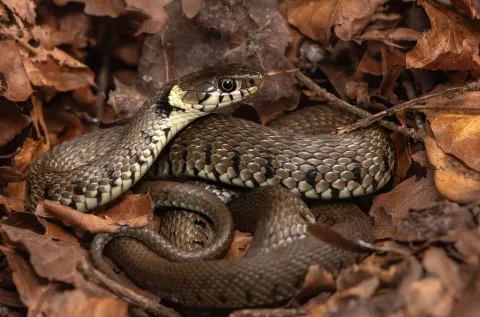
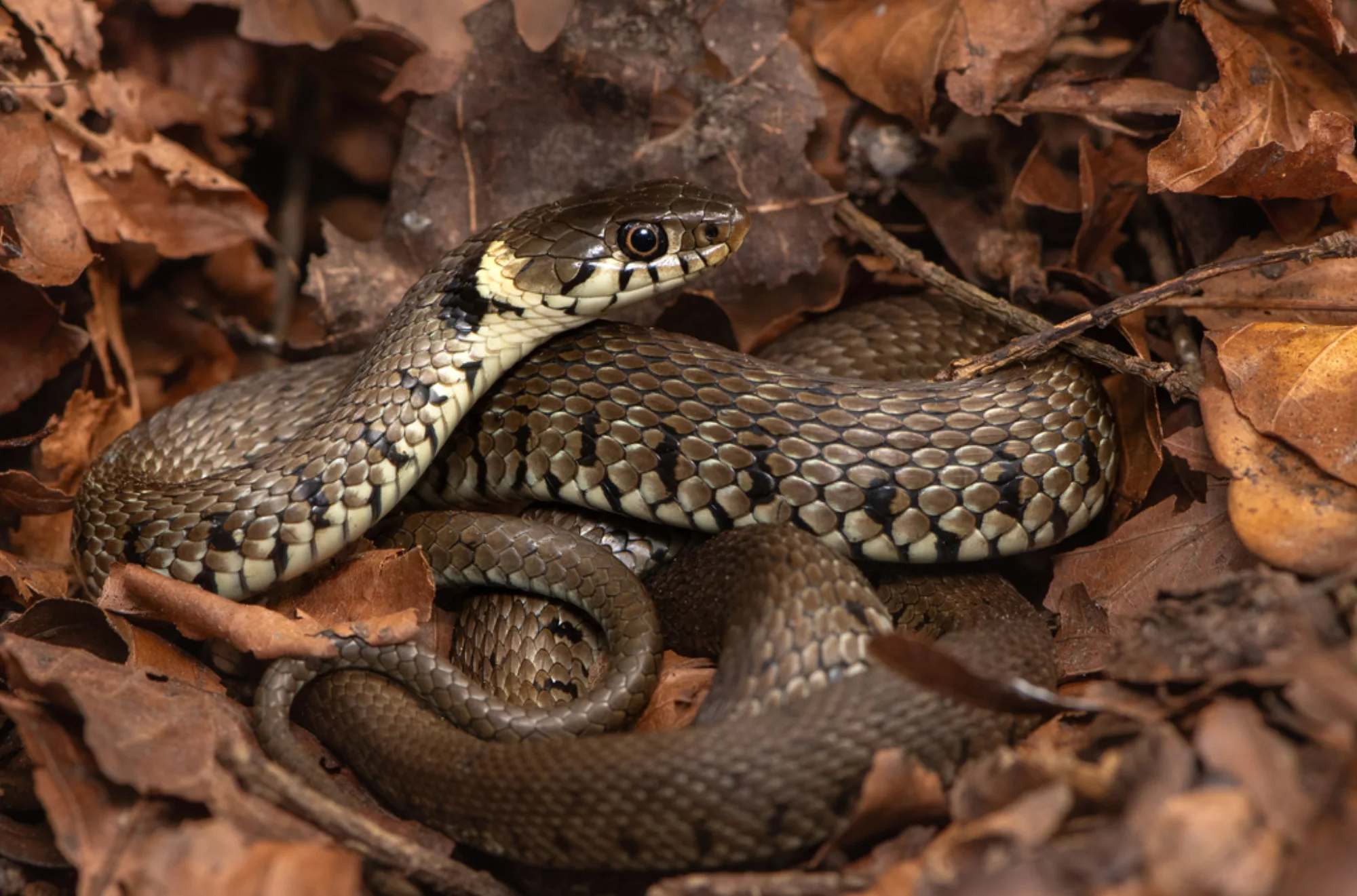
Dark bars along a grey-green back and sides help distinguish the Banded Grass Snake, Natrix helvetica. This non-venomous snake has a pale underside and a yellow and black collar around its neck, and can grow to over a metre long. Its Western European range includes France, Italy, Switzerland, western Germany and the Netherlands, as well as Britain north to southern Scotland.
A strong swimmer, it is often found near freshwater, although individuals do not always need water throughout the season. Look for it around pond edges, in open woodland and along the edges of fields and woods, where it can find shelter and bask. It also inhabits gardens, parks and dry grasslands. The snake searches actively for live prey, often at the water's edge, taking mainly amphibians, especially common frogs and common toads. Fish, small land mammals and nestling birds are also on its menu. After a large meal, it may stay in one place and bask until digestion is complete.
During the coldest months, it typically hibernates underground, sometimes from October until April. Males emerge first in spring and spend much of the day basking. Females lay batches of eight to 40 leathery eggs between June and July, favouring rotting vegetation such as compost heaps. The young hatch after around 10 weeks and are immediately independent. When threatened, the snake may hiss, strike with its mouth closed or feign death, sometimes releasing a garlic-smelling fluid. Predators include owls, storks, foxes and domestic cats. In Great Britain, the snake is legally protected against killing, harm and other forms of taking or trade without a valid licence.
Written from the English Wikipedia article Barred grass snake (CC BY-SA 4.0).
- Records
- 13,927
- Countries
- 7
No atlas park has a record of the Banded Grass Snake in or around it yet.
These are open occurrence records, so they show where people looked for and recorded the Banded Grass Snake as much as where it lives. Cells are up to 25 km across, and every location is generalised to its cell.
Generalised encounter areas, not exact locations. Each shape is a grid cell coloured by how likely the species is there.
- Very likelyFrance25 km zone · high confidence · 7010 records · updated 80 days ago
- Very likelyUnited Kingdom25 km zone · high confidence · 6340 records · updated 80 days ago
- Very likelyGermany25 km zone · medium confidence · 258 records · updated 80 days ago
- Very likelySwitzerland25 km zone · high confidence · 245 records · updated 80 days ago
- Very likelyLuxembourg25 km zone · medium confidence · 40 records · updated 80 days ago
- Very likelyItaly25 km zone · medium confidence · 34 records · updated 80 days ago
Conservation status not assessed here yet, so every location is generalised to its grid cell.