Flatback Turtle
Natator depressus
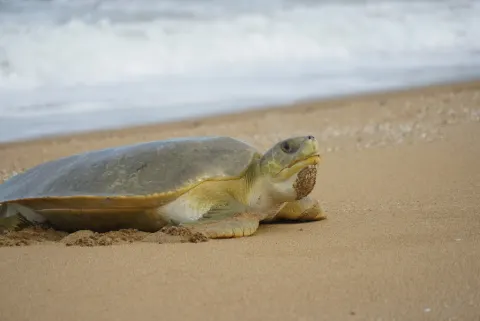
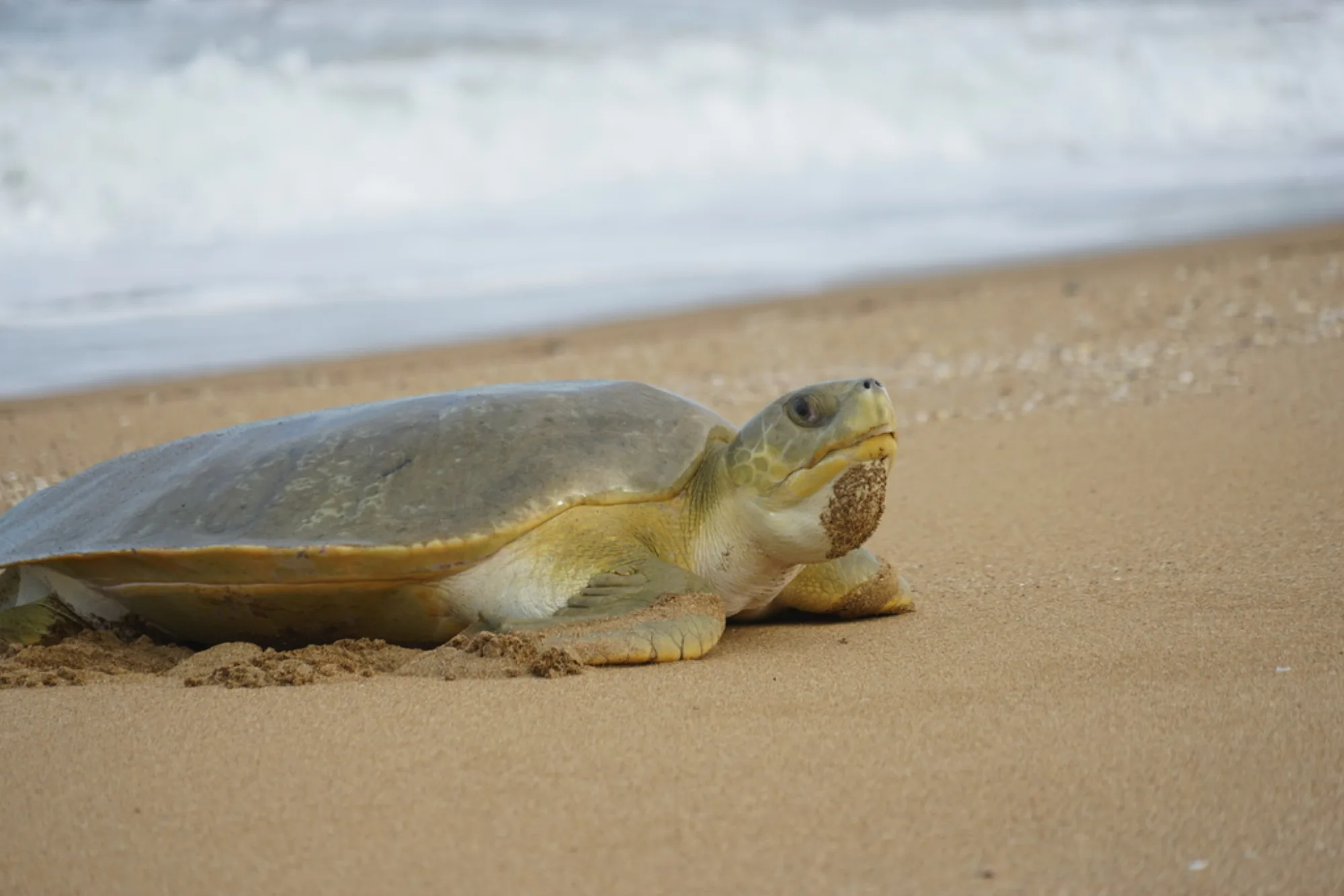
With a smooth, low-domed shell and edges that turn upwards at the sides, the Flatback Turtle (Natator depressus) has a distinctive profile among sea turtles. Its shell and head range from olive green to grey-green, while its underside is cream to pale yellow. Adults average 76 to 96 cm in shell length and 70 to 90 kg in weight, with females larger than males.
Flatbacks live in tropical coastal waters around northern Australia, Papua New Guinea and Indonesia, generally at depths of 60 m or less. They favour shallow, soft-bottomed waters on the Australian continental shelf, including bays, lagoons, estuaries and grassy areas. They do not make the long open-ocean migrations seen in other sea turtles. Their diet consists mostly of animals found in shallow water, including jellyfish, shrimp, sea cucumbers and soft corals, though they occasionally eat seagrass. Females nest on sandy Australian beaches, returning to the same beach for later clutches and nesting seasons. A female typically nests every two to three years and lays about three clutches in a season, each averaging approximately 50 eggs. Hatchlings stay close to shore, feeding first on plankton near the surface before moving to soft-bottomed habitats as they grow.
On land, dingoes, foxes, feral dogs and pigs prey on flatbacks, while sharks and saltwater crocodiles take adults. Coastal development can destroy nesting beaches and feeding sites or block access to them, and vehicle tracks can trap hatchlings making their way to the sea. Turtles are also caught incidentally in fishing gear, while eggs and meat are harvested for traditional use. Rising seas and more frequent or intense tropical storms may destroy nests or entire nesting sites.
Written from the English Wikipedia article Flatback sea turtle (CC BY-SA 4.0).
- Records
- 3,407
- Countries
- 1
- Atlas places
- 3
These are open occurrence records, so they show where people looked for and recorded the Flatback Turtle as much as where it lives. Cells are up to 25 km across, and every location is generalised to its cell.
Generalised encounter areas, not exact locations. Each shape is a grid cell coloured by how likely the species is there.
- Very likelyAustralia25 km zone · medium confidence · 3407 records · updated 80 days ago
Conservation status not assessed here yet, so every location is generalised to its grid cell.