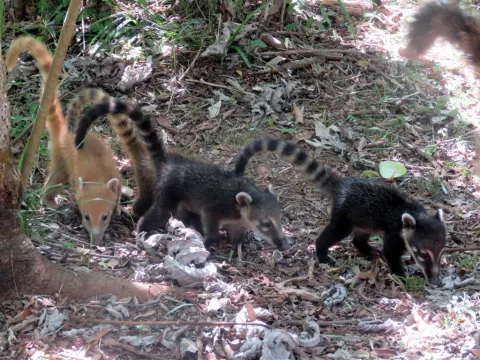
South American Coati
Nasua nasua
With its long tail and variable colouring, the South American Coati is a member of the raccoon family found across tropical and subtropical South America. Adults generally weigh 2 to 7.2 kg and measure 85 to 113 cm long, with the tail making up half that length. Its tail rings can be faint, and its snout lacks the extensive white colouring of the white-nosed coati. East of the Andes, it inhabits lowland forests across a range stretching south from Colombia and The Guianas to northern Argentina and Uruguay, at elevations up to 2,500 m. It has also been recorded in western Ecuador and in northern and western Colombia, and is more likely to occur where forest cover is greater.
Active by day, the coati moves on the ground and in trees, where it typically sleeps. It searches high in the canopy for fruit and also feeds mainly on bird eggs, invertebrates and other small animals. On the ground, it probes crevices for prey, turns over rocks and tears open logs with its claws. Females usually travel in bands of 15 to 30 animals, while males tend to live alone. Group members make soft whining sounds, but their alarm calls are loud woofs and clicks. When alarmed, coatis climb trees, then drop to the ground and scatter. In the wild, females leave their group to give birth in a tree nest, returning with their young 5 to 6 weeks later. Foxes, jaguars and jaguarundis prey on coatis, as do humans on occasion.
Written from the English Wikipedia article South American coati (CC BY-SA 4.0).
- Records
- 993
- Countries
- 11
- Atlas places
- 8
These are open occurrence records, so they show where people looked for and recorded the South American Coati as much as where it lives. Cells are up to 25 km across, and every location is generalised to its cell.
Generalised encounter areas, not exact locations. Each shape is a grid cell coloured by how likely the species is there.
- Very likelyBrazil25 km zone · medium confidence · 306 records · updated 80 days ago
- Very likelyFrench Guiana25 km zone · medium confidence · 282 records · updated 80 days ago
- Very likelyArgentina25 km zone · high confidence · 274 records · updated 80 days ago
- Very likelyColombia25 km zone · medium confidence · 95 records · updated 80 days ago
- Very likelyEcuador25 km zone · medium confidence · 18 records · updated 80 days ago
- LikelyBolivia25 km zone · medium confidence · 12 records · updated 80 days ago
- LikelyPeru25 km zone · medium confidence · 5 records · updated 80 days ago
- PossibleUruguay25 km zone · medium confidence · 1 record · updated 80 days ago
- PossibleChile25 km zone · low confidence · 0 records · updated 80 days ago
- PossibleUnited Kingdom25 km zone · low confidence · 0 records · updated 80 days ago
Conservation status not assessed here yet, so every location is generalised to its grid cell.