Purple Frog
Nasikabatrachus sahyadrensis
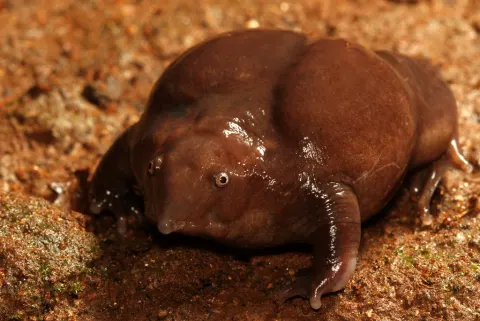
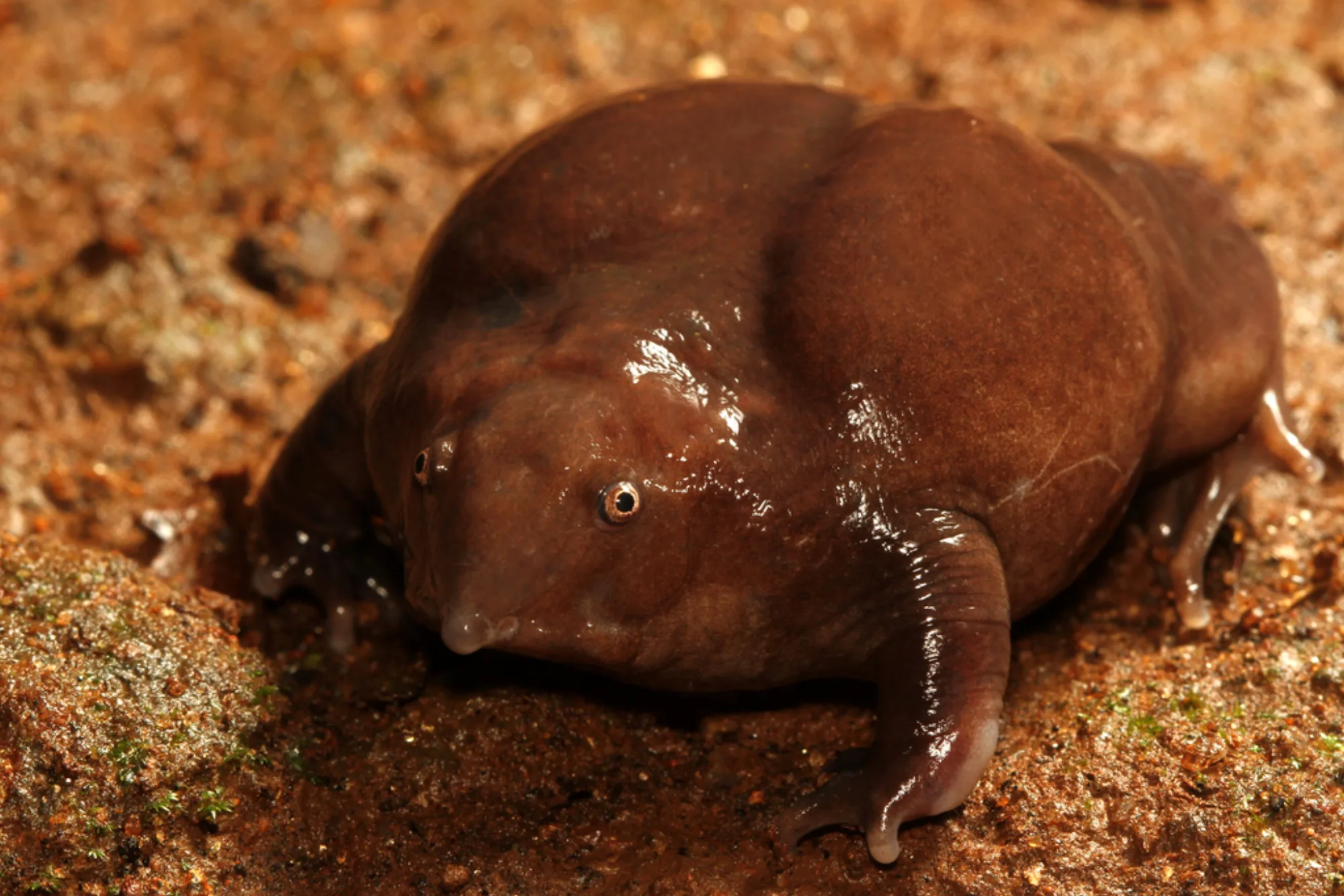
Rounded and robust, the Purple Frog has a small head and a distinctive pointed snout. Adults are usually dark purplish-grey, and males are about a third as long as females. One specimen measured 7.0 cm from snout to vent. Its call is a prolonged, harsh sound, likened to the clucking of a chicken. The species lives only in India's Western Ghats, with a range extending south from Camel's Hump Hill Range to the northern reaches of Agasthyamalai Hill Range. It typically lives near stream banks, where its flattened body helps it cling to submerged rocks against strong currents.
A sighting takes timing: this frog lives underground for most of its life, emerging during the monsoon for two weeks to breed. Males call from beneath a thin layer of soil and emerge beside temporary streams formed by rain. The frogs lay around 3,000 eggs in a rock pool, usually at sites in crevices along fast-flowing streams. Tadpoles have suckers that allow them to live in torrential streams, and they change into frogs after around 100 days. Adults forage underground, feeding mainly on termites.
Changes to habitat are a major threat, as land is converted for farming and settlement. Dams built during the monsoon also affect small habitats needed by the frog. People collect tadpoles during the monsoon, and the use of frogs for food and traditional medicine has been identified as a major threat. Research and trade in the frogs as pets are also considered major causes of their decline.
Written from the English Wikipedia article Purple frog (CC BY-SA 4.0).
- Records
- 5
- Countries
- 1
- Atlas places
- 1
These are open occurrence records, so they show where people looked for and recorded the Purple Frog as much as where it lives. Cells are up to 25 km across, and every location is generalised to its cell.
Generalised encounter areas, not exact locations. Each shape is a grid cell coloured by how likely the species is there.
- Very likelyIndia25 km zone · medium confidence · 5 records · updated 80 days ago
Conservation status not assessed here yet, so every location is generalised to its grid cell.