Proboscis Monkey
Nasalis larvatus
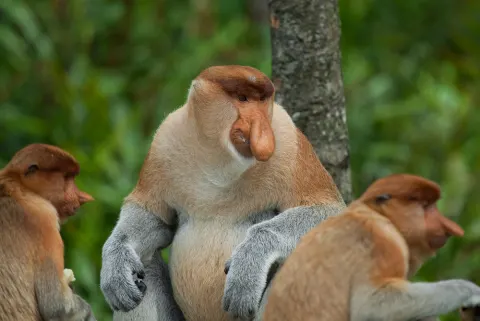
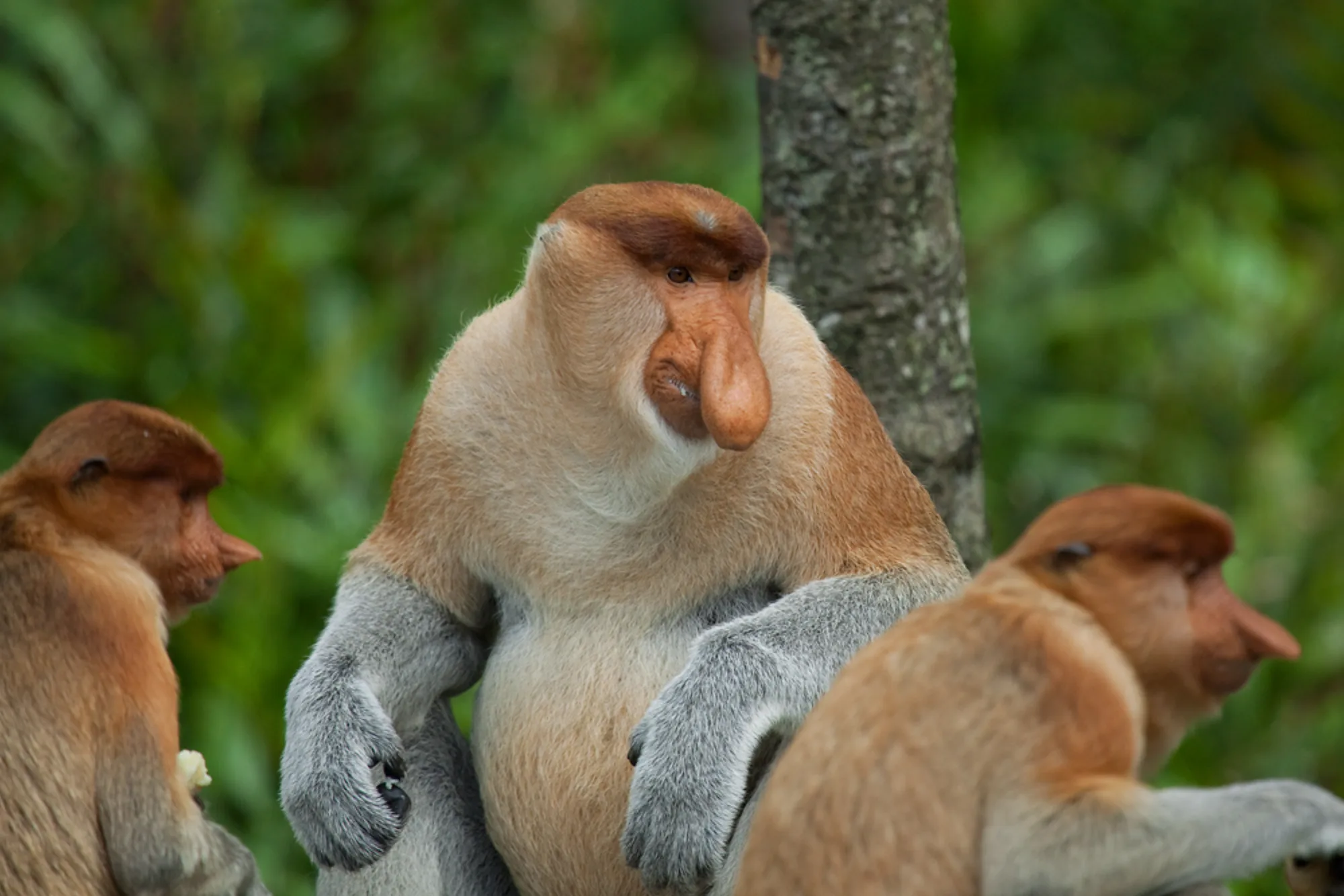
A long, hanging nose makes the male Proboscis Monkey easy to recognise. His nose can exceed 10.2 cm and reach below his mouth, while the female's is smaller and the youngster's turns upwards. Both sexes have rounded bellies and long coats, with back fur ranging from bright orange to reddish brown, yellowish brown or brick-red. Infants start life with blue faces, which gradually become cream like those of adults.
Found only on Borneo, this tree-dwelling monkey lives across Brunei, Indonesia and Malaysia. It favours lowland mangrove, riverine and dipterocarp forests, particularly near coasts and rivers. A capable swimmer, it crosses rivers and can travel up to 20 m underwater, sometimes jumping into the water from branches. Groups usually contain one adult male, several adult females and their young, although all-male groups and solitary animals also occur. As evening approaches, groups gather at sleeping sites, often near rivers. They feed mainly on fruit and leaves, favouring unripe fruit and young leaves, with flowers, seeds and insects making up a smaller part of the diet. Fruit dominates from January to May, while leaves take over from June to December. Infants start on solid food at six weeks, with weaning occurring at seven months; mothers allow other group members to hold them.
Logging and oil palm plantations have destroyed habitat, leaving populations fragmented. Hunting also takes a toll in some areas, where the monkeys are eaten or used in traditional Chinese medicine. False gharials prey on them, and several other predators may do so, including saltwater crocodiles and Sunda clouded leopards.
Written from the English Wikipedia article Proboscis monkey (CC BY-SA 4.0).
- Records
- 331
- Countries
- 3
- Atlas places
- 2
These are open occurrence records, so they show where people looked for and recorded the Proboscis Monkey as much as where it lives. Cells are up to 25 km across, and every location is generalised to its cell.
Generalised encounter areas, not exact locations. Each shape is a grid cell coloured by how likely the species is there.
- Very likelyMalaysia25 km zone · medium confidence · 270 records · updated 80 days ago
- Very likelyIndonesia25 km zone · medium confidence · 46 records · updated 80 days ago
- LikelyBrunei25 km zone · medium confidence · 15 records · updated 80 days ago
Conservation status not assessed here yet, so every location is generalised to its grid cell.