Flightless Cormorant
Nannopterum harrisi
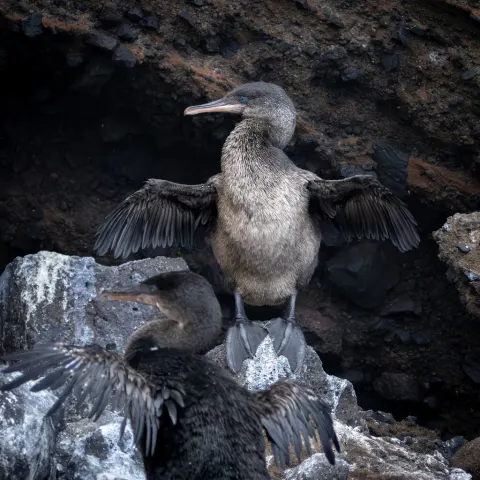
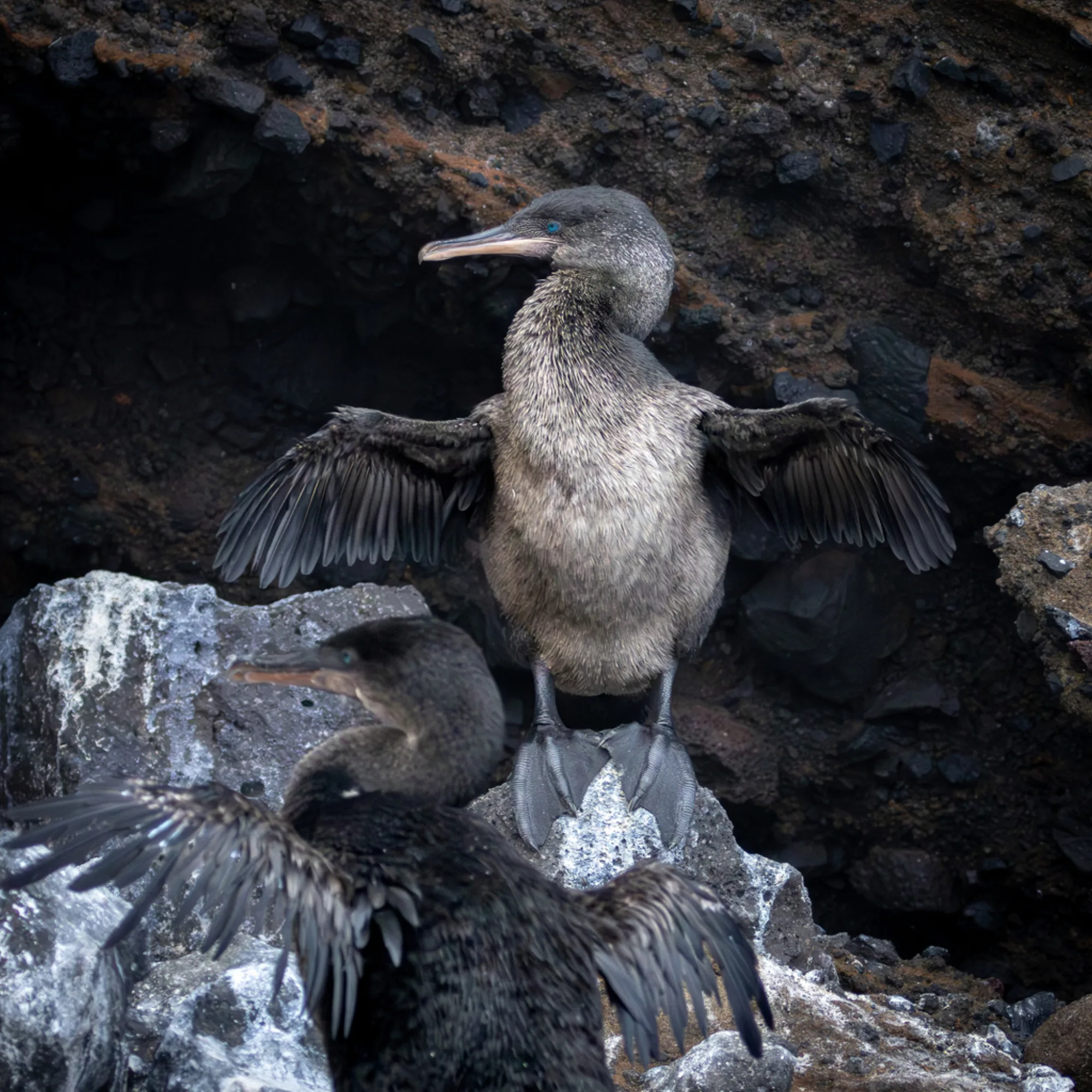
On the rocky shores of the Galápagos, the Flightless Cormorant stands apart from its relatives: it is the only known cormorant unable to fly. It is also the largest living member of its family, measuring 89 to 100 cm in length and weighing 2.5 to 5.0 kg. Look for a long neck, short wings, a hooked beak and turquoise eyes, with blackish upperparts and brown below. Males and females look alike, although males are larger. Young birds are glossy black with dark eyes, while adults make low growling calls.
Its range is confined to two islands: Fernandina and, on Isabela, the north and west coasts, where it lives along rocky shores and feeds in shallow bays and straits. A bird may spend most or all of its life on a local stretch of coast only several hundred metres long. Strong legs and webbed feet drive it through the water in pursuit of fish, small octopuses and other small marine animals. It feeds near the sea floor, no more than 200 metres offshore, and dries its small wings in the sun after diving.
Nesting usually takes place from April to October, when cooler seas bring plentiful marine food, and colonies of up to about 12 pairs form. Nests are built from seaweed and flotsam just above the high water mark, and both parents incubate the eggs and care for the chicks. Fishing nets reduce the birds' food supply and can catch and kill them, while introduced predators pose another threat. Warmer sea temperatures during the breeding season can reduce breeding success, and a large oil spill would also threaten this bird with its small population and limited range.
Written from the English Wikipedia article Flightless cormorant (CC BY-SA 4.0).
- Records
- 4,718
- Countries
- 1
- Atlas places
- 1
These are open occurrence records, so they show where people looked for and recorded the Flightless Cormorant as much as where it lives. Cells are up to 25 km across, and every location is generalised to its cell.
Generalised encounter areas, not exact locations. Each shape is a grid cell coloured by how likely the species is there.
- Very likelyEcuador25 km zone · high confidence · 4718 records · updated 80 days ago
Conservation status not assessed here yet, so every location is generalised to its grid cell.