Double-crested Cormorant
Nannopterum auritum
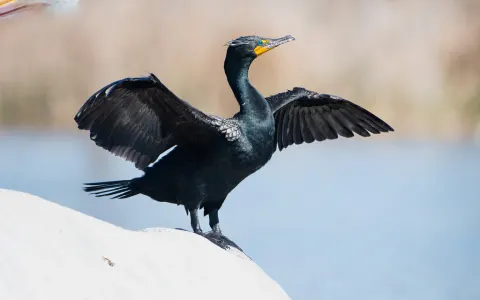
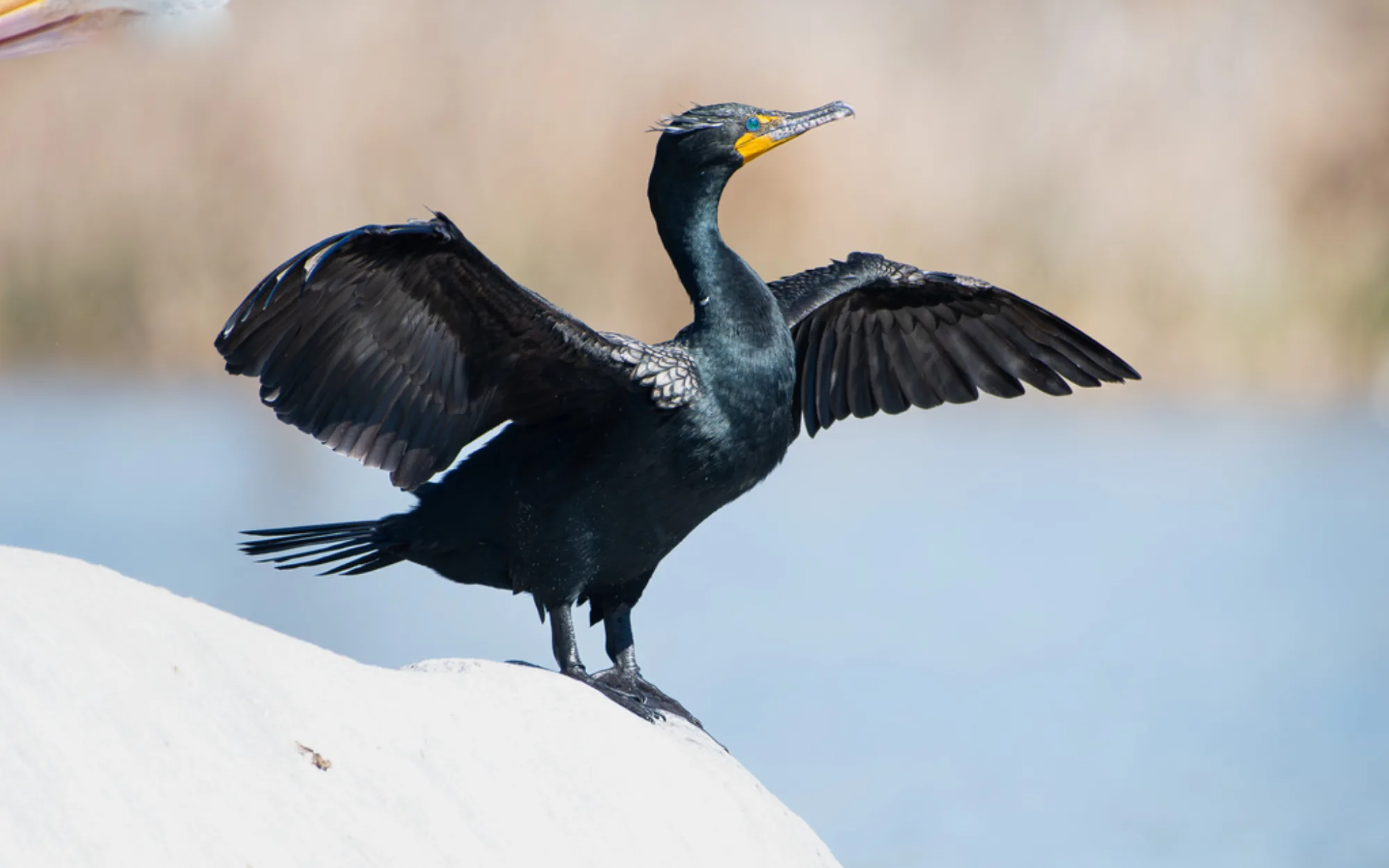
Often seen swimming low in the water, the Double-crested Cormorant may show only its head and long neck above the surface. This stocky waterbird measures 70 to 90 cm in length and has webbed feet and a hooked bill. Adults are mostly black, with orange or yellow skin on the face. During the breeding season, they grow two crests above the eyes, coloured white, black or a mixture of both. Young birds are greyer or browner, with light colouring on the throat and breast that becomes darker towards the belly.
The species ranges widely across North America, from Alaska's Aleutian Islands to Florida and Mexico, and lives around rivers, lakes and coasts. It leaves the coldest parts of its breeding range for winter and can be found along both coasts wherever water remains free of ice. Watch for it diving from the surface in search of food, propelled underwater by its feet. Fish make up most of its diet, though it also eats amphibians, crustaceans and insects. After a dive, it may stand for long periods with its wings spread to dry, as its feathers are not fully waterproof. In flight, birds travel low over the water and sometimes leave their colony in long, single-file lines.
Double-crested Cormorants usually gather in colonies, sometimes alongside other waterbirds, and give a deep, guttural grunt. They breed near coasts and inland waters, building stick nests in trees, on cliffs and on the ground where islands provide suitable sites. DDT caused numbers to fall in the 1960s, although the population has since increased. Colonies have also faced persecution where they are thought to compete with fishing, and control measures have included culling and egg addling.
Written from the English Wikipedia article Double-crested cormorant (CC BY-SA 4.0).
- Records
- 4,317,621
- Countries
- 19
- Atlas places
- 1
These are open occurrence records, so they show where people looked for and recorded the Double-crested Cormorant as much as where it lives. Cells are up to 25 km across, and every location is generalised to its cell.
Generalised encounter areas, not exact locations. Each shape is a grid cell coloured by how likely the species is there.
- Very likelyUnited States25 km zone · high confidence · 3728576 records · updated 86 days ago
- Very likelyCanada25 km zone · high confidence · 557160 records · updated 86 days ago
- Very likelyMexico25 km zone · high confidence · 12701 records · updated today
- Very likelyBelize25 km zone · high confidence · 9302 records · updated today
- Very likelyCuba25 km zone · high confidence · 3997 records · updated today
- Very likelyBahamas25 km zone · high confidence · 2854 records · updated today
- Very likelyBermuda25 km zone · high confidence · 1691 records · updated today
- LikelyCayman Islands25 km zone · high confidence · 362 records · updated today
- LikelySt. Pierre & Miquelon25 km zone · high confidence · 278 records · updated today
- LikelyGuatemala25 km zone · high confidence · 145 records · updated today
Conservation status not assessed here yet, so every location is generalised to its grid cell.