Cape Cobra
Naja nivea
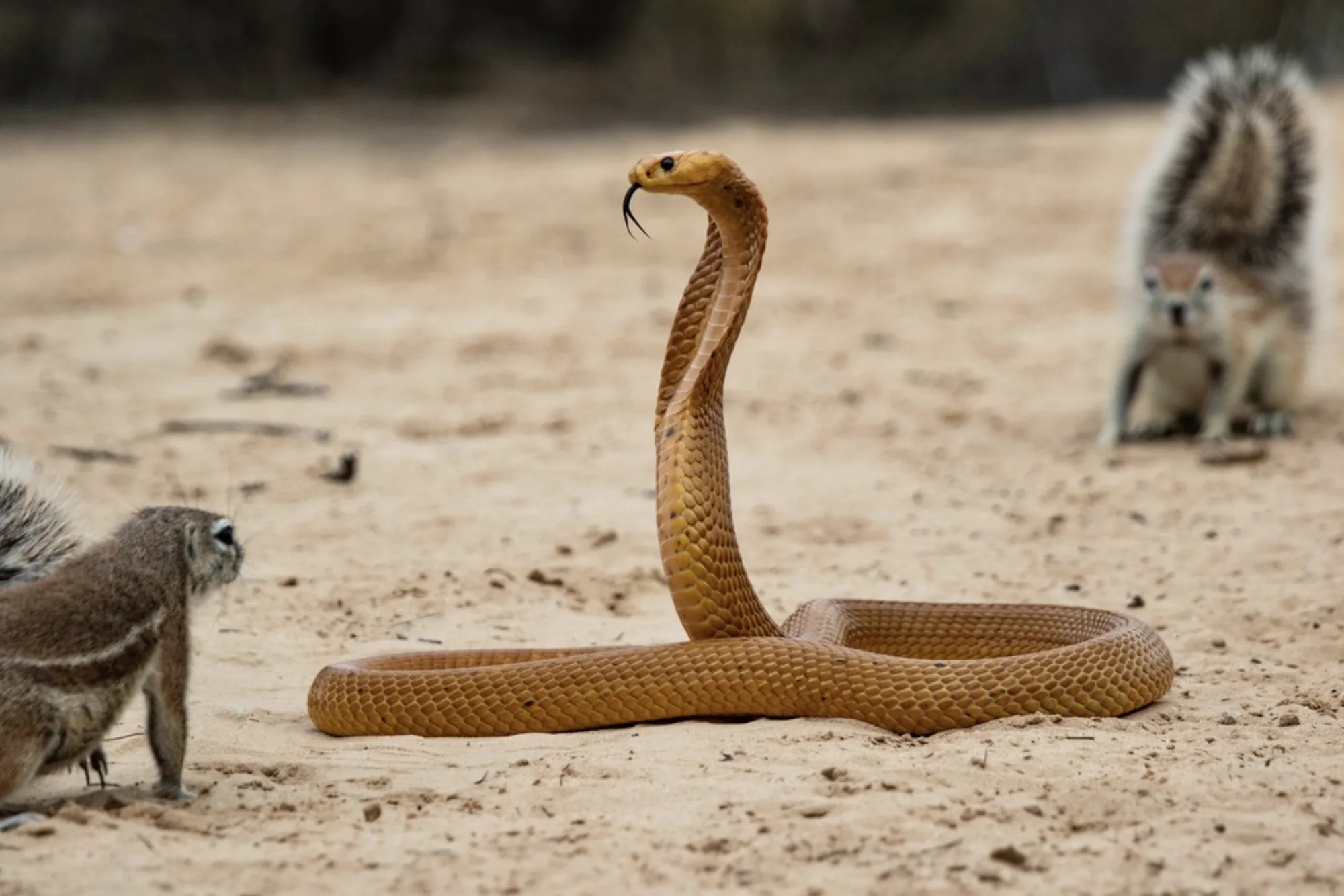
Colour is an uncertain guide to the Cape Cobra (Naja nivea), a medium-sized, highly venomous snake of southern Africa. It can be yellow, golden brown, dark brown or black, with pale or black speckles and blotches. Several colour forms can occur in the same place, while young snakes generally have a conspicuously dark throat. Adults are typically 1.2 to 1.4 m long, and males are slightly larger than females.
The species occurs most often in South Africa, and also lives in southern Namibia, southwestern Botswana and western Lesotho. Its habitats include fynbos, bushveld, karoo scrubland, arid savanna and desert. It often occupies rodent burrows and abandoned termite mounds, as well as rock crevices in dry regions. It also enters villages and some suburbs, sometimes going into houses to escape daytime heat or look for rodents.
Cape Cobras forage by day, though in very hot weather they may become active around twilight. They move quickly on the ground and climb trees and bushes, where they raid sociable weaver nests. Their varied diet includes rodents, lizards, birds, other snakes and carrion. When cornered, a cobra lifts its front body, opens its wide hood and sometimes gives a loud hiss; it strikes readily in defence. Females lay 8 to 20 eggs in midsummer, in a hole, an abandoned termite mound or another warm, wet place. Hatchlings are independent from birth. Honey badgers, meerkats, mongooses, birds of prey and other snakes prey on Cape Cobras, which also come into direct contact with people around homes.
Written from the English Wikipedia article Cape cobra (CC BY-SA 4.0).
- Records
- 54
- Countries
- 2
- Atlas places
- 5
These are open occurrence records, so they show where people looked for and recorded the Cape Cobra as much as where it lives. Cells are up to 25 km across, and every location is generalised to its cell.
Generalised encounter areas, not exact locations. Each shape is a grid cell coloured by how likely the species is there.
- Very likelySouth Africa25 km zone · medium confidence · 53 records · updated 80 days ago
- LikelyBotswana25 km zone · medium confidence · 1 record · updated 80 days ago
Conservation status not assessed here yet, so every location is generalised to its grid cell.