Black-necked Spitting Cobra
Naja nigricollis
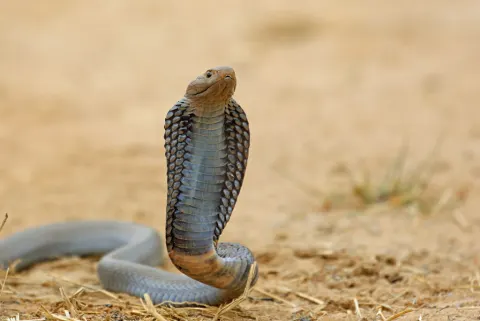
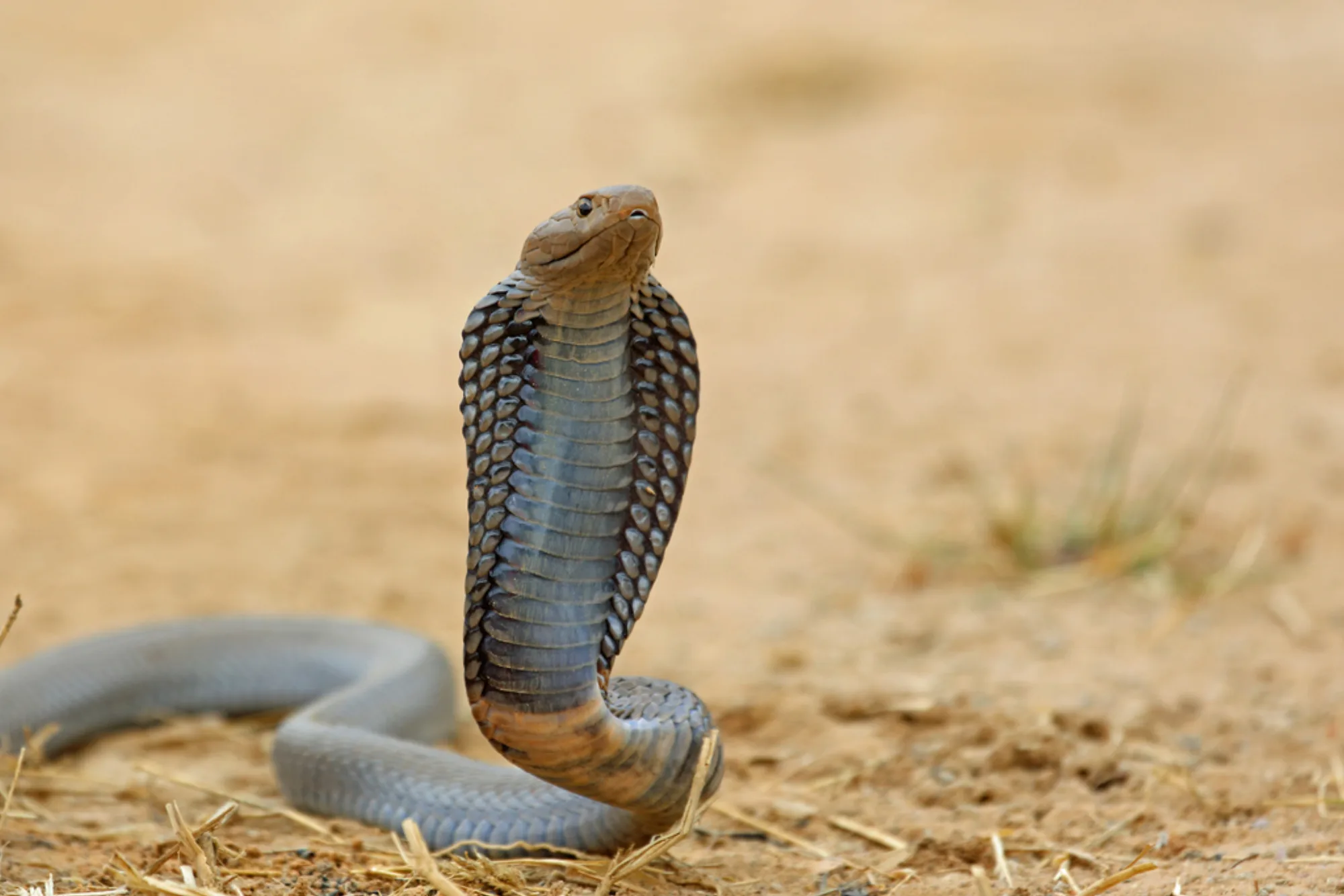
Across much of sub-Saharan Africa, the Black-necked Spitting Cobra (Naja nigricollis) is a venomous snake whose appearance varies widely from place to place. It generally reaches 1.2 to 2.2 metres in length. Some have dark or pale grey upperparts, a yellowish or reddish belly and a wide black neck band. Others are yellowish-brown, copper-coloured, deep reddish-brown or olive brown, while some are striped black and white or entirely white with dark eyes. When threatened, the cobra can project venom, which irritates the skin and eyes and can cause permanent blindness if it reaches the eyes and is not washed off.
The species occurs in western, eastern and central Africa and parts of southern Africa, but is absent from the Congo Basin rainforests. Savanna and semi-desert are usual habitats, although it also lives in coastal scrub, dry grassland and cleared former forest, particularly near rivers and streams. In southeastern Nigeria, it occupies altered landscapes that include farmland, plantations and suburban areas. Tree trunks appear to be favoured hiding places, though abandoned termite mounds and rodent holes also offer shelter or a place to cool down. It climbs trees well and may spend time in them.
Depending on season, location and average daytime temperature, this cobra may be active by day or by night. Its diet includes small rodents, birds and fish, as well as lizards, eggs and other snakes. Females commonly lay 10 to 15 eggs, and the young are independent from birth. Snake eagles and other snakes prey on it; the short-toed snake eagle may pose a particular threat.
Written from the English Wikipedia article Black-necked spitting cobra (CC BY-SA 4.0).
- Records
- 76
- Countries
- 5
- Atlas places
- 7
These are open occurrence records, so they show where people looked for and recorded the Black-necked Spitting Cobra as much as where it lives. Cells are up to 25 km across, and every location is generalised to its cell.
Generalised encounter areas, not exact locations. Each shape is a grid cell coloured by how likely the species is there.
- Very likelyBenin25 km zone · medium confidence · 70 records · updated 80 days ago
- PossibleNamibia25 km zone · medium confidence · 3 records · updated 80 days ago
- UncommonKenya25 km zone · medium confidence · 3 records · updated 80 days ago
- UncommonTanzania25 km zone · low confidence · 0 records · updated 80 days ago
- UncommonZambia25 km zone · low confidence · 0 records · updated 80 days ago
Conservation status not assessed here yet, so every location is generalised to its grid cell.