Indian Cobra
Naja naja
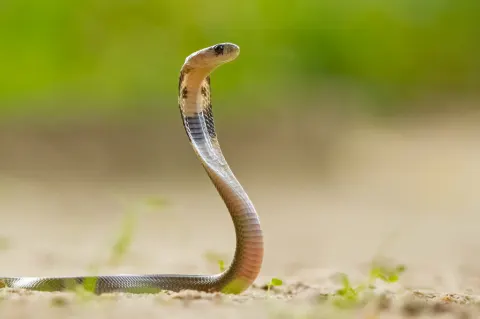
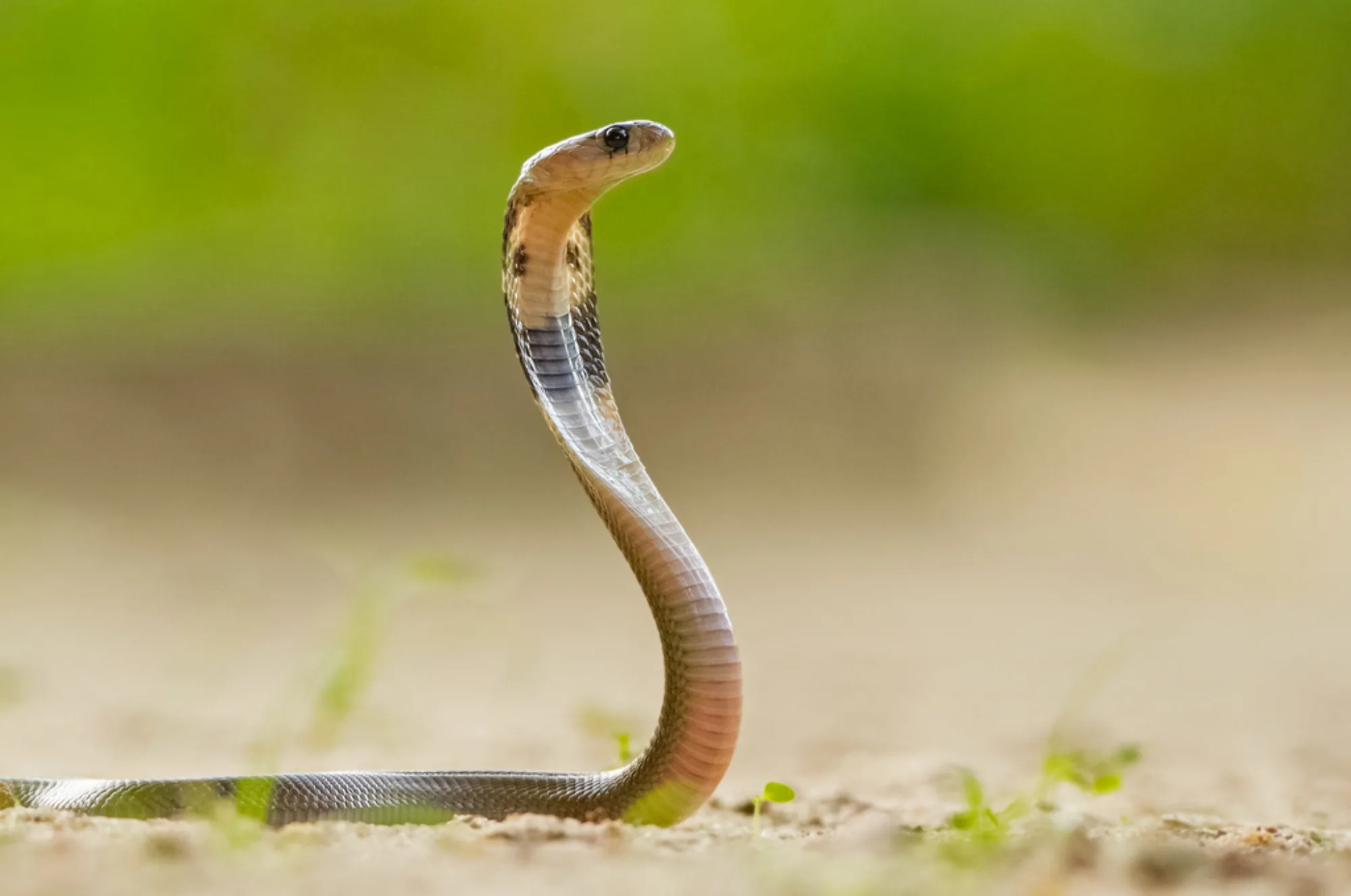
A broad hood gives the Indian Cobra one of its most recognisable features: when threatened, this heavy-bodied, venomous snake spreads it wide. Many have a mark on the back of the hood, where two circular patterns joined by a curved line resemble spectacles. Colour and pattern vary greatly across its range, and some cobras lack the hood mark. Most adults measure 1 to 1.5 metres, although some, especially in Sri Lanka, reach 2.1 to 2.2 metres.
Native to the Indian subcontinent, the cobra ranges from Pakistan and India to southern Nepal, Bangladesh and Sri Lanka. Its habitats range from forests and wetlands to farmland, rocky ground, villages and city outskirts. Often found near water, it takes shelter in mammal dens, hollow trees, rock piles and termite mounds. It avoids true deserts and occurs from sea level up to 2,000 metres. Rodents, birds such as plovers and grebes, lizards and frogs are among its prey. After a quick bite, the cobra waits for its venom to paralyse the animal, then swallows it whole. It sometimes enters buildings in pursuit of rodents.
From April through July, females usually lay between 10 and 30 eggs, choosing termite mounds or rat holes as nesting places. The eggs hatch 48 to 69 days later, and the young are independent from birth. People sometimes kill Indian cobras, and the species has also traditionally been used by snake charmers. The snake follows the movements of a charmer's instrument, rather than responding to its music.
Written from the English Wikipedia article Indian cobra (CC BY-SA 4.0).
- Records
- 213
- Countries
- 4
- Atlas places
- 4
These are open occurrence records, so they show where people looked for and recorded the Indian Cobra as much as where it lives. Cells are up to 25 km across, and every location is generalised to its cell.
Generalised encounter areas, not exact locations. Each shape is a grid cell coloured by how likely the species is there.
- Very likelyIndia25 km zone · medium confidence · 202 records · updated 80 days ago
- Very likelyBangladesh25 km zone · medium confidence · 3 records · updated 80 days ago
- LikelySri Lanka25 km zone · medium confidence · 8 records · updated 80 days ago
- PossiblePakistan25 km zone · low confidence · 0 records · updated 80 days ago
Conservation status not assessed here yet, so every location is generalised to its grid cell.