Black And White Cobra
Naja melanoleuca
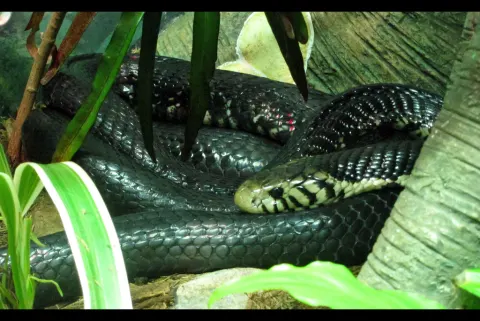
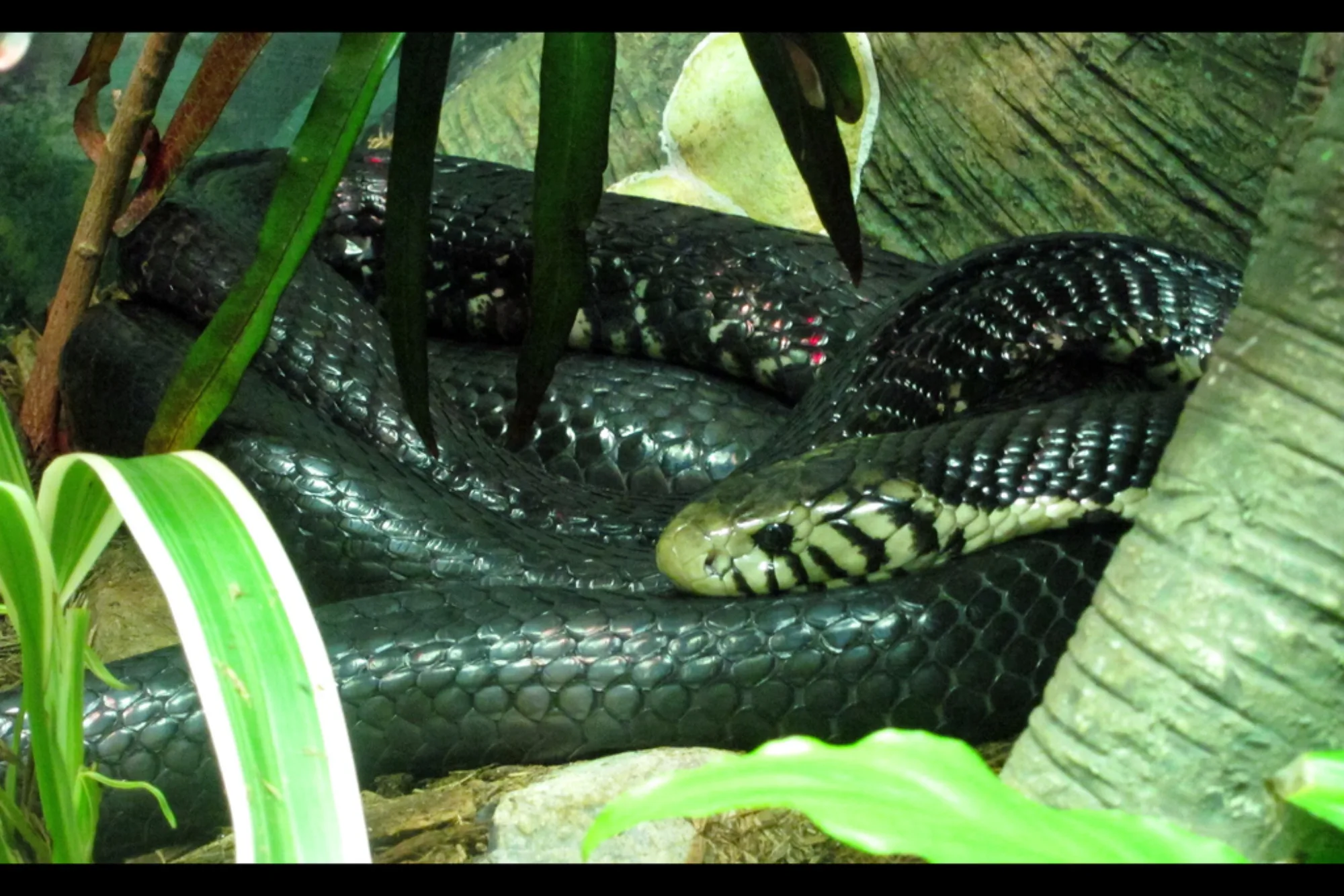
Glossy black with pale, dark-barred lips, the Black And White Cobra is one form of a highly venomous African snake also known as the forest cobra. Its colour varies across its range: some are banded black and yellow, while others are brownish or blackish-brown above with paler bellies. Adults average 1.4 to 2.2 m in length, and individuals measuring up to 3.2 m have been recorded in the wild. When alarmed, it can lift its forebody, spread a narrow hood and hiss loudly.
The snake occurs mainly in central Africa, with records from countries including Cameroon, Gabon and the Democratic Republic of Congo. It favours lowland forest and moist savanna, but also uses habitats from western African mangroves to grassland and drier areas. Secretive and fond of holes, it can persist around central African towns and live in trees on fruit plantations. It is an agile climber and capable swimmer, and in some places fish make up the main part of its diet.
Mostly active by day in uninhabited places, the cobra may also venture out at night in urban areas. When resting, it shelters in places such as hollow logs, root clusters, rock crevices and abandoned termite mounds. Its varied prey includes amphibians, fish, other snakes, lizards, birds, eggs and small mammals. In summer, females lay 11 to 26 eggs in sheltered sites, including hollow trees and holes in the ground, and may guard them. The young are independent when they hatch and usually measure 22 to 25 cm long.
Written from the English Wikipedia article Forest cobra (CC BY-SA 4.0).
- Records
- 73
- Countries
- 5
- Atlas places
- 1
These are open occurrence records, so they show where people looked for and recorded the Black And White Cobra as much as where it lives. Cells are up to 25 km across, and every location is generalised to its cell.
Generalised encounter areas, not exact locations. Each shape is a grid cell coloured by how likely the species is there.
- Very likelyBenin25 km zone · medium confidence · 54 records · updated 80 days ago
- Very likelyCameroon25 km zone · medium confidence · 12 records · updated 80 days ago
- PossibleSouth Africa25 km zone · medium confidence · 7 records · updated 80 days ago
- UncommonNigeria25 km zone · low confidence · 0 records · updated 80 days ago
- RareGabon25 km zone · low confidence · 0 records · updated 80 days ago
Conservation status not assessed here yet, so every location is generalised to its grid cell.