Egyptian Cobra
Naja haje
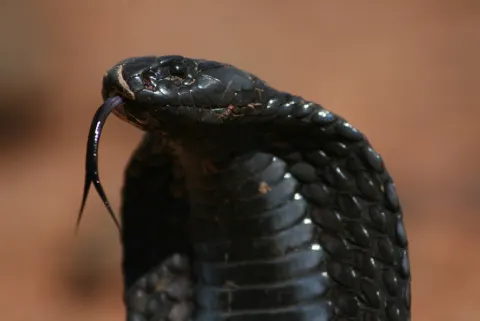
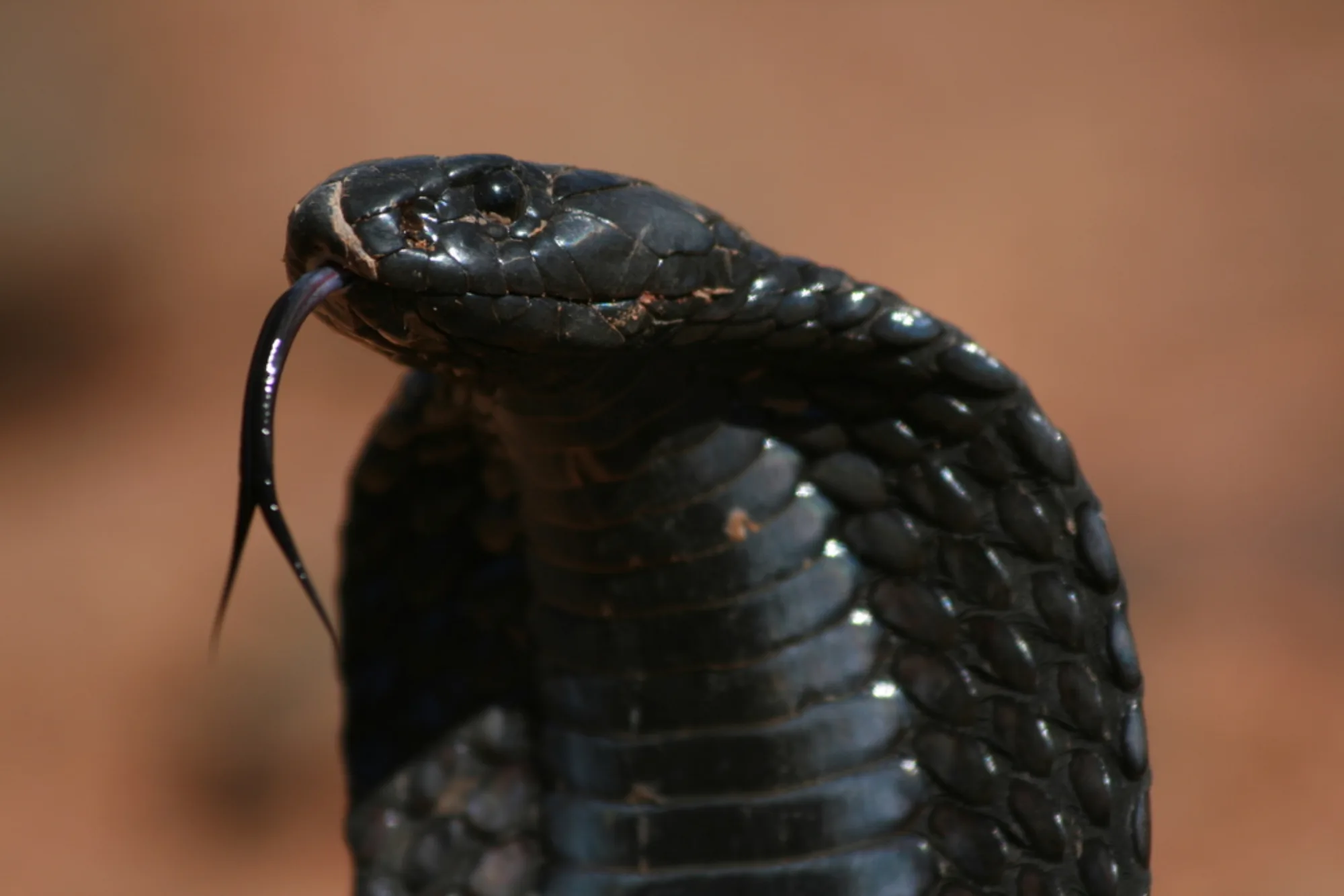
A broad, rounded snout and an expandable hood help distinguish the Egyptian Cobra, a large venomous snake of Africa. Its stout body is usually some shade of brown, although colours range from copper-red and grey-brown to black. Many have a teardrop mark below the eye, while specimens from Morocco are almost entirely black. An Egyptian Cobra averages roughly 1.4 metres long, and the longest specimen recorded measured 2.59 metres. Its venom can kill a person, but unlike some other African cobras, it does not spit venom.
The species occurs across much of North Africa above the Sahara and in West African savannas below it, reaching the Congo Basin in the south and Kenya and Tanzania in the east. It occupies habitats from steppe and dry or moist savanna to semi-desert with some water and vegetation. Often found near water, it also lives among scrub and in agricultural fields, and has been recorded swimming in the Mediterranean Sea. Villages attract it with rodent pests and domestic chickens, and it sometimes enters houses.
Mostly active at twilight or at night, the cobra may also bask in the early morning sun. It favours a permanent base in an abandoned animal burrow, termite mound or rocky outcrop, but travels actively in search of food. Toads are its preferred prey, but it also takes eggs and birds, as well as lizards, other snakes and small mammals. When approached, it generally tries to escape, but if threatened it raises its body, spreads its hood and strikes.
Written from the English Wikipedia article Egyptian cobra (CC BY-SA 4.0).
- Records
- 3
- Countries
- 4
No atlas park has a record of the Egyptian Cobra in or around it yet.
These are open occurrence records, so they show where people looked for and recorded the Egyptian Cobra as much as where it lives. Cells are up to 25 km across, and every location is generalised to its cell.
Generalised encounter areas, not exact locations. Each shape is a grid cell coloured by how likely the species is there.
- Very likelyBenin25 km zone · medium confidence · 3 records · updated 80 days ago
- LikelyMorocco25 km zone · low confidence · 0 records · updated 80 days ago
- PossibleSudan25 km zone · low confidence · 0 records · updated 80 days ago
- UncommonCongo - Kinshasa25 km zone · low confidence · 0 records · updated 80 days ago
Conservation status not assessed here yet, so every location is generalised to its grid cell.