Ringed Water Cobra
Naja annulata
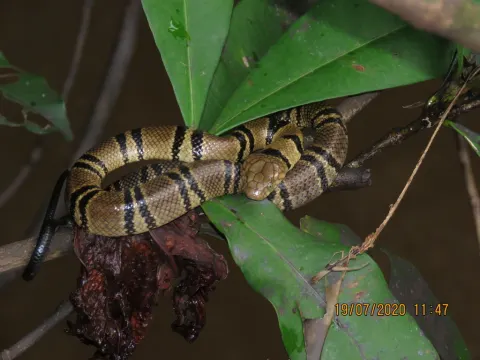
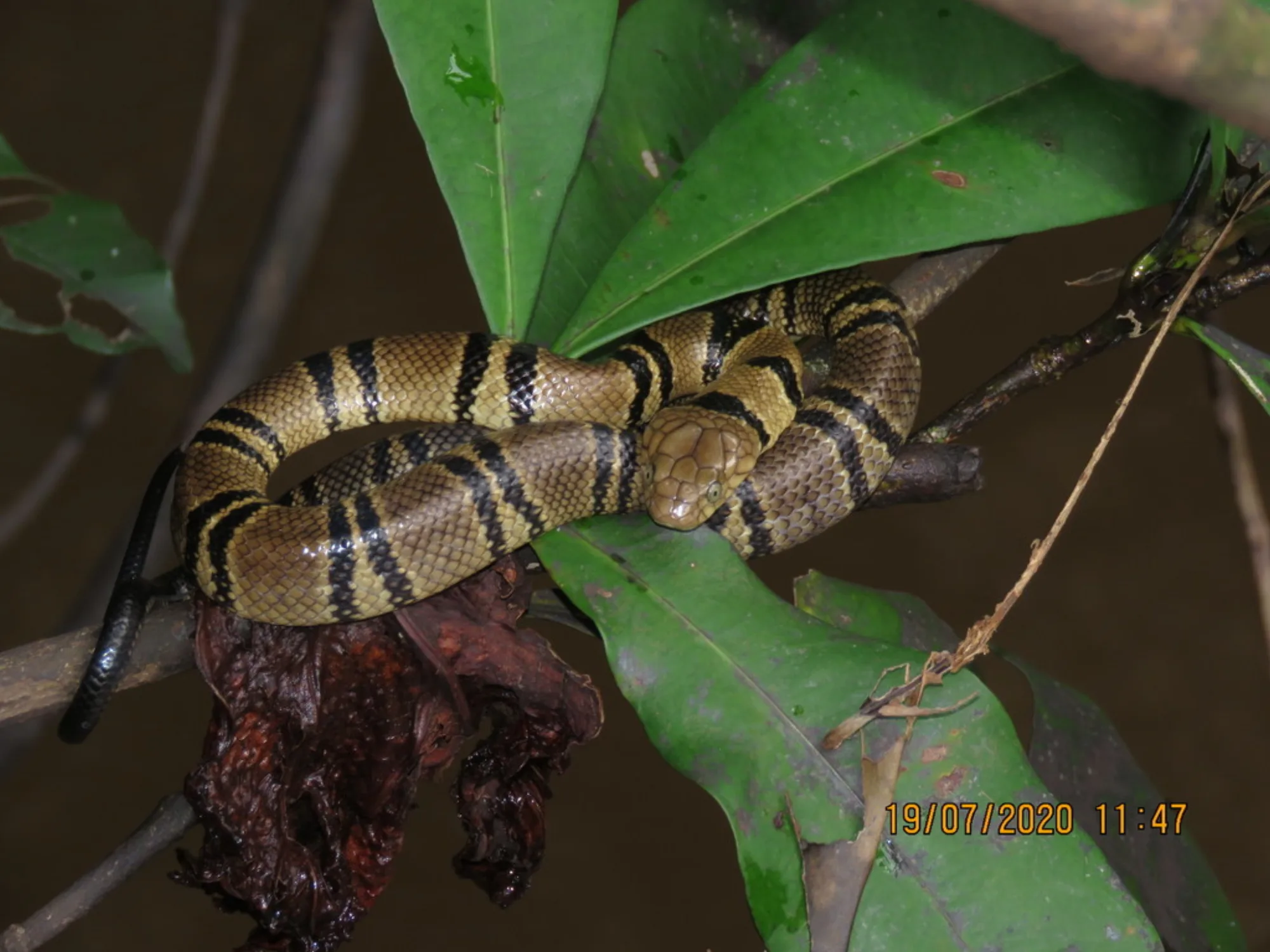
This heavy-bodied snake is one of only two water cobra species on earth. Reaching average lengths of 1.4 to 2.2 metres, the Ringed Water Cobra is identified by its glossy brown or reddish-brown scales marked with black bands. It has a flat, broad head and a black tail, with a pale yellow underside. Though it can flare a thin hood when it feels threatened, this snake is generally not aggressive and prefers to flee from human encounters.
Native to central and western Africa, these cobras live along the banks of rivers and lakes in wooded savanna or forested regions. They are found in countries including Gabon, Rwanda, and Cameroon, as well as the shores of Lake Tanganyika. As a largely aquatic animal, it is a talented swimmer that can stay submerged for 10 minutes and dive to depths of 25 m. While it is active during both day and night, it is most frequently out in the daylight.
On land, the snake moves slowly and hides under bridges, jetties, or tree roots. Its diet consists almost entirely of fish, though it sometimes eats amphibians like toads and frogs. Because it is a secretive animal that stays close to the water, it is rarely seen by people. While its specific conservation threats are not detailed, its venom is a potent neurotoxin, and the snake will bite if it is provoked.
Written from the English Wikipedia article Naja annulata (CC BY-SA 4.0).
- Records
- 0
- Countries
- 1
- Atlas places
- 0
These are open occurrence records, so they show where people looked for and recorded the Ringed Water Cobra as much as where it lives. Cells are up to 25 km across, and every location is generalised to its cell.
Generalised encounter areas, not exact locations. Each shape is a grid cell coloured by how likely the species is there.
- Very likelyCongo - Kinshasa25 km zone · low confidence · 0 records · updated 1 day ago
Conservation status not assessed here yet, so every location is generalised to its grid cell.