Anchieta's Cobra
Naja anchietae
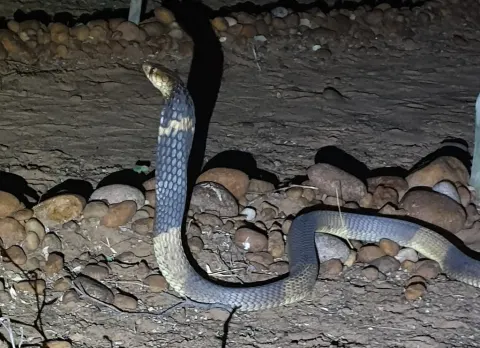
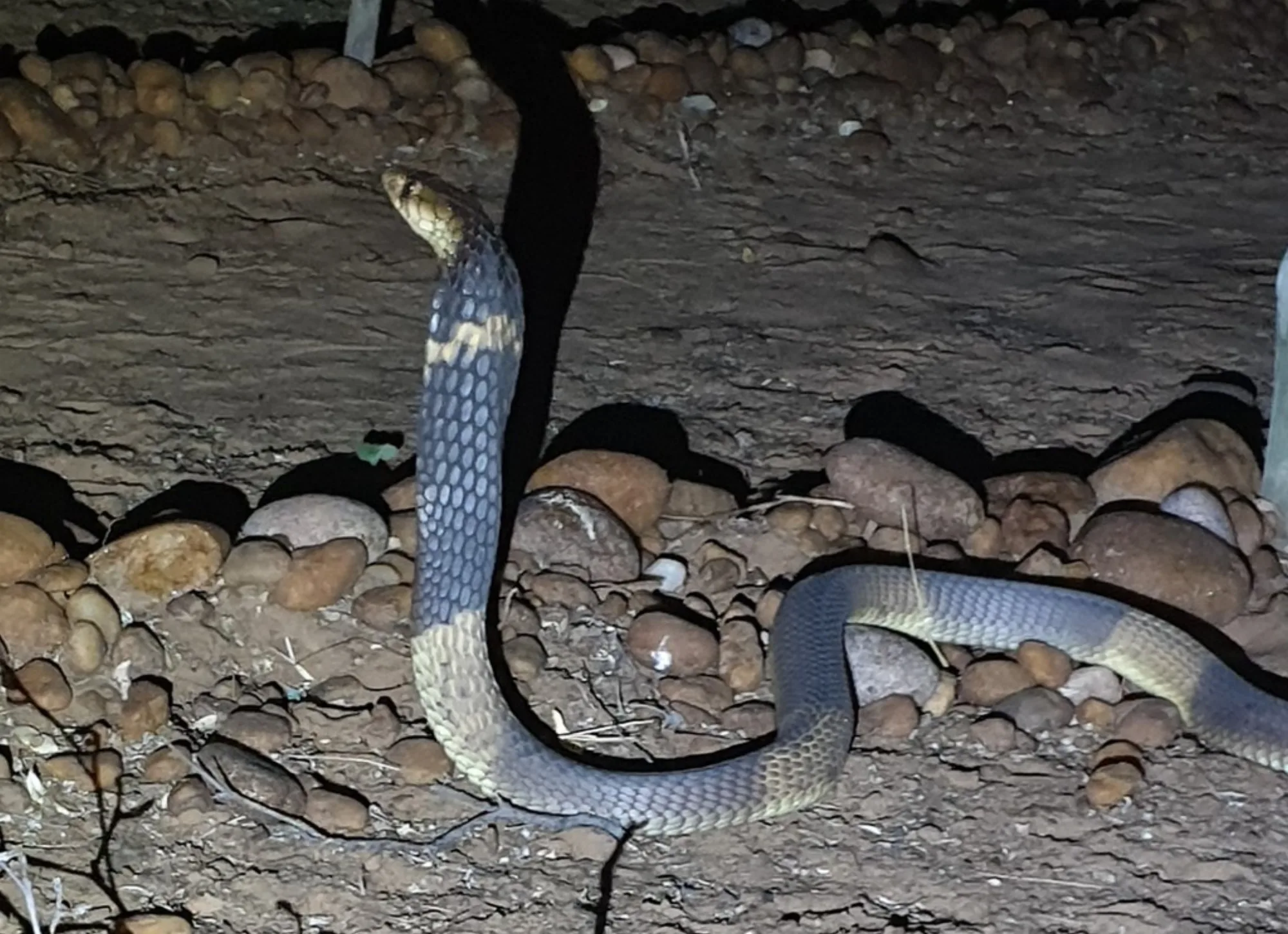
This medium-sized snake from southwestern Africa is easily identified by the large, impressive hood it expands when it feels threatened. Reaching an average length of 1.0 metre, though some individuals grow to 2.0 metres or more, it possesses a rounded snout and a moderately slender body. Younger snakes are typically yellowish or light brown with a black band circling the neck. As they mature, they turn a darker brown and the neck band fades. A rare banded phase also exists, featuring a black body marked with six to eight yellow bands.
Travellers might encounter the Anchieta's Cobra in mesic savanna grasslands, rocky areas, or wooded spots near rivers and wetlands. It is native to southern Angola, Namibia, northern Botswana, and parts of Zambia and Zimbabwe. While it avoids true deserts and forests, it sometimes lives near human homes, sheltering under houses or in poultry runs. This ground-dwelling species is active at night, but often spends the day basking in the sun near retreats like hollow trees or abandoned termite mounds.
When cornered, the snake may feign death or assume a defensive posture, lifting its body and spreading a hood measuring 10 to 12 centimetres across. It is an opportunistic hunter that eats toads, lizards, other snakes, birds, and small mammals like mice. In early summer, females lay between 47 and 60 eggs. Beyond the risk of human conflict near settlements, this cobra is hunted by honey badgers, monitor lizards, and birds of prey such as snake eagles and secretary birds.
Written from the English Wikipedia article Anchieta's cobra (CC BY-SA 4.0).
- Records
- 3
- Countries
- 2
- Atlas places
- 1
These are open occurrence records, so they show where people looked for and recorded the Anchieta's Cobra as much as where it lives. Cells are up to 25 km across, and every location is generalised to its cell.
Generalised encounter areas, not exact locations. Each shape is a grid cell coloured by how likely the species is there.
- Very likelyNamibia25 km zone · medium confidence · 3 records · updated 1 day ago
- PossibleZambia25 km zone · low confidence · 0 records · updated 1 day ago
Conservation status not assessed here yet, so every location is generalised to its grid cell.