New Zealand Greater Short-tailed Bat
Mystacina robusta
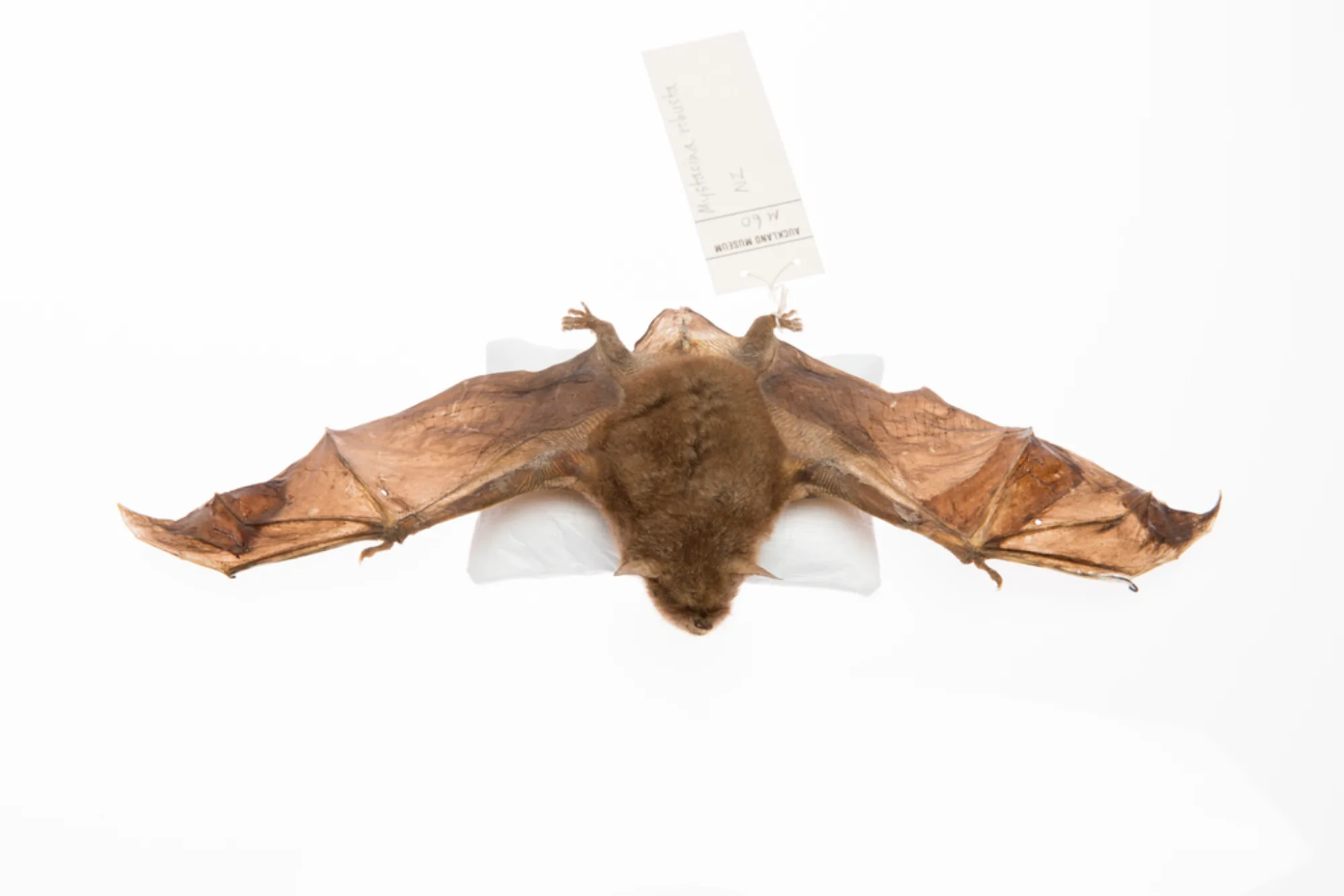
This elusive mammal belongs to a family found only in New Zealand. Known as the New Zealand Greater Short-tailed Bat, it is bigger than its close relative, the lesser short-tailed bat. It typically reaches a body length of 90mm with a wingspan of 300mm. Photos of the animal reveal dark-brown fur and even darker wings. While its ears are smaller than the lesser variety, its forearm length averages between 45.3 and 47.5mm.
In the past, these bats lived across the North and South Islands, but they were later confined to small islands near Stewart Island / Rakiura. They have been found roosting inside granite caves or tree cavities. When active, they fly low to the ground, usually staying within ten feet of the surface. These bats only emerge after dusk and are known to crawl along the floor. Although their exact diet is unconfirmed, they likely eat fruit, nectar, and pollen alongside insects such as moths, flies, and beetles.
While no confirmed sightings have occurred since 1965, recent reports and unusual echolocation calls have given hope that the species still exists. Their decline began with the arrival of the Polynesian rat, and they were later wiped out from their last known refuges by an accidental invasion of ship rats in 1963. Because they were not identified as a unique species until after their presumed disappearance, they were not initially prioritized for protection. Today, they are among the most wanted lost species in the world.
Written from the English Wikipedia article New Zealand greater short-tailed bat (CC BY-SA 4.0).
- Atlas places
- 0
These are open occurrence records, so they show where people looked for and recorded the New Zealand Greater Short-tailed Bat as much as where it lives. Cells are up to 25 km across, and every location is generalised to its cell.
No encounter zones yet
Where and when you can expect to see New Zealand Greater Short-tailed Bat is calculated from observation density. No zones have been computed for this species yet.