Giant Anteater
Myrmecophaga tridactyla
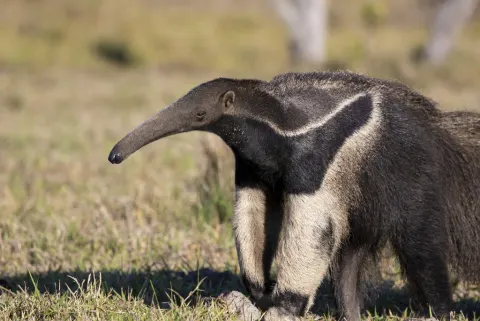
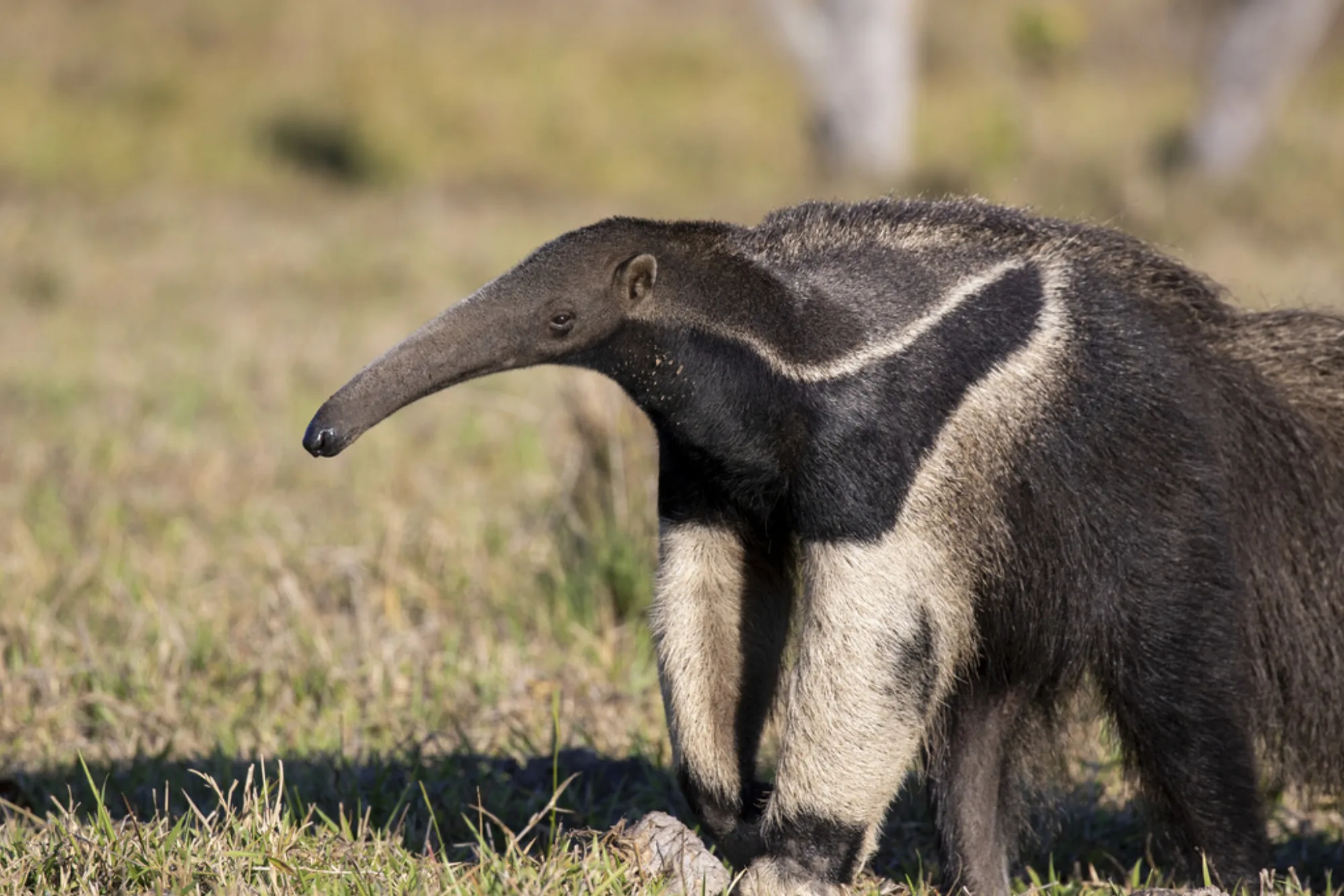
With its long, narrow snout and bushy tail, the Giant Anteater cuts a distinctive figure on the ground. It is the largest living anteater, measuring 182 to 217 cm in total length. Its coat is mostly greyish brown or black, mottled with white, with a bold black mark outlined in white running from the throat towards the shoulders. Its pale forelegs have black bands around the wrists and hands, while the hind legs are dark and a mane runs along the back.
Native to Central and South America, it ranges from Honduras to Bolivia and northern Argentina. It can live in grassland, tropical rainforest and dry shrubland where there is enough prey. In the Brazilian Pantanal, anteaters have been observed moving and feeding in open areas, then resting in forests. They can be active by day or night, and may sleep curled up with the bushy tail covering the body. Mostly solitary, they use scent and markings to keep in contact with one another. A keen sense of smell helps them find ants and termites, whose nests they tear open with their claws before collecting the insects with a long, sticky tongue.
Giant anteaters breed throughout the year, and a female gives birth to a single pup after a pregnancy of 170 to 190 days. She carries the young on her back, where its black and white band lines up with hers, helping to conceal it. Habitat destruction, fire, vehicle collisions and attacks by dogs all threaten the species. People also hunt giant anteaters for food and other uses, and the animals have disappeared from many parts of their former range.
Written from the English Wikipedia article Giant anteater (CC BY-SA 4.0).
- Records
- 395
- Countries
- 6
- Atlas places
- 6
These are open occurrence records, so they show where people looked for and recorded the Giant Anteater as much as where it lives. Cells are up to 25 km across, and every location is generalised to its cell.
Generalised encounter areas, not exact locations. Each shape is a grid cell coloured by how likely the species is there.
- Very likelyBrazil25 km zone · medium confidence · 235 records · updated 80 days ago
- Very likelyColombia25 km zone · medium confidence · 80 records · updated 80 days ago
- Very likelyArgentina25 km zone · medium confidence · 70 records · updated 80 days ago
- LikelyGuyana25 km zone · medium confidence · 8 records · updated 80 days ago
- LikelyBolivia25 km zone · medium confidence · 2 records · updated 80 days ago
- PossibleEcuador25 km zone · low confidence · 0 records · updated 80 days ago
Conservation status not assessed here yet, so every location is generalised to its grid cell.