Numbat
Myrmecobius fasciatus
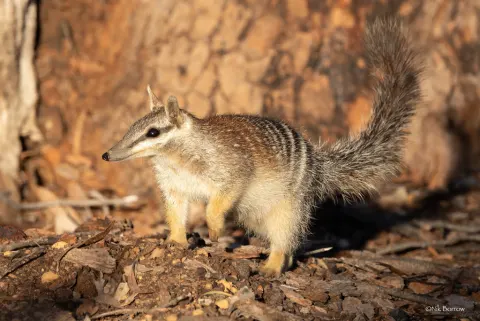
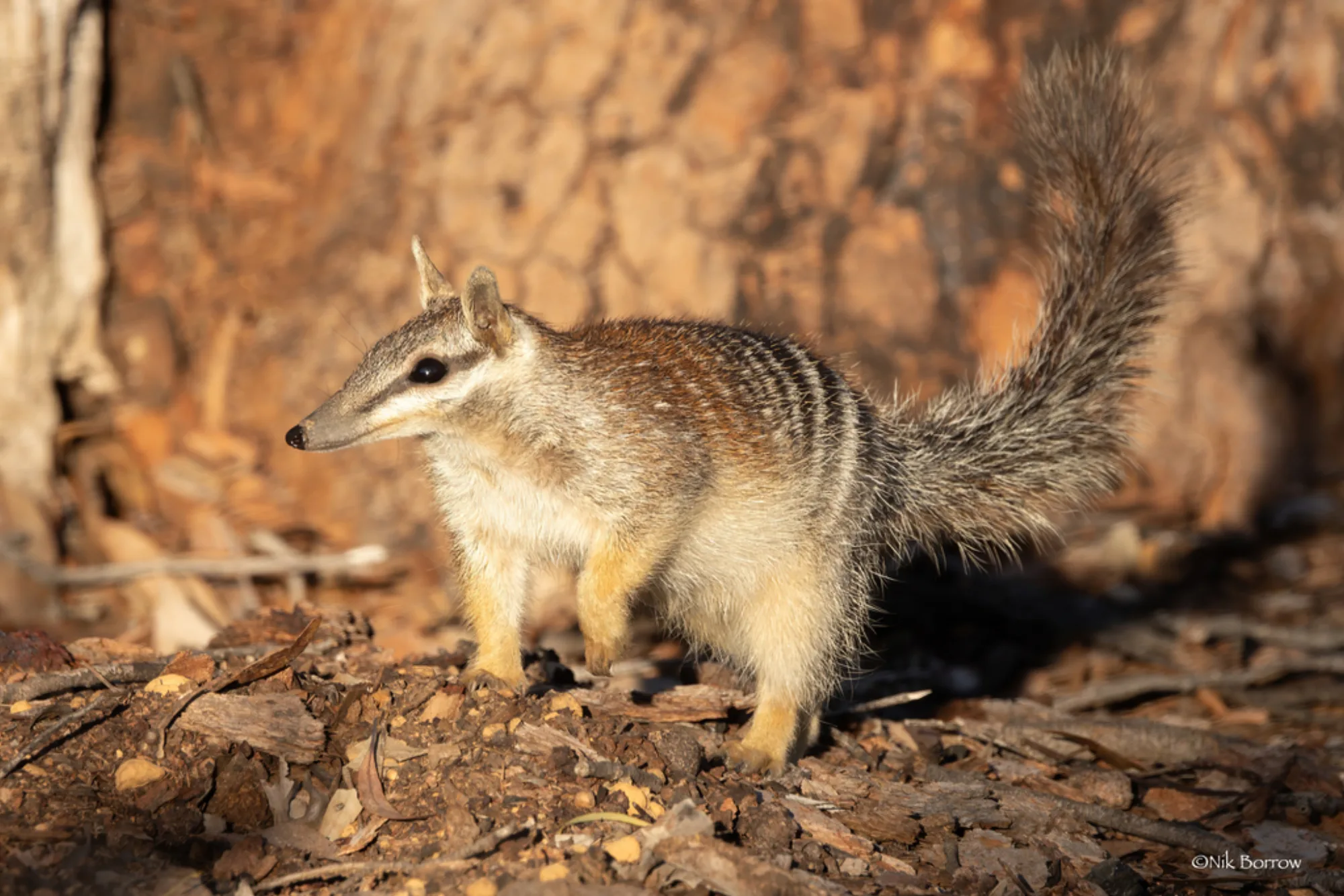
A small marsupial with a pointed muzzle and a bushy tail, the Numbat is active during the day. Its coat can be grey or reddish-brown, with a brick-red patch sometimes showing on the upper back. A black stripe runs through each eye, while four to eleven white stripes cross the hindquarters and fade towards the middle of the back. Including the tail, it measures 35 to 45 centimetres in length.
Once widespread across southern Australia, numbats now occur naturally in eucalypt forest in Western Australia, including Dryandra Woodland and Tone-Perup Nature Reserve. They have also been reintroduced to fenced reserves, including Yookamurra Sanctuary in the South Australian mallee and Scotia Sanctuary in semi-arid New South Wales. Adults live alone and defend territories, although male and female territories overlap. Much of the day is spent looking for termites, which they dig from loose soil and catch with a long, sticky tongue. Their feeding follows termite activity: in summer they shelter during the heat of the day, then feed again in the late afternoon. At night they retreat to a nest in a hollow log, a tree hollow or a burrow lined with soft plant material.
Numbats usually produce one litter a year, breeding in February and March. After weaning, the young stay in a nest or ride on their mother's back, becoming independent by November. Raptors and reptiles prey on numbats, as do introduced red foxes and feral cats. Their range has contracted sharply since European arrival, and protection from introduced predators has helped make reintroductions possible.
Written from the English Wikipedia article Numbat (CC BY-SA 4.0).
- Records
- 1,372
- Countries
- 1
No atlas park has a record of the Numbat in or around it yet.
These are open occurrence records, so they show where people looked for and recorded the Numbat as much as where it lives. Cells are up to 25 km across, and every location is generalised to its cell.
Generalised encounter areas, not exact locations. Each shape is a grid cell coloured by how likely the species is there.
- Very likelyAustralia25 km zone · high confidence · 1372 records · updated 80 days ago
Conservation status not assessed here yet, so every location is generalised to its grid cell.