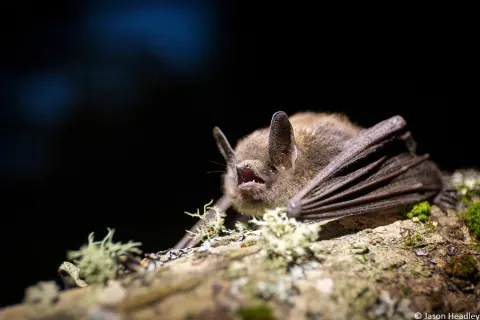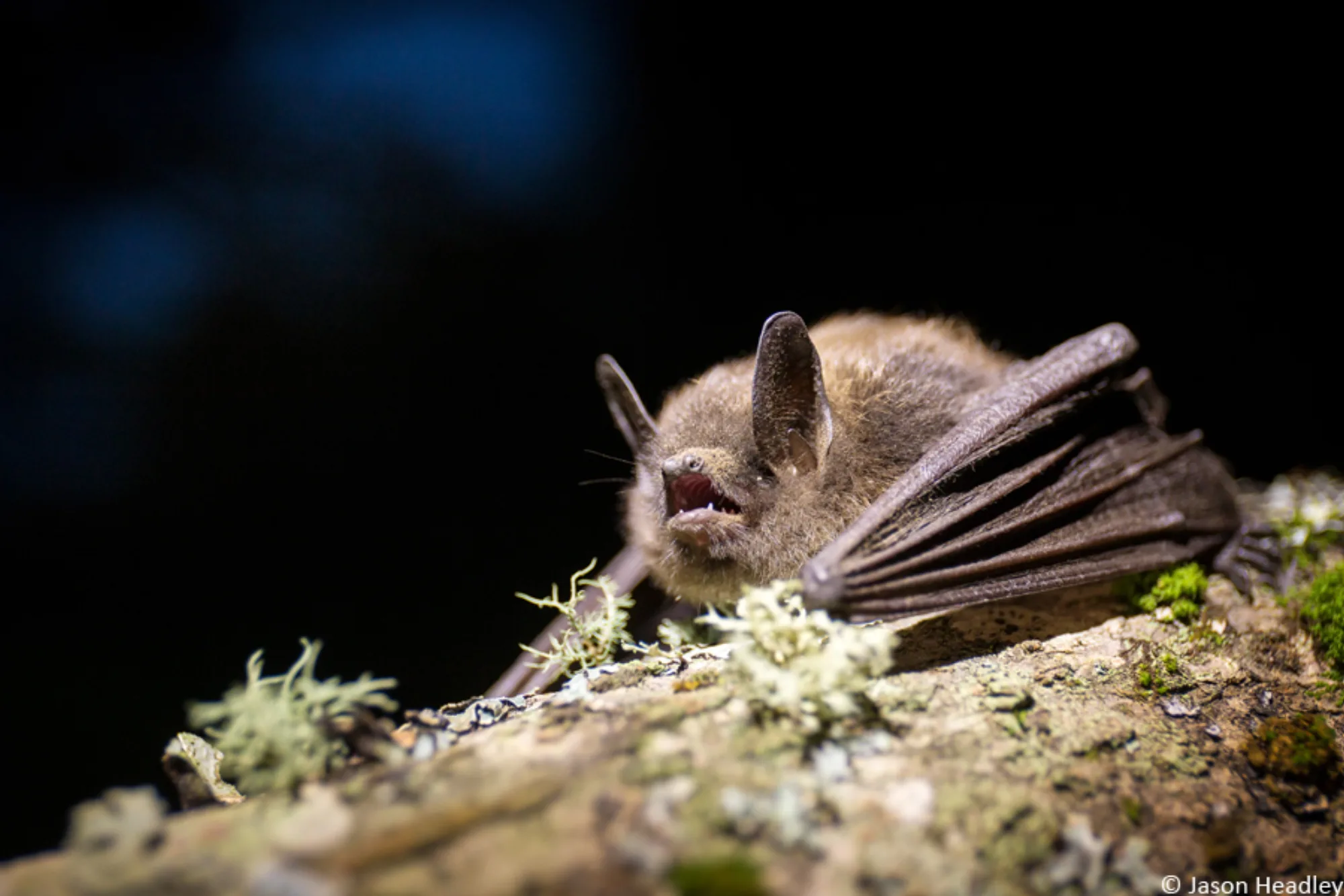
Little Brown Bat
Myotis lucifugus
Small enough to weigh just 5.5 to 12.5 g, the Little Brown Bat has glossy fur in shades of tan, reddish brown or dark brown, with a lighter belly. Its body measures 8.0 to 9.5 cm, and its wingspan reaches 22.2 to 26.9 cm. Similar bats share its range, including the Indiana bat and the northern long-eared bat.
Across much of North America, its range stretches from Alaska and much of Canada to Labrador, and south to Southern California and northern parts of Arizona and New Mexico. By day it shelters in places such as tree hollows, buildings, wood piles and rocky outcrops, favouring warm, dark roosts. It emerges at dusk to hunt, using echolocation to find prey and often foraging along the edges of vegetation, water or streams. Its varied diet includes beetles, flies, moths, mosquitoes and spiders. In spring and summer, females gather in maternity colonies, usually numbering several hundred bats, while males and non-reproductive females roost alone or in small groups. Females give birth to one pup annually; the young begin flying and weaning at around three weeks old.
For winter, these bats hibernate in caves or old mines, and females may travel hundreds of kilometres from their summer ranges to reach them. White-nose syndrome, a fungal disease that strikes during hibernation, has caused heavy losses: from 2006 to 2011, it killed more than one million Little Brown Bats in the Northeastern United States. Owls and raccoons also prey on them, and bats foraging or crossing roads are at risk from moving vehicles.
Written from the English Wikipedia article Little brown bat (CC BY-SA 4.0).
- Records
- 436
- Countries
- 3
- Atlas places
- 5
These are open occurrence records, so they show where people looked for and recorded the Little Brown Bat as much as where it lives. Cells are up to 25 km across, and every location is generalised to its cell.
Generalised encounter areas, not exact locations. Each shape is a grid cell coloured by how likely the species is there.
- Very likelyCanada25 km zone · medium confidence · 232 records · updated 80 days ago
- Very likelyUnited States25 km zone · medium confidence · 197 records · updated 80 days ago
- Very likelyMexico25 km zone · medium confidence · 7 records · updated 80 days ago
Conservation status not assessed here yet, so every location is generalised to its grid cell.