Bank Vole
Myodes glareolus
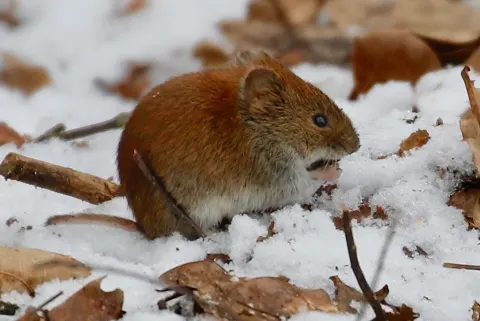
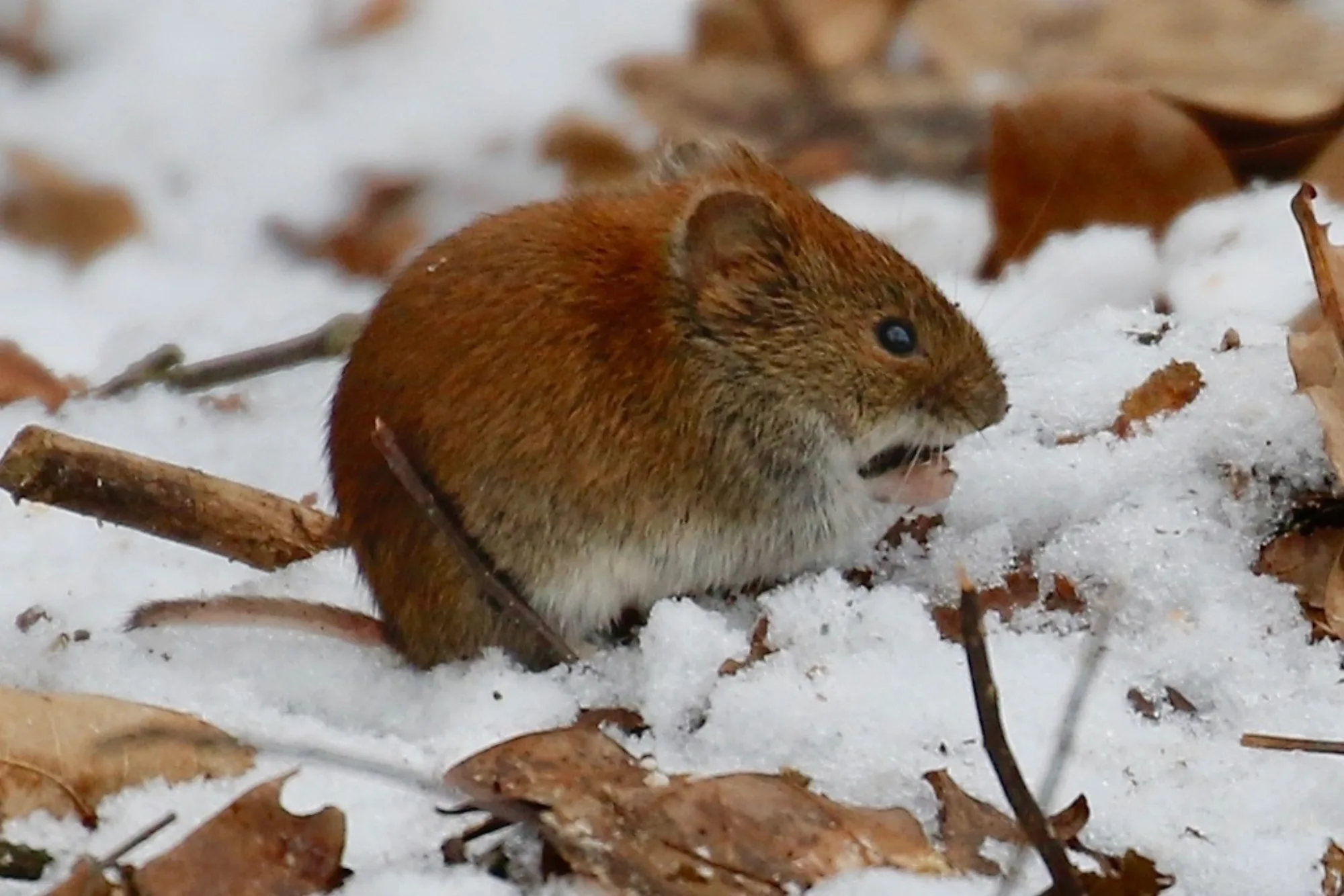
With its reddish-brown back and rounded shape, the Bank Vole is a small woodland rodent that can resemble a mouse when young. Adults have a stout body, a slightly rounded head and a hairy tail about half the length of the body. A reddish-brown gloss shows on its grey sides, and its whitish-grey belly can have a muted yellow tinge. Head and body measure 83 to 121 mm, and the tail measures 38 to 76 mm. Young voles are darker, with greyer underparts.
Bank Voles live across much of Europe and northwestern Asia, including Great Britain, and have also been introduced to Ireland. Look for suitable cover in deciduous and mixed woodland, where scrub, low plants and leaf litter shelter them. They also inhabit hedgerows, field verges, river banks, swamps and parks, as well as places thick with bracken and brambles. In mountains and northern parts of their range, they occupy coniferous woodland up to 1,800 metres. They avoid bare ground, using tunnels and worn paths through the undergrowth to help escape predators.
Active by day and night, these voles do not hibernate. They dig shallow, branching burrows, store food underground and make nests of moss, dry grass and leaves near or above the surface. Their seasonal diet includes leaves, roots, buds, fruit, nuts and seeds, with occasional insects, spiders and worms. They climb into scrub and low branches, and feed on tree bark in winter. Breeding runs from late April to September, with up to four litters a year. Foxes, stoats, weasels and several birds of prey eat bank voles; lead on road verges and chemicals near farmland can also harm them.
Written from the English Wikipedia article Bank vole (CC BY-SA 4.0).
- Records
- 46,431
- Countries
- 18
No atlas park has a record of the Bank Vole in or around it yet.
These are open occurrence records, so they show where people looked for and recorded the Bank Vole as much as where it lives. Cells are up to 25 km across, and every location is generalised to its cell.
Generalised encounter areas, not exact locations. Each shape is a grid cell coloured by how likely the species is there.
- Very likelySwitzerland25 km zone · high confidence · 23108 records · updated 80 days ago
- Very likelyFinland25 km zone · high confidence · 6153 records · updated 80 days ago
- Very likelyFrance25 km zone · medium confidence · 5937 records · updated 80 days ago
- Very likelyPoland25 km zone · high confidence · 2236 records · updated 80 days ago
- Very likelyUnited Kingdom25 km zone · medium confidence · 1856 records · updated 80 days ago
- Very likelyNorway25 km zone · medium confidence · 1633 records · updated 80 days ago
- Very likelyGermany25 km zone · high confidence · 1298 records · updated 80 days ago
- Very likelyItaly25 km zone · high confidence · 1250 records · updated 80 days ago
- Very likelySweden25 km zone · medium confidence · 1148 records · updated 80 days ago
- Very likelyLuxembourg25 km zone · high confidence · 642 records · updated 80 days ago
Conservation status not assessed here yet, so every location is generalised to its grid cell.