Coypu
Myocastor coypus
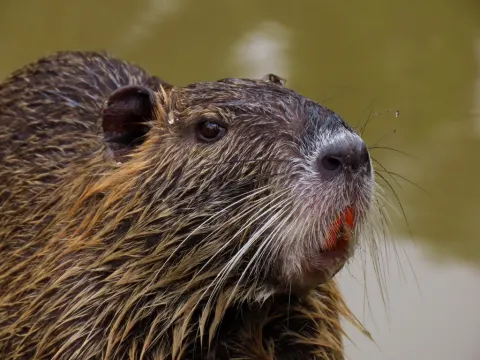
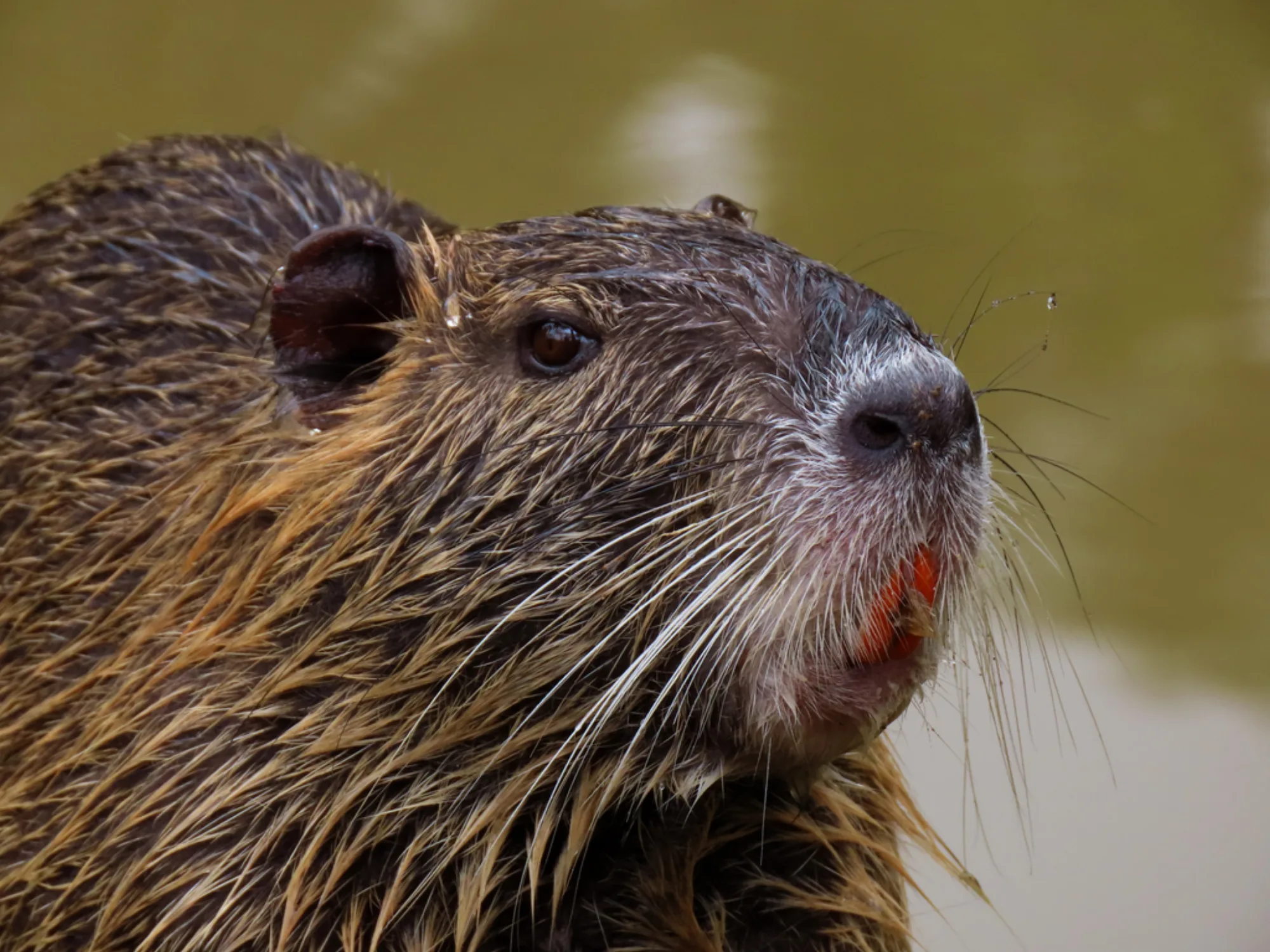
With its round, hairless tail and broad orange-yellow front teeth, the Coypu can look like a large rat or a small beaver. This semiaquatic rodent has darkish brown fur, a white patch on its muzzle and webbed hind feet. Adults typically weigh 4 to 9 kg and measure 40 to 60 cm in body length, with a tail 30 to 45 cm long. Unlike the beaver's flat tail, the Coypu's is round.
Its native range covers temperate and subtropical South America, from Chile and Argentina to Uruguay, Paraguay and southern Brazil and Bolivia. Fur farmers introduced it to North America, Europe and Asia. Look for it around freshwater marshes and wetlands, though it also lives in brackish marshes and occasionally salt marshes. Coypus use burrows beside water, sometimes taking over those abandoned by beavers or other animals, and can build floating rafts from vegetation. They live in colonies, with a male sharing a den with several females and their offspring. Activity is mainly around dusk and at night, although they may forage by day when food is scarce. Their diet centres on aquatic and waterside plants, including reeds and rushes, as well as roots and other underground plant parts.
Females give birth to an average of four pups and usually have two litters a year. The young are born furred with open eyes and can swim with their parents and eat vegetation within hours. In its native range, the Coypu is prey for predators including the cougar and culpeo. It is hunted and trapped for fur in some regions, and overharvesting has caused local extinctions in its native range. Cold winters can also bring fatal infections after frostbite on the tail, while eradication programmes target introduced populations.
Written from the English Wikipedia article Nutria (CC BY-SA 4.0).
- Records
- 43,558
- Countries
- 6
No atlas park has a record of the Coypu in or around it yet.
These are open occurrence records, so they show where people looked for and recorded the Coypu as much as where it lives. Cells are up to 25 km across, and every location is generalised to its cell.
Generalised encounter areas, not exact locations. Each shape is a grid cell coloured by how likely the species is there.
- Very likelyFrance25 km zone · high confidence · 38162 records · updated 80 days ago
- Very likelyGermany25 km zone · high confidence · 3201 records · updated 80 days ago
- Very likelySwitzerland25 km zone · high confidence · 1565 records · updated 80 days ago
- Very likelyArgentina25 km zone · high confidence · 353 records · updated 80 days ago
- Very likelyCzechia25 km zone · high confidence · 186 records · updated 80 days ago
- Very likelyUnited States25 km zone · high confidence · 91 records · updated 80 days ago
Conservation status not assessed here yet, so every location is generalised to its grid cell.