Gummy Shark
Mustelus antarcticus
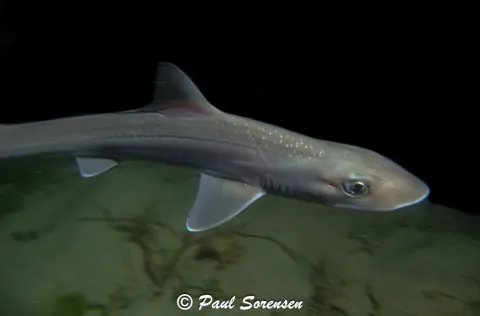
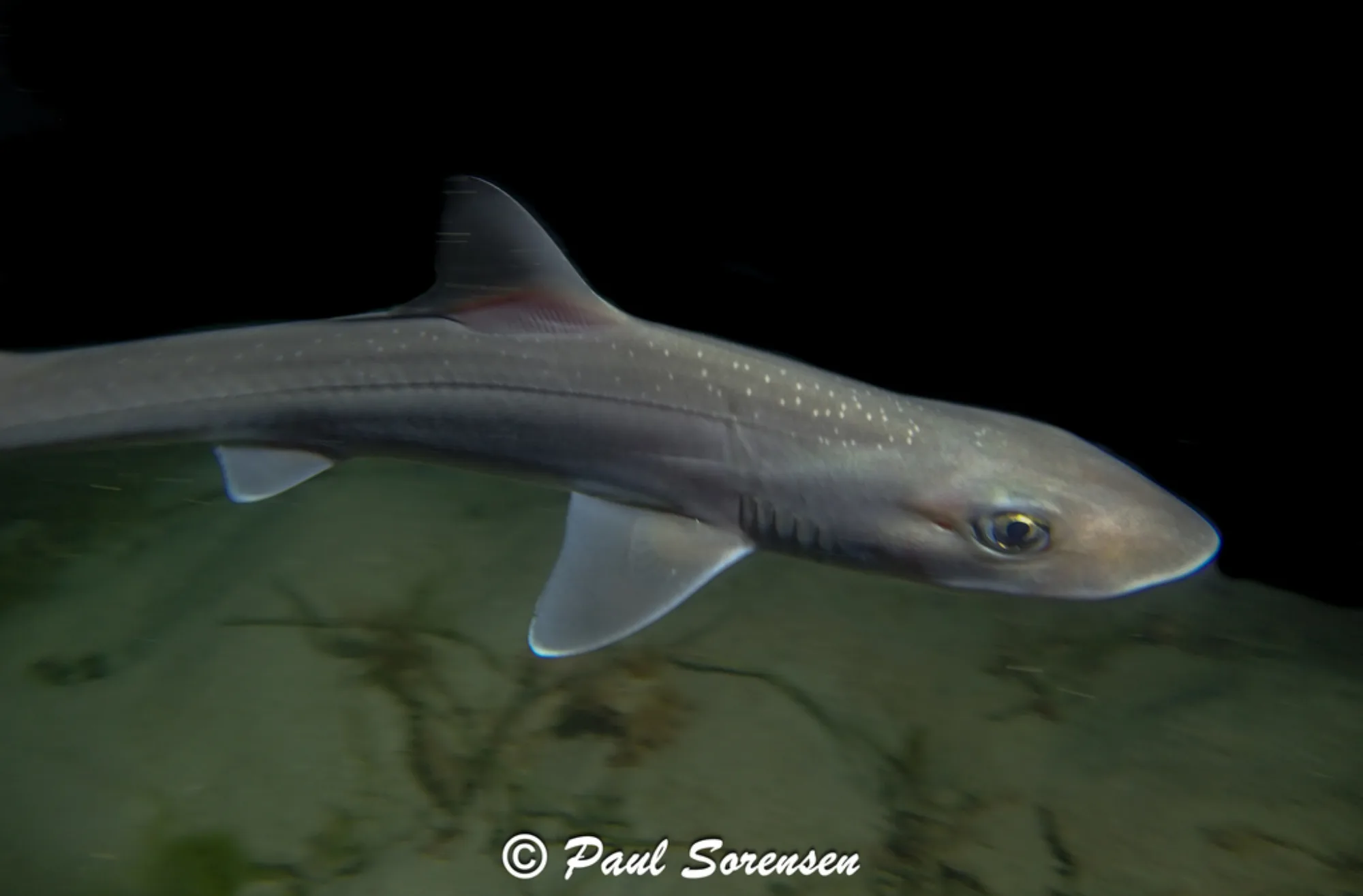
A slender shark with a dark grey back, white spots and a silvery-white belly, the Gummy Shark spends much of its life close to the seabed. Its flat, plate-like teeth give its jaws an almost toothless appearance, but are well suited to crushing prey. Males can reach 157 cm and females 175 cm. Although most often found around southern Australia, it also occurs in coastal waters of the Pacific and Indian oceans, including around Japan. In Australia, its range reaches west to Shark Bay and east to Port Stephens, and includes Tasmania and the Bass Strait. It favours sandy areas in temperate water and has been found from the surface to 350 m deep.
Gummy sharks move closer to shore at night to hunt crustaceans, marine worms, small fish and cephalopods, including octopus, squid and cuttlefish. Young sharks travel less than adults, while females tend to range farther than males. They are usually separated by sex and size, and in Western Australia females occur mainly in the west and southwest, while males tend to remain in the southeast. Eggs hatch inside the mother, and pregnant females use sheltered inshore nursery areas to give birth. After a gestation of eleven to twelve months, a female has an average of 14 pups, although a litter can contain up to 57.
People catch Gummy Sharks for food and sport, and capture and release can affect their survival. Young sharks also face predation by broadnose sevengill sharks in shallow water. Changes in nursery salinity can stress juveniles, and wet-season conditions in Pittwater Estuary have prompted young sharks to move towards deeper nurseries, putting their survival and growth at risk.
Written from the English Wikipedia article Gummy shark (CC BY-SA 4.0).
- Records
- 6,540
- Countries
- 1
- Atlas places
- 3
These are open occurrence records, so they show where people looked for and recorded the Gummy Shark as much as where it lives. Cells are up to 25 km across, and every location is generalised to its cell.
Generalised encounter areas, not exact locations. Each shape is a grid cell coloured by how likely the species is there.
- Very likelyAustralia25 km zone · high confidence · 6540 records · updated 81 days ago
Conservation status not assessed here yet, so every location is generalised to its grid cell.