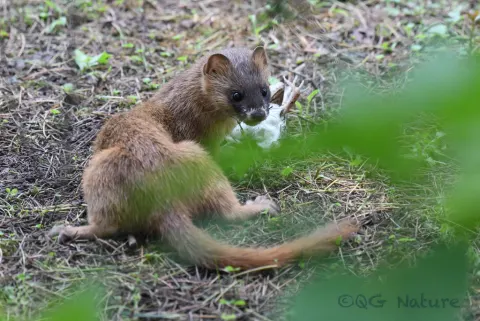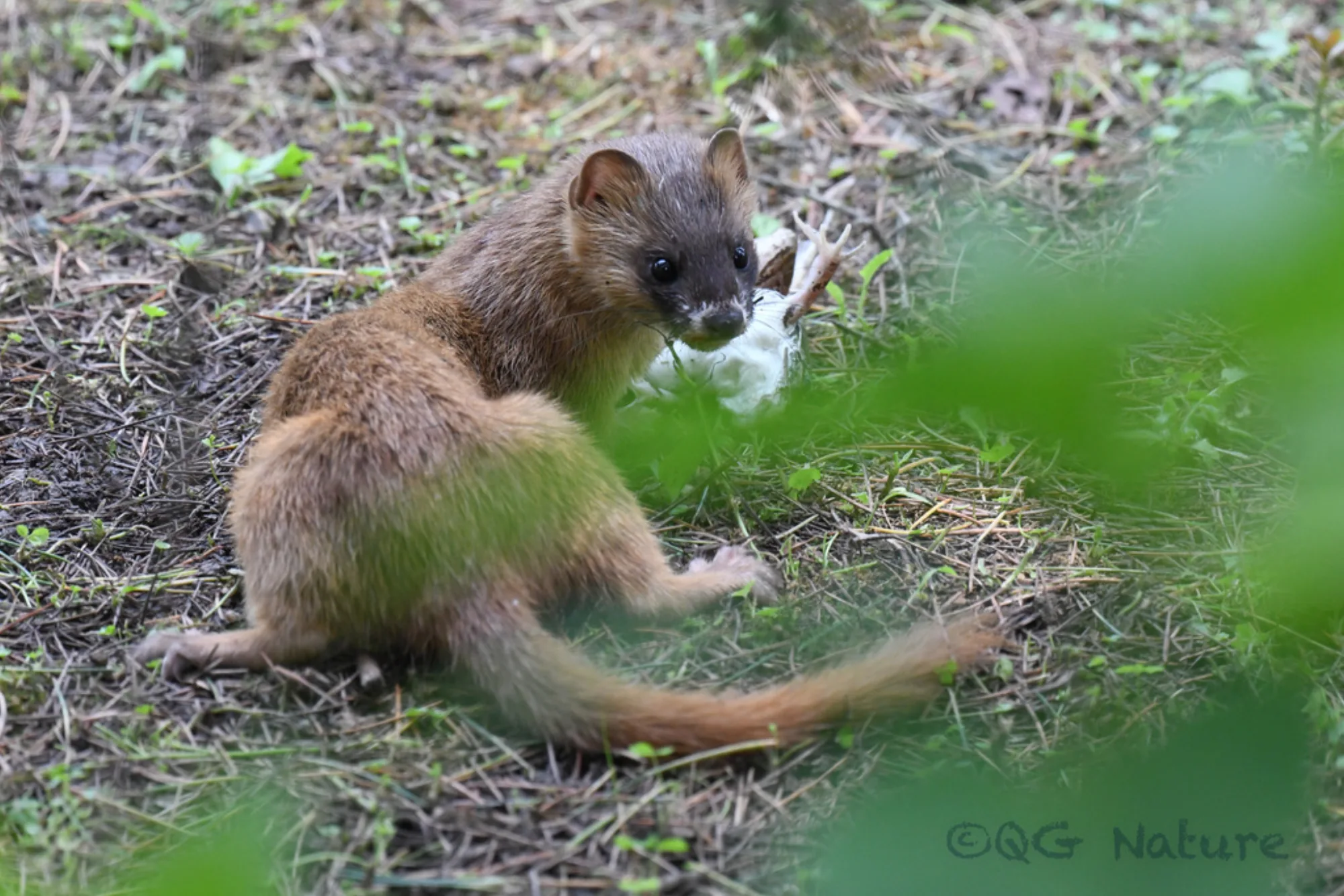
Siberian Weasel
Mustela sibirica
A long body, short legs and a dark coffee-brown mask give the Siberian Weasel a distinctive outline and face. Its coat ranges from bright reddish ochre to straw-red, sometimes with orange or peach tones, and is paler on the flanks and belly. Its tail is brighter than its back, and its chin and lips are white to pale ochre. In winter, the fur becomes very dense, soft and fluffy. This medium-sized weasel is widespread in Asia, from the Himalayas to China and Korea, and across Siberia to the Russian Far East. It lives in forests and open areas, and has also been introduced to Honshu, Shikoku and Kyushu.
Siberian weasels are active hunters, pursuing prey through snow, water, logs and even houses. They favour small to medium-sized rodents, including water voles in the western part of their range and voles and mice in the east. In some places they also eat fish, while small birds are an important food elsewhere. They store surplus food and, in Ussuriland during winter, scavenge extensively from prey killed by wolves and yellow-throated martens. A weasel may nest in a fallen log, an empty stump, a brushwood pile or among exposed roots, and can enlarge another species' den. Adults have a permanent burrow as well as temporary shelters, sometimes several kilometres apart. Litters contain 4 to 10 kits, born blind and sparsely covered in white hair. The young open their eyes after a month and become independent by late August. Siberian weasels are heavily harvested for their fur in Siberia and the Far East, and are hunted with dogs or caught in box traps.
Written from the English Wikipedia article Siberian weasel (CC BY-SA 4.0).
- Records
- 115
- Countries
- 3
No atlas park has a record of the Siberian Weasel in or around it yet.
These are open occurrence records, so they show where people looked for and recorded the Siberian Weasel as much as where it lives. Cells are up to 25 km across, and every location is generalised to its cell.
Generalised encounter areas, not exact locations. Each shape is a grid cell coloured by how likely the species is there.
- Very likelySouth Korea25 km zone · medium confidence · 85 records · updated 81 days ago
- Very likelyChina25 km zone · medium confidence · 19 records · updated 81 days ago
- Very likelyRussia25 km zone · medium confidence · 11 records · updated 81 days ago
Conservation status not assessed here yet, so every location is generalised to its grid cell.