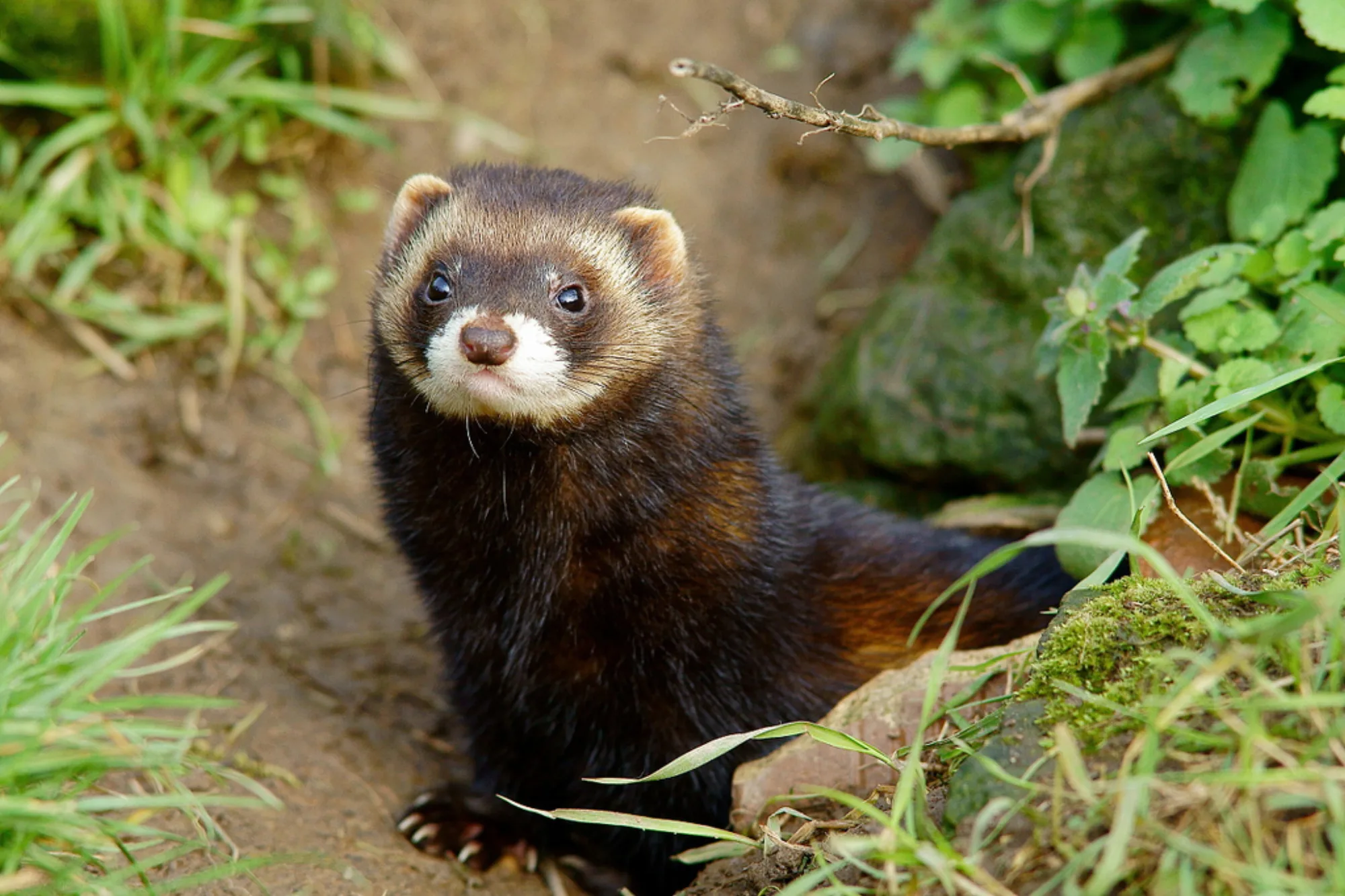
European Polecat
Mustela putorius
Dark brown fur and a dark facial mask give the European Polecat a distinctive appearance. This short-legged mustelid has a compact body, a short tail and pale underfur that can show through along its flanks. Its summer coat is shorter and duller than its winter coat, and the ears have white edges. Normally shy around people, it is usually silent, but can growl when angry or squeak when distressed. It also marks territory with a particularly foul-smelling liquid.
The species ranges across Europe to the Urals and occurs in Morocco's Rif Mountains, where it has been found from sea level to 2,400 m. Its range excludes Ireland and northern Scandinavia, along with large parts of the Balkans and the eastern coast of the Adriatic. Polecats have several dens across their range and show particular activity near rabbit warrens. In winter, some rest by day in farm buildings or haystacks; others occasionally use abandoned badger or fox burrows. Home ranges can overlap even among animals of the same sex.
Small rodents, amphibians and birds are important foods, although the polecat also takes reptiles and, in Britain, commonly kills rabbits and brown rats. It stalks its prey and sometimes stores food, especially when frogs and toads are plentiful. Litters usually arrive in May or early June, with five to ten kits that become independent after two to three months. In Britain, polecats were heavily persecuted by gamekeepers, and traps set for rabbits have caused accidental deaths. In parts of France, poisoning campaigns against muskrats have contributed to declines. Invasive American mink can also drive polecats out of wetland habitats.
Written from the English Wikipedia article European polecat (CC BY-SA 4.0).
- Records
- 22,852
- Countries
- 12
No atlas park has a record of the European Polecat in or around it yet.
These are open occurrence records, so they show where people looked for and recorded the European Polecat as much as where it lives. Cells are up to 25 km across, and every location is generalised to its cell.
Generalised encounter areas, not exact locations. Each shape is a grid cell coloured by how likely the species is there.
- Very likelySwitzerland25 km zone · medium confidence · 11366 records · updated 80 days ago
- Very likelyFrance25 km zone · medium confidence · 4958 records · updated 80 days ago
- Very likelyBelgium25 km zone · high confidence · 3247 records · updated 80 days ago
- Very likelyUnited Kingdom25 km zone · high confidence · 1713 records · updated 80 days ago
- Very likelyLuxembourg25 km zone · high confidence · 413 records · updated 80 days ago
- Very likelyGermany25 km zone · medium confidence · 402 records · updated 80 days ago
- Very likelyDenmark25 km zone · medium confidence · 313 records · updated 80 days ago
- Very likelyNetherlands25 km zone · high confidence · 177 records · updated 80 days ago
- Very likelySpain25 km zone · medium confidence · 116 records · updated 80 days ago
- Very likelyLiechtenstein25 km zone · high confidence · 76 records · updated 80 days ago
Conservation status not assessed here yet, so every location is generalised to its grid cell.